

The way organizations view talent is changing. New technologies, evolving job roles, and continuous automation are changing what organizations need from their people. As a result, identifying, managing and developing the right skills has become one of the biggest challenges organizations face today. Traditional HR frameworks that once relied on static job descriptions or annual evaluations no longer work in such a dynamic environment.
In this constantly changing work environment, having clear visibility into what skills the organization possesses and those it needs to develop has become essential. This is where AI skills mapping plays a crucial role. It allows organizations to analyze, understand, and visualize employee capabilities through data-driven insights.
When supported by artificial intelligence, skills mapping becomes faster, more accurate, and far more actionable. This approach creates a map of workforce capabilities that helps organizations unlock true talent mobility and drive business growth.

AI skills mapping combines artificial intelligence, data analytics, and organizational insight to identify and connect skills within the workforce. It gathers data from multiple sources such as employee assessments, job descriptions, learning platforms, and performance reviews.
Machine learning algorithms analyze the collected data to find patterns, similarities and potential skill proximities. For instance, if an employee demonstrates proficiency in one programming language, AI can infer related capabilities and suggest complementary skills that the employee should develop next. Over time, the system learns and evolves, providing more accurate insights than before.
AI skill mapping generates a real-time picture of an organization’s collective strengths and weaknesses. HRs can then use this workforce intelligence to plan more effectively, design personalized learning paths and match people to opportunities that best fit their potential.
Traditional skills matrices served an important role in helping organizations document who possessed which skills. Yet, their limitations are increasingly visible. They provide a static view that fails to reflect the speed at which employees acquire or lose proficiency. Traditional skills matrices also rely heavily on subjective inputs from managers or employees, which can introduce inconsistencies and bias.
In fast-changing industries such as Information Technology (IT) or Information Technology Enabled Services (ITeS) companies, this lack of real-time insight can hinder decision-making. This may result in organizations struggling to redeploy internal talent quickly or identify skill shortages before they become critical. Without accurate data, investments in training or recruitment may not deliver the desired results.
AI-driven skills mapping overcomes these issues by continuously collecting and updating information. It turns skills management into a dynamic and ongoing process rather than a static administrative task.

An internal skills graph acts as the heart of AI skills mapping. It visually represents how employees, roles, and skills are interconnected within an organization. Each skill acts as a node linked to the employees who possess the skill. These connections extend to related skills and potential career pathways.
This networked view allows HR leaders to understand what skills exist and how they interact. For example, an internal skills graph can reveal clusters of expertise in certain teams, highlight cross-functional skills, or expose areas of underutilized potential. It can also identify how developing one skill can open pathways to multiple roles, aiding in more precise career planning.
By providing this kind of visibility, an internal skills graph becomes a critical source of workforce intelligence.
Organizations are increasingly realizing that the talent they need might be hidden within their workforce. Building an internal skills graph allows companies to unlock talent mobility by aiding HR in discovering internal capabilities.
When HRs know exactly what skills exist within the organization, they can identify employees who are ready for lateral moves, promotions, or new projects. This helps fill roles faster while also improving engagement and retention.
Moreover, a skills graph allows employees from different backgrounds or departments to explore career transitions that align with their skills rather than being limited by their current role titles. The result is a more agile, motivated, and future-ready workforce.
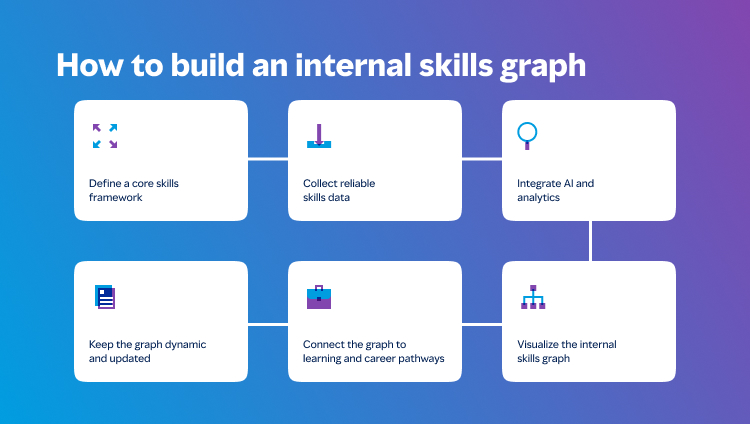
The first step is to identify the technical, behavioral, and cognitive skills that are most critical to your business strategy. This framework should cover current requirements as well as emerging skills that the organization may need in the future.
Accurate data is the foundation of effective skills management. Hence, it is vital to gather information through scientifically validated assessments, self-assessments, and manager evaluations. One should also incorporate data from learning management systems and performance reviews to get a well-rounded picture.
The collected data must be fed into an AI-enabled platform that can identify connections between skills and roles. The system will use natural language processing and pattern recognition to categorize skills, highlight overlaps, and detect potential growth areas.
The fourth step involves translating the analyzed data into a visual format. A good internal skills graph allows HR leaders to quickly see who possesses what skill, where clusters of expertise exist and which areas need development.
An internal skills graph becomes powerful when integrated with learning and career frameworks. By doing this, it allows employees to see their current position in the skills landscape and receive personalized recommendations for training or new roles. This helps foster a culture of continuous learning and upward mobility.
Skills evolve over time, and the data should reflect that. Companies must encourage regular assessments and skill updates to ensure the graph remains accurate. An evolving skills graph will provide ongoing workforce intelligence that supports business decisions across recruitment, training, and succession planning.
AI skills mapping and internal skills graphs are essential tools that organizations must leverage for a brighter tomorrow. As organizations adopt skills-based approaches to hiring and development, these technologies will play a greater role in connecting business needs with employee growth.
In a world where adaptability determines success, understanding your internal skills ecosystem is the foundation of a resilient and future-ready organization.
Originally published December 10 2025, Updated January 14 2026

Harsh Vardhan Sharma, with 6 years of content writing expertise across diverse B2B and B2C verticals, excels in crafting impactful content for broad audiences. Beyond work, he finds joy in reading, traveling, and watching movies.
Skills assessment tests are used in the recruitment process to determine if a candidate possesses the necessary skills (analytical, technical, interpersonal, etc.) to thrive in a job role. Skills assessment tests are an essential component of recruitment today.


Thanks for submitting the comment. We’ll post the comment once its verified.








 Behavioral Competencies
 Cognitive Competencies
 Coding Competencies
 Domain Competencies

















Would you like to comment?