 English







Characteristics of high-performing employees: How to identify, develop, and retain top talent
Summary
This article explains the defining characteristics of high-performing employees and what sustained high performance looks like in day-to-day execution. It also outlines practical, objective ways to identify top talent and the most effective approaches to develop and retain them over time.
Introduction
Every organization aims to build a workforce that consistently delivers exceptional results. At the heart of this goal are high-performing employees who combine expertise, accountability, adaptability, and a strong commitment to excellence. Their ability to drive productivity, foster innovation, and positively influence team performance makes them invaluable assets to any business.
However, identifying top performers is only the first step. Organizations should also invest in understanding the characteristics that define high-performing employees and implement strategies that support growth and retention. Not retaining top talent may result in lost expertise, reduced productivity, and higher recruitment costs.
By cultivating an environment where exceptional talent is recognized, supported, and empowered, organizations can strengthen workforce performance and achieve sustainable business success.
12 behaviors that define high performers
High-performing employees are identified through consistent, observable behaviors that translate into reliable outcomes. These behaviors show how work is prioritized, executed, and communicated, especially under pressure or during change. Over time, consistency in these actions leads to measurable, repeatable value for the organization.
1. Outcome ownership
Standout employees take responsibility for outcomes, not only tasks. They confirm expectations early, including scope, timelines, and quality standards. They then monitor progress closely and raise risks in time to protect delivery.
2. Prioritization and focus
High performance depends on working on the right things in the right order. Top employees link daily work to business priorities and make trade-offs when capacity is limited. This keeps attention on critical deliverables and reduces time spent on low-value activities. It also ensures that the effort is directed toward work with measurable business impact.
3. Consistent delivery and quality
Top talent delivers results reliably over time. Work is planned realistically, and quality is maintained through simple controls such as review and validation. This reduces rework and builds confidence in the output.
4. Business and customer orientation
High performers understand how the organization creates value. They consider customer impact, internal, or external, before making decisions. They also balance speed, cost, quality, and risk to ensure outcomes support long-term performance.
5. Learning agility
High performers pick up new skills rapidly and put them into practice right away. They seek feedback, identify gaps, and close them through focused development. This enables faster improvement and stronger performance in changing roles. It also helps the organization respond faster to new tools, skills, and market needs.
6. Adaptability to change
Business priorities change, and high performers adjust without losing momentum. They reset plans when needed and communicate changes clearly. This helps maintain alignment and protects delivery under uncertainty.
7. Sound judgment and decision-making
High performers make decisions with the right level of analysis for the situation. They evaluate options, explain trade-offs, and act in a timely manner. This supports progress while managing risk appropriately. Decision quality improves because choices are practical, accountable, and aligned to outcomes.
8. Proactive problem-solving
Top employees do not accept repeated issues as normal. They identify root causes and implement practical improvements to prevent recurrence. Over time, this strengthens processes and improves results for the wider team. The focus remains on prevention and continuous improvement, not repeated firefighting.
9. Clear and timely communication
Strong performance requires clear communication. High performers share updates that state what has changed, what is needed, and when. They tailor the level of detail to the audience, which reduces confusion and speeds up the execution. This also improves coordination and reduces delays caused by misalignment.
10. Collaboration that strengthens outcomes
High-performing employees contribute to shared success, not only individual output. They coordinate early, follow through on commitments, and share context to reduce rework. When disagreements occur, they address them professionally and keep focus on outcomes. This strengthens trust and improves cross-functional delivery.
11. Resilience and sustainable performance
Top performance should be sustainable. High performers manage pressure through planning, prioritization, and early escalation of capacity risks. This supports consistent delivery without creating burnout for themselves or others.
12. Integrity and values alignment
Performance is not only about what is delivered, but also about how it is delivered. High performers act with transparency, follow policies and standards, and make principled decisions even under pressure. This builds trust, strengthens team culture, and protects the organization’s long-term credibility.
Identifying high-performing employees using objective criteria
Objective identification requires more than a manager's opinion or a single rating. An impartial approach combines clear standards with consistent evidence collected over time. The aim is to recognize sustained impact while reducing bias in talent decisions.
Performance data
Combine KPIs, OKRs, and productivity measures to assess results against role outcomes, while factoring in quality indicators such as rework, error rates, and SLA adherence.
Behavioral assessments
Assess workplace, competency, and leadership traits using behavioral assessments that focus on observable actions such as accountability, collaboration, communication, and ethical conduct.
Cognitive ability assessments
Evaluate learning ability, decision-making, and problem-solving through structured, scenario-based cognitive assessments. This helps to test judgment and performance in ambiguous situations.
360-degree feedback
Use structured 360-degree feedback from peers, managers, and cross-functional partners to validate an employee’s impact, reliability, and collaboration. Ensure the feedback includes specific examples to support the assessment.
Skill assessments
Validate technical, role-specific, and future-ready competencies using practical skill assessments or standardized rubrics. Use the results to confirm current capability and readiness as role requirements evolve.
Strategies to accelerate top employee development
Top talent develops fastest when growth is planned, supported, and linked to real business needs. Development should be treated as a structured process, not an occasional training activity.
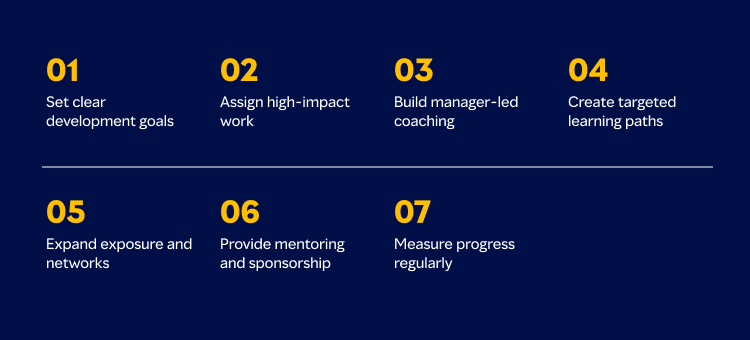
1. Set clear development goals
Define specific capability gaps and target outcomes, then translate them into measurable development goals tied to role expectations and future scope.
2. Assign high-impact work
Use stretch assignments, critical projects, and ownership of visible outcomes to accelerate learning through real responsibility and decision-making.
3. Build manager-led coaching
Equip managers to coach consistently through regular check-ins, actionable feedback, and practical guidance on how to improve performance in the role.
4. Create targeted learning paths
Offer role-relevant learning that strengthens technical skills, business understanding, and leadership behaviors, with application built into day-to-day work.
5. Expand exposure and networks
Increase access to senior leaders, cross-functional teams, and strategic forums so top talent gains context, influence skills, and a broader perspective.
6. Provide mentoring and sponsorship
Use mentors for skill and career guidance, and sponsors to advocate for opportunities, visibility, and advancement based on demonstrated performance.
7. Measure progress regularly
Track development through clear indicators such as project outcomes, skill validation, feedback quality, and readiness for expanded scope, then adjust plans accordingly.
Retention practices for high-performing employees
Retaining high performers requires intentional steps that make it easier for them to do great work and feel valued. This includes clear growth opportunities, equal recognition, and removing day-to-day blockers like unnecessary approvals, unclear processes, and repeated rework.
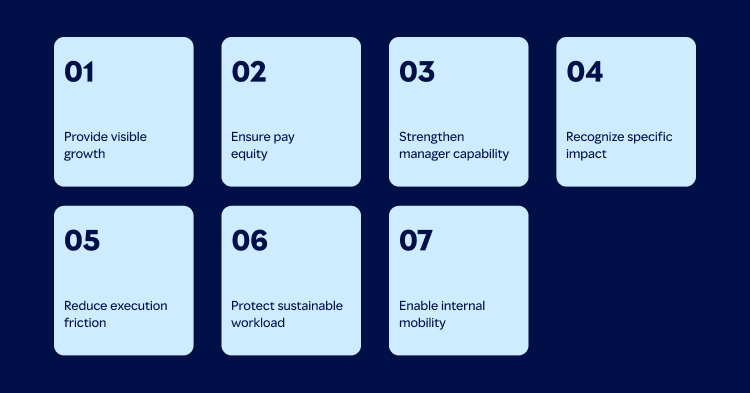
1. Provide visible growth
Create clear progression through expanded scope, stretch assignments, and access to critical work, even when promotions are limited.
2. Ensure pay equity
Maintain competitive compensation and internal fairness, and communicate reward decisions with clear, consistent logic.
3. Strengthen manager capability
Develop managers’ ability to set expectations, coach performance, give timely feedback, and address issues early.
4. Recognize specific impact
Give recognition that is timely and evidence-based, explicitly linking contributions to business outcomes and team value.
5. Reduce execution friction
Remove unnecessary approvals, unclear processes, and repeated rework drivers that slow delivery and dilute motivation.
6. Protect sustainable workload
Monitor capacity and redistribute work to prevent high performers from carrying chronic overload due to systemic gaps.
7. Enable internal mobility
Offer transparent internal moves and project opportunities so high performers can grow without leaving the organization.
Conclusion
Building and retaining a high-performing workforce requires more than identifying top talent. It demands a sustained commitment to developing potential, recognizing contributions, and fostering a culture where employees can excel. Organizations that embed these principles into their people's strategy strengthen engagement, enhance performance, and build a lasting competitive advantage. Therefore, investing in talent is no longer just an HR priority. It is a strategic business imperative that drives innovation, resilience, and sustainable growth.
FAQs
What makes someone a high-performing employee?
What are the top characteristics of high performers?
Can personality tests identify high performers?
What's the difference between high performers and high potentials?
How can HR identify high performers objectively?





Get awesome marketing content related to Hiring & L&D in your inbox each week
Stay up-to-date with the latest marketing, sales, and service tips and news
By using our offerings and services, you are agreeing to the Terms of Services and License Agreement and understand that your use and access will be subject to the terms and conditions and Privacy Notice