In the Philippines’ fast-evolving job market, organizations are realizing that resumes and interviews alone do not provide enough insights to make confident hiring decisions. They need a way to measure skills and potential, something to see beyond the glossy varnish of CVs.
Enter hiring assessments; these are structured, science-backed tools that go beyond surface-level credentials to reveal a candidate’s true potential and fit. From BPOs to ecozone manufacturing companies, Philippine organizations are turning to these assessments to streamline recruitment, reduce mis-hire costs, and build resilient teams.
This comprehensive guide unpacks everything HR leaders need to know, from the types of assessments gaining popularity to navigating Data Privacy Act compliance, selecting the right vendor, and peering into the AI-driven future of hiring.

Hiring assessments are structured tools that help employers evaluate candidates on skills, behaviors, and potential rather than just relying on CVs and interviews. They include psychometric tests, cognitive exams, coding or language tests, situational judgement tests, and simulations that mirror day-to-day job realities.
For Philippine organizations, like the rest of the world, hiring assessments are increasingly delivered online and integrated into applicant tracking systems. This allows recruiters to screen hundreds or thousands of applicants. Instead of depending on educational/professional background, HR teams can use assessment data to predict which candidates are most likely to perform well, stay longer, and fit the team’s working style.
Good assessments share a few characteristics. They are standardized, meaning every candidate receives comparable tasks or questions. They are validated, which means the tool has been statistically tested to show that scores are actually related to job performance or other outcomes that matter to the business. And they are designed to be fair and accessible, for example, by using clear language, reasonable time limits, and mobile-friendly formats, all of which are critical in a country where mobile internet remains the primary way many candidates apply for jobs.
The Philippines is witnessing a demand for talent. Overall hiring activity grew by 11% year-over-year as of March 2025, according to the foundit Insights Tracker. The same report indicates that recruitment activity experienced a 20% year-over-year increase in April 2025 and continues to rise in most functional roles. This signals a robust demand for qualified workers.
This growth comes with churn – voluntary attrition. In the Philippine job market, voluntary attrition hovers around 17% as per Mercer’s Total Remuneration Survey, which puts pressure on employers to improve the quality of hire and retention.
The Contact Center Association of the Philippines (CCAP) has repeatedly highlighted early-tenure attrition as a structural challenge in volume hiring environments.
When hiring is fast and volumes are high, typical for BPO, shared services, retail, and logistics, traditional CV screening and unstructured interviews do not provide the consistency and predictive power that HR teams need.
Assessments solve several of these problems at once. They help organizations:
For HR leaders, assessments are no longer ‘nice to have’ addons; they are becoming the core infrastructure for building a future-ready workforce in a tight labor market.
Psychometric assessments measure psychological attributes that influence how someone behaves and performs at work. Common categories include personality tests (e.g., assessing traits like conscientiousness, openness, or extraversion), emotional intelligence (EI) tests, and motivation and values assessments.

In the Philippine context, psychometric tests are heavily used by recruiters who are looking for service orientation, resilience, coachability, and cultural fit. These qualities align with the country’s strong emphasis on ‘pakikisama’ (harmonious relationships) and teamwork. Psychometric tests give a structured way to measure these traits and turn them into actionable insights for hiring and development.
What does pakikisama mean?
Pakikisama refers to the value of getting along with others, maintaining harmony, and being considerate of group feelings. It emphasizes smooth interpersonal relationships, cooperation, and avoiding conflict, especially within a group or community.
Cognitive tests measure how people think rather than what they already know. Typical dimensions include numerical reasoning, verbal reasoning, logical or abstract reasoning, spatial awareness, and information processing speed. Decades of global research show that general cognitive ability is one of the strongest predictors of job performance across many roles.
In fast-changing industries like IT, fintech, logistics, and analytics, employers value candidates who can learn complex systems quickly, solve unfamiliar problems, and apply judgment under pressure. Cognitive assessments help identify this learning potential, which is especially important in the Philippines, where, according to the Future of Jobs Report 2025 by the World Economic Forum (WEF), 43% of core skills required by companies are expected to change by 2030, which is above the global average skill disruption rate.
Companies often place cognitive tests early in the hiring funnel. For example, a shared services center might ask candidates to complete a 20-minute numerical and logical reasoning test before they are invited to interviews. Those who pass on to the next stage undergo more role-specific evaluations and behavioral interviews, saving recruiters time and ensuring that interview panels focus their energy on candidates who are more likely to succeed.
Skills-based assessments evaluate whether candidates can perform real job tasks. They include coding challenges, Excel or financial modelling tasks, language proficiency tests, case study presentations, customer service simulations, and hands-on technical trials. Unlike psychometrics (which infer potential) or cognitive tests (which measure learning ability), skills assessments show what a person can do today.
The move toward skills-based hiring is a global trend, with recent research showing that organizations that hire for skills instead of specific degrees can widen their talent pools by 10X, as per LinkedIn’s Skills-First: Reimagining the Labor Market and Breaking Down Barriers report. This approach aligns strongly with the Philippine talent market, where employers face a significant skills gap but also a young, trainable workforce that may not always have formal credentials.
By combining skills tests with psychometric and cognitive tools, employers gain a rich, 360-degree view of each candidate’s readiness and runway for growth.
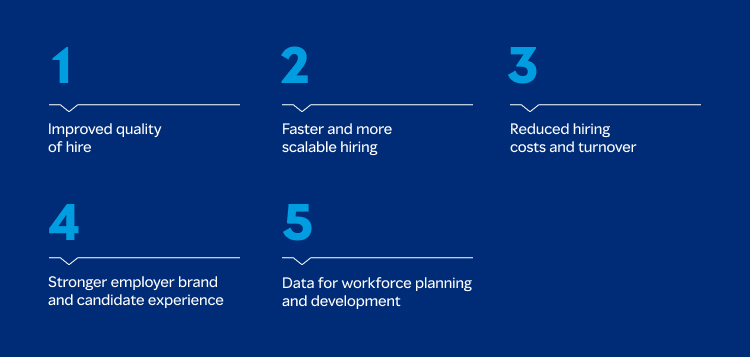
When carefully selected and implemented, hiring assessments can transform recruitment from a reactive, CV-driven activity into a strategic capability.
Key benefits include:
The Philippine labor market is large, young, and urbanized. As per the Labor Market Profile: The Philippines by the Danish Trade Union Development Agency (DTDA), the working age population is about 77 million, with an employment rate above 95% and unemployment at around 2.6% as of the 2025-2026 labor market profile. The service sector dominates, employing most workers, while special economic zones have nearly doubled their employment from 2012 to 2022, underscoring the country’s role as a hub for BPO and export-oriented services.
Hiring demand remains robust. The foundit Insights Tracker reported that the recruitment index climbed from 132 in April 2024 to 159 in April 2025, a 20% year-on-year increase. Roles in engineering, production, real estate, marketing and communications, finance and accounts, hospitality, and HR all showed steady gains, indicating broad-based growth beyond just IT and BPO.
Culturally, Filipino organizations value close interpersonal relationships, respect for hierarchy, and community orientation. This shapes how hiring decisions are made, as managers often look for candidates who demonstrate humility, teamwork, and a willingness to go the extra mile for colleagues or customers. At the same time, younger workers entering the labor market expect more flexibility, learning opportunities, and clear career paths, which pushes employers to use assessments not just for gatekeeping but also for development and internal mobility planning.
Any assessment program in the Philippines must comply with the Data Privacy Act of 2012 (Republic Act 10173) and its implementing rules. The Act classifies employment-related information, including test scores and behavioral data, as personal or even sensitive personal information that requires lawful processing, secure storage, and clear purpose limitation.
Practically, this means employers should:
Anti-discrimination considerations are equally important. While Philippine law does not yet contain a single unified anti-discrimination code, various statutes and local ordinances prohibit discrimination based on gender, disability, and other protected characteristics. Employers should therefore ensure their assessments are demonstrably job-related and not biased against any group, for example, by removing irrelevant questions, providing accommodations to candidates with disabilities, and regularly reviewing score patterns across demographic segments.
Leading organizations are moving toward a ‘privacy by design’ and ‘ethics by design’ approach to assessments by embedding fairness, transparency, and explainability into the evaluation process from the start rather than treating compliance as an afterthought.

Choosing an assessment partner is a strategic decision that affects hiring outcomes, candidate experience, and legal risk. The Philippine HR technology market is growing fast, so HR leaders have more options than ever.
When evaluating vendors, consider the following dimensions:
Looking ahead, hiring assessments in the Philippines, like globally, will be shaped by three converging forces – digital transformation, skills disruption and rising expectations around fairness and candidate experience.
First, technological adoption is accelerating. The HR technology market is expected to grow by 7.5% annually through 2033, as per the IMARC report. This reflects rising investment in AI-powered recruitment tools that automate sourcing, resume screening, and predictive analytics. Assessment platforms are increasingly using adaptive testing and AI-driven scoring to shorten test times while maintaining accuracy, as well as video-based tools that analyze both content and communication style during interviews.
Second, the scale of the skills challenge is becoming impossible to ignore. As already discussed, the World Economic Forum’s Future of Jobs report shows that 68% of Filipino workers will need upskilling or reskilling by 2030, and that skills gaps are perceived as the biggest obstacle to business transformation by 67% of surveyed employers. As jobs and skills evolve, assessments will shift from one-off gatekeepers to ongoing tools for internal mobility, learning pathways, and career development.
Third, governance and ethics will take center stage. Regulators and candidates both will demand transparency about what is being measured, how data is used, and how bias is monitored. Organizations that can demonstrate robust, ethical assessment practices that are grounded in science, compliant with local law, and respectful of candidate rights will be better positioned to attract talent in an increasingly discerning market.
For Philippine employers, the opportunity is clear – by embracing thoughtful, data-driven hiring assessments today, they can build more skilled, agile, and inclusive teams that are ready for the next decade of growth and disruption.
Originally published January 16 2026, updated January 16 2026

Talent acquisition is all about strategizing for sourcing, hiring, and retaining the talent an organization needs. This blog offers more insights on the topic.








 Behavioral Competencies
 Cognitive Competencies
 Coding Competencies
 Domain Competencies