

Online examinations have rapidly evolved from a temporary alternative to becoming a core component of modern assessment strategies. Universities and professional bodies now routinely conduct tests remotely and certify candidates through digital exams.
The convenience and scale offered by remote assessments are undeniable. Institutions can reach candidates across geographies, reduce logistical complexity, and conduct exams more frequently. However, this shift has also introduced a fundamental challenge: ensuring exam integrity when candidates are not physically present in controlled environments.
As remote assessments become more common, concerns around impersonation, unauthorized assistance, and misuse of devices have increased multifold. Maintaining academic integrity while delivering a seamless candidate experience has therefore become a critical priority for institutions and exam authorities.
This is where AI proctoring for online exams is proving to be transformative. Modern AI-assisted proctoring software enables institutions to monitor candidate behavior, detect suspicious activities, and maintain exam security at scale. Through intelligent automation and advanced monitoring capabilities, proctoring systems are helping organizations conduct remote assessments with the same level of integrity as traditional exam halls.
Yet, as adoption grows, so does the variety of available solutions. Not all remote proctoring software platforms offer the same level of accuracy, scalability, or candidate experience. For institutions running high-stakes assessments, choosing the right platform requires careful evaluation.
Understanding how to choose AI proctoring software is therefore becoming an essential capability for organizations conducting online examinations.
The growing adoption of digital assessments across education, certification, and corporate learning has significantly increased the demand for reliable proctoring solutions. Some of the key reasons why AI-assisted proctoring is becoming essential are:
Today, some of the most critical examinations are conducted remotely. Government agencies increasingly use online screening tests to manage large applicant pools. Universities are adopting digital entrance exams to expand access and streamline admissions processes. Professional certification bodies administer remote exams to enable global participation.
In the corporate world, online assessments are now central to campus hiring and employee learning programs. Organizations evaluate technical, cognitive, and behavioral skills through digital testing platforms that can accommodate thousands of candidates simultaneously.
As the scale of online exams increases, so does the need for strong online exam cheating prevention mechanisms.
Remote testing environments create new opportunities for exam malpractice. Candidates may attempt impersonation by asking someone else to take the exam on their behalf. Others may switch browser tabs to search for answers, use secondary devices such as smartphones, or collaborate with individuals present in the room.
Without effective monitoring mechanisms, these behaviors can undermine the credibility of exam results.
Traditional invigilation methods cannot easily scale to remote environments. Monitoring thousands of candidates through human proctors alone is both inefficient and costly. This challenge has accelerated the adoption of automated proctoring tools powered by artificial intelligence.
Advances in artificial intelligence have significantly enhanced the capabilities of modern proctoring systems. Through intelligent AI exam monitoring, platforms can analyze video feeds, audio signals, and screen activity to detect unusual behaviors during exams.
For example, facial recognition can confirm candidate identity at the start of the test. Behavioral analysis models can detect unusual eye movement or head positioning that may indicate attempts to access external resources. Suspicious activities are automatically flagged and recorded for review.
These capabilities enable institutions to monitor large-scale remote exams efficiently while maintaining high standards of integrity.
At its core, AI-assisted proctoring software combines multiple monitoring technologies to create a secure remote testing environment.
Most solutions capture video through the candidate’s webcam, record audio from the surrounding environment, and track on-screen activity during the exam. Artificial intelligence algorithms analyze these data streams in real time to identify patterns that may indicate potential violations.
When suspicious behavior is detected, the system generates alerts and stores supporting evidence that exam administrators can review later.
Modern proctoring systems typically include several key monitoring capabilities.
Video monitoring allows the system to observe the candidate and detect the presence of additional individuals in the room. Audio monitoring helps identify conversations or background cues that may indicate collaboration.
Screen recording captures on-screen activity, ensuring candidates do not access unauthorized resources or switch applications during the test.
Another important component is AI-based anomaly detection. Machine learning models analyze behavioral patterns such as frequent head movement, repeated glances away from the screen, or sudden disappearance from the webcam frame.
Identity verification technologies add another critical layer of security. These may include facial recognition, ID verification, or biometric authentication to confirm that the correct candidate is taking the exam.
Organizations can adopt different proctoring approaches depending on the nature of their assessments, some of which are:
Many institutions now prefer hybrid models that combine AI detection with human oversight. This approach balances efficiency with fairness by allowing artificial intelligence to identify potential issues while enabling human reviewers to interpret the context.
Solutions such as those offered by Mercer Assessments combine AI-assisted monitoring with human review workflows, helping institutions maintain both accuracy and fairness in remote exam environments.
When evaluating AI-assisted proctoring software, institutions should focus on capabilities that strengthen security without compromising candidate experience. Some of the key features that they should look for are:
A secure exam begins with accurate candidate authentication. Proctoring platforms should be able to verify identity before the exam begins and confirm that the same individual remains present throughout the session.
Facial recognition technologies compare live webcam images with stored profile photographs or uploaded ID documents. Some platforms also support continuous authentication, periodically verifying candidate identity during the exam.
Behavioral monitoring plays a central role in AI proctoring for online exams. Advanced systems analyze eye movement, facial orientation, and head position to detect patterns that may indicate suspicious behavior.
For example, repeated glances away from the screen may suggest that the candidate is consulting external resources. Similarly, unusual movements or gestures may indicate attempts to use secondary devices.
AI algorithms detect these patterns and generate alerts that proctors can review.
Secure browser technology is another essential feature for preventing exam misconduct. These tools restrict actions such as opening additional tabs, switching applications, or copying exam content.
Some solutions also disable screen-sharing tools and block background applications that could facilitate cheating.
Mercer Assessments’ MSB is one such solution that restricts device functionality by blocking access to unauthorized apps and websites.
Many cheating attempts involve secondary devices such as smartphones or tablets. Advanced online exam cheating prevention systems can detect the presence of additional devices within the webcam frame.
Some platforms also allow candidates to perform a quick room scan before the exam begins to confirm that no unauthorized materials are present.
Effective AI exam monitoring platforms generate detailed integrity reports after the exam concludes. These reports typically include time-stamped violations, screenshots, and video evidence of suspicious behavior.
Automated reporting significantly reduces the time required for post-exam review and enables institutions to make faster and more informed decisions.
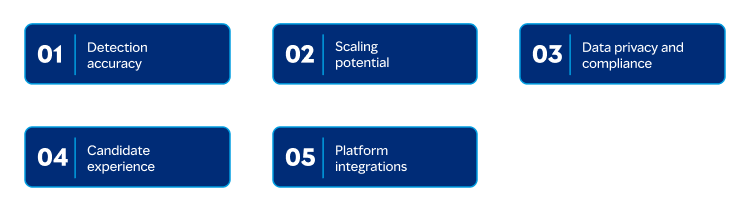
Selecting the right remote proctoring software requires looking beyond feature lists. Institutions must evaluate broader operational considerations that influence exam reliability and candidate experience. Some key factors they must consider are:
The effectiveness of automated proctoring tools depends heavily on the accuracy of their detection models. Systems that generate too many false positives can create unnecessary investigations and candidate dissatisfaction.
High-quality platforms rely on well-trained AI models capable of distinguishing genuine violations from normal test-taking behavior.
Large-scale exams may involve tens of thousands of candidates taking tests simultaneously. Proctoring platforms must therefore be supported by robust infrastructure capable of handling high concurrency.
Platforms built for large-scale assessments, such as those used in hiring and national-level exams, are better equipped to handle such demand.
Exam monitoring involves collecting sensitive personal data such as video recordings and biometric information. Institutions must ensure that the chosen platform complies with relevant data protection regulations and follows secure data storage practices.
A secure exam environment should not create unnecessary friction for candidates. Proctoring software should function smoothly across devices and internet conditions, with minimal setup requirements.
Accessibility features are also essential to ensure that candidates with different needs can participate without barriers.
Most organizations already use learning management systems or digital assessment platforms. The proctoring solution should integrate easily with these systems through APIs or built-in connectors.
Solutions such as those provided Mercer Assessments are often designed to integrate with broader assessment ecosystems, simplifying exam administration.
Despite the growing availability of AI-assisted proctoring software, many institutions encounter challenges due to avoidable selection mistakes.
One common issue is prioritizing cost over capability. While budget considerations matter, low-cost solutions may lack the reliability or scalability required for high-stakes exams.
Another mistake is overlooking candidate experience. Overly complex setup processes or intrusive monitoring methods can create unnecessary stress for candidates.
Organizations also sometimes fail to conduct large-scale pilot tests before full implementation. Systems that perform well in small trials may struggle under the pressure of thousands of concurrent users.
Finally, ignoring privacy and compliance considerations can expose institutions to legal risks and reputational damage.
The next generation of AI proctoring for online exams will likely extend beyond simple monitoring to deeper behavioral intelligence.
Emerging technologies such as behavioral biometrics can identify candidates based on unique interaction patterns like typing rhythm or mouse movement. These signals may provide additional layers of authentication without intrusive monitoring.
Continuous authentication models are also gaining attention. Instead of verifying identity only once at the beginning of the exam, future systems may confirm candidate identity throughout the session.
Over time, exam platforms are expected to combine assessment analytics with proctoring intelligence, enabling institutions to analyze both candidate responses and behavioral patterns. This integrated approach can provide deeper insights into exam integrity.
As remote assessments continue to expand, ensuring exam integrity will remain a central concern for institutions worldwide.
Modern AI-assisted proctoring software provides powerful capabilities for identity verification, behavior monitoring, and automated incident reporting. When implemented effectively, these systems allow institutions to conduct large-scale remote exams without compromising security.
Organizations that carefully evaluate detection accuracy, scalability, candidate experience, and compliance will be better positioned to select the right proctoring platform.
Originally published March 27 2026, Updated March 27 2026

Harsh Vardhan Sharma, with 6 years of content writing expertise across diverse B2B and B2C verticals, excels in crafting impactful content for broad audiences. Beyond work, he finds joy in reading, traveling, and watching movies.
Online remote proctoring is the technology through which exams are conducted online in a cheating-free manner, using high-speed internet and a computer with a webcam. Online remote proctoring uses video streaming and AI or human proctors to invigilate large-scale exams securely.


Thanks for submitting the comment. We’ll post the comment once its verified.








 Behavioral Competencies
 Cognitive Competencies
 Coding Competencies
 Domain Competencies
















Would you like to comment?