

For years, campus hiring was driven by scale. Large groups, tight timelines, and academic filters dominated these recruitment drives. But with changing times, campus recruitment is undergoing a reset. As business models become more digital, roles become more specialized, and skills become more fluid, organizations are shifting from volume hiring to quality hiring during campus recruitment.
This change is being driven by three forces. First, the rise of AI in campus recruitment has transformed how candidates are screened, assessed, and shortlisted. Second, online campus assessments and remote proctored hiring have removed geographical and logistical constraints. Third, there is growing pressure on organizations to prove the return on investment of their campus hiring strategy through measurable outcomes such as quality of hire and early performance.
As a result, assessment-led hiring is becoming central to campus recruitment trends in India. Talent leaders are now focusing on how accurately they can predict on-the-job success, how fairly they can assess potential, and how quickly new hires can become productive.
Traditionally, campus hiring followed a set pattern. Organizations visited a limited set of campuses – mostly colleges in Tier 1 cities, used academic performance as cut-offs, conducted a few standardized tests and hired in bulk for broad roles. While the process was efficient on paper, this model often resulted in skill mismatches, longer ramp-up times, and higher early attrition.
Now organizations are shifting towards precision hiring. Roles are now defined more clearly; skill expectations are mapped upfront, and candidates are assessed for specific job requirements and skills rather than generic potential. Skill-based hiring in India is becoming the preferred approach, allowing organizations to match graduate talent to roles with greater accuracy and confidence.
As hiring becomes more targeted in general, assessment-led decision-making has become more important. These structured assessments help reduce hiring bias by applying consistent evaluation standards across institutions and candidate pools. These tests also enable recruiters to easily measure the quality of hire by linking assessment outcomes with performance data. This allows them to track campus hiring ROI through metrics such as conversion rates, productivity benchmarks, and retention trends.
These shifts highlight the fact that campus hiring in India is becoming more structured and more intentional. Instead of being a one-time hiring exercise, it is now being treated as a long-term talent decision.
As organizations adapt to this change, clear patterns are emerging in how they run and measure campus hiring. These patterns outline the key campus recruitment trends shaping Indian enterprises in 2026.
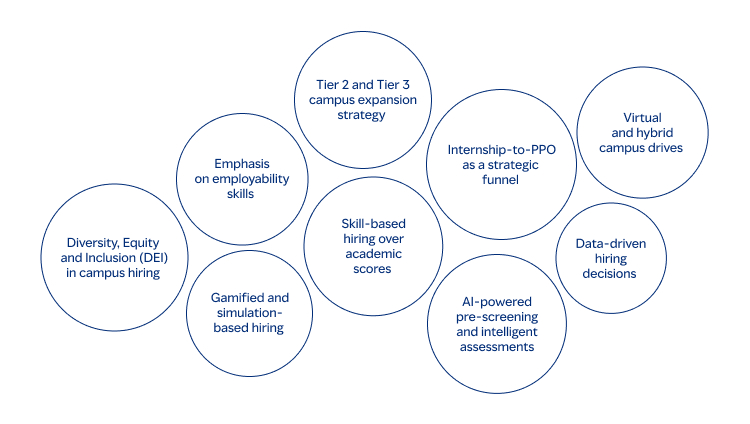
What’s changing
AI in campus recruitment is now reshaping the complete recruitment process, right from the first stage. With AI, resume screening is automated, so is assessment delivery and in some cases, evaluation as well. At the same time, remote proctored hiring has matured with many proctoring platforms using AI to ensure test integrity without disrupting the candidate’s experience. Together, these changes allow organizations to move from reactive screening to more predictive hiring.
Why it matters for organizations
The use of AI helps maintain consistency across large applicant pools and reduces dependence on subjective early screening. Over time, this also improves fairness and quality of hire.
How talent leaders should respond
Talent leaders should focus on using AI as a decision-support tool. The emphasis should be on clarity and explainability, ensuring that AI-driven insights are easy to understand and align with role requirements.
What’s changing
For many organizations, academic scores were once the easiest way to filter candidates, but this approach is now losing relevance. Skill-based hiring in India is gaining ground as roles demand practical ability, learning agility, and behavioral fit rather than theoretical knowledge alone. As a result, campus hiring assessments are increasingly mapped to specific job skills.
Why it matters for organizations
This shift matters because skills offer a far better indicator of workplace readiness. When candidates are evaluated on what they can do, organizations see faster onboarding and stronger early performance. It also allows companies to access capable talent from a wider range of campuses.
How talent leaders should respond
To respond to this change, talent leaders need to define skill expectations clearly before campus drives begin. Assessments should be designed to reflect real work scenarios, ensuring alignment between hiring decisions and on-the-job demands.
Virtual and hybrid campus drives
What’s changing
Virtual and hybrid campus drives have become a natural extension of campus hiring strategies. What began as a response to COVID disruption is now a deliberate choice. Online campus assessments, virtual interviews, and digital group exercises allow organizations to engage multiple campuses without the limitations of travel and scheduling.
Why it matters for organizations
This approach matters because it improves both reach and efficiency. Organizations can evaluate more candidates in less time while maintaining uniform assessment standards. Candidates also benefit from a more accessible and transparent process.
How talent leaders should respond
Talent leaders should therefore design campus hiring journeys that are digital by default. At the same time, clear communication and structured timelines are essential to ensure candidates remain engaged throughout the process.
What’s changing
Campus hiring is becoming increasingly measurable. Instead of relying on intuition or legacy benchmarks, talent teams now track assessment outcomes, offer acceptance rates, and early performance indicators. These insights help connect hiring decisions with business results.
Why it matters for organizations
This matters because data brings accountability to campus hiring. It allows organizations to understand which campuses, roles, and assessment methods deliver the best outcomes. Over time, this leads to more predictable and defensible hiring decisions.
How talent leaders should respond
Talent leaders should use this data not just for reporting, but for improvement. Each campus hiring cycle should inform the next, creating a feedback loop that steadily improves hiring quality.
What’s changing
Campus recruitment trends in India show a clear expansion beyond traditional Tier 1 institutions. As competition for talent increases, organizations are now actively engaging Tier 2 and Tier 3 campuses as part of long-term workforce planning.
Why it matters for organizations
This shift matters because it reduces reliance on a small set of colleges and creates more resilient talent pipelines. However, without consistent evaluation standards, quality can vary widely.
How talent leaders should respond
Talent leaders should address this by using standardized, skill-based assessments across all campuses. This ensures fairness, maintains quality, and builds trust in the hiring process regardless of campus tier.
What’s changing
Internships are no longer viewed as short-term exposure programs. They are increasingly designed as structured pipelines for full-time hiring. Organizations now evaluate interns against defined performance criteria, using assessments and feedback to inform PPO decisions.
Why it matters for organizations
This approach matters because it reduces hiring risk. By observing candidates in real work settings, organizations gain deeper insight into capability, motivation, and cultural fit. Candidates, in turn, gain clarity on role expectations.
How talent leaders should respond
Talent leaders should integrate internships into the overall campus hiring strategy. Clear benchmarks, regular feedback, and formal evaluation checkpoints help ensure PPO decisions are both fair and data-backed.
What’s changing
Alongside technical capability, employability skills are receiving greater attention. Skills such as communication, problem-solving, adaptability, and teamwork play a critical role in early career success. As a result, graduate employability assessments now include behavioral and situational evaluation.
Why it matters for organizations
This focus matters because employability skills determine how quickly graduates adjust to the workplace. Strong technical skills alone are often not enough in dynamic, collaborative environments.
How talent leaders should respond
Talent leaders should ensure these skills are assessed formally during campus hiring, rather than inferred during interviews. This creates a more complete view of candidate readiness.
What’s changing
DEI is increasingly shaping how campus hiring processes are designed. Instead of relying on post-hiring interventions, organizations are embedding inclusion into assessment and evaluation methods. Blind hiring practices and standardized scoring are becoming more common.
Why it matters for organizations
This matters because early-career hiring sets the foundation for long-term workforce diversity. Fair and transparent assessment processes also strengthen the employer brand among graduates.
How talent leaders should respond
Talent leaders should rely on structured, assessment-led hiring models to reduce bias and ensure equal opportunity across candidate groups.
What’s changing
To better understand how the candidate may perform if hired, organizations are adopting gamified and simulation-based hiring methods. Hackathons, case studies, and role simulations allow candidates to demonstrate problem-solving and decision-making in practical contexts.
Why it matters for organizations
This trend matters because simulations provide richer insight than traditional tests. They show how candidates approach challenges, collaborate with others, and respond under pressure.
How talent leaders should respond
Talent leaders should use simulations s a complement to structured assessments. Clear scoring criteria and alignment with role expectations ensure these tools remain objective and effective.
To operationalize the above-mentioned campus hiring trends, organizations need integrated solutions rather than fragmented tools. Mercer Assessments offers end-to-end virtual campus hiring solutions.
With Mercer Assessments’ online campus hiring solutions, organizations can target the right campuses and engage students virtually. This helps companies broaden their reach and implement a seamless virtual screening and interview process. The solution lets organizations conduct pan-India virtual campus drives, using its campus intelligence and campus management solutions. It facilitates the assessment of candidates remotely and securely via robust proctoring tools. Additionally, it allows organizations to schedule and conduct remote online interviews, using its virtual interview and coding interview platforms.
With a customizable selection of assessments – ranging from coding challenges and aptitude tests to language evaluations and personality assessments, Mercer Assessments guarantees that your campus hiring initiatives will not only meet but exceed expectations.
Campus recruitment in India has shifted its focus to accuracy, fairness, and future readiness instead of scale. Campus hiring trends in 2026 clearly point towards assessment-led, skill-based, and data-driven hiring models.
For talent leaders, the opportunity is clear. By embracing AI in campus recruitment, investing in skill-based hiring frameworks, and leveraging structured online assessments, organizations can transform campus hiring into a strategic advantage rather than a seasonal exercise.
Originally published March 17 2026, Updated March 17 2026

Aniket is a digital growth strategist specializing in SEO and content strategy for the hiring and assessment space. He combines technical SEO, automation, and search intent intelligence to drive qualified B2B demand across global markets.
Campus hiring is the process of recruiting fresh graduates from colleges. Campus recruitment starts with campus selection, following which a recruitment team visits campuses for engagement activities, candidate screening and interviewing.


Thanks for submitting the comment. We’ll post the comment once its verified.








 Behavioral Competencies
 Cognitive Competencies
 Coding Competencies
 Domain Competencies

















Would you like to comment?