

For all organizations, strong leadership remains a foundational lever for success. A clear leadership vision does not just chart business goals. It gives people within an organization meaning, shapes culture, and helps teams stay aligned even when external pressures mount.
Leaders who communicate purpose and direction build trust, engagement and resilience, influencing performance, innovation and long-term sustainability.
And when organizations face volatility in markets, technology shifts and workforce expectations, it is the effective leadership that becomes the anchor that helps teams stay grounded, motivated and united.

The world of work is evolving rapidly, and 2026 is predicted to bring shifts that make leadership more challenging and more critical than before. Some of the key changes are:
AI has moved from being a technological advantage to a foundational layer of business for most organizations. It now informs decisions, analyses patterns, and completes tasks at speeds humans fail to match. Leaders must understand how AI affects customers, employees, ethics, productivity, and long-term competitiveness. They must guide teams to adopt technology with confidence while ensuring that decisions remain fair, transparent, and human-centric.
Now more than ever, supply chains, digital infrastructure, regulatory frameworks, and customer expectations are deeply linked across countries. Leaders must be prepared for ripple effects that move quickly from one region to another. Geopolitical awareness and global sensitivity have become core elements of leadership.
People, especially Gen Z, are redefining what they expect from work. They want meaningful roles, modern skills, flexible models and leaders who are accessible and authentic. Younger employees now value learning more than hierarchy. Experienced employees, on the other hand, want stability with choice, not rigid structures. Leadership in 2026 requires deeper listening and the ability to build workplaces where diverse expectations can coexist.
Static job descriptions are losing relevance. Organizations are reorganizing around capabilities, not titles. Skills in analytics, problem solving, collaboration, adaptability and digital tools are becoming essential building blocks of strategy. Leaders must allocate talent based on strengths and future potential, not only on job level.
Customers now evaluate brands based on their values. Similarly, stakeholders expect organizations to act responsibly and demonstrate integrity. Employees assess leaders based on behavior, not only performance. Investors look for long-term resilience, not short-term gains. Trust has become a strategic asset, and leaders must protect it continuously.
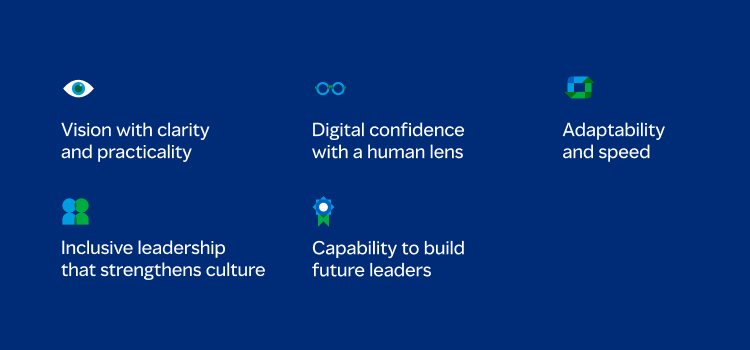
To lead effectively in this environment, leaders need a combination of strategic, digital, and people-focused capabilities. These are no longer desirable qualities. They are essential expectations.
Leaders must see ahead with accuracy but also translate that vision into actions that employees can understand. Clarity is not about having perfect answers. It is about providing direction that keeps the organization aligned even when conditions change.
While leaders do not need to code or design systems, they must understand technology deeply enough to make informed decisions. They must evaluate tools, identify opportunities, safeguard ethics and help teams embrace change without fear.
Organizations that move faster will set the pace for entire industries. Leaders must notice trends early, adjust strategy quickly, and encourage teams to experiment. Adaptability builds resilience and allows companies to shape change instead of reacting to it.
Teams are now more diverse in mindset, background, and expectations. Hence, leaders must create environments where people feel respected and valued. Inclusion strengthens creativity, decision quality, and long-term performance.
Leadership is no longer limited to senior roles. Organizations need leaders at every level to manage decisions, projects, and people. Senior leaders in 2026 must create pathways that help employees grow into leadership roles. A strong leadership pipeline ensures continuity and supports innovation.
Organizations need structured efforts to prepare leaders for the future. Leadership development cannot be reactive. It must be systematic, data-informed, and future-ready.
A leadership strategy requires clarity about what exactly leadership means in the organization. This includes behaviors, responsibilities, values, and expectations. Creating a common leadership framework provides this clarity, ensuring consistency and alignment across all levels and regions.
Skill mapping should guide hiring, development, and mobility. Leaders must understand what the organization needs today and what it will need down the line in the next three to five years. Skills like digital literacy, communication, analysis, and collaboration must be central to all talent decisions.
Classroom and legacy forms of learning alone do not build leaders. Organizations looking to elevate their leadership strategy should combine training with real-world exposure through stretch projects, role rotations, cross-functional assignments, and digital capability programs. These experiences will help develop situational judgement, emotional intelligence, and strategic thinking skills that are crucial for leadership roles.
AI and analytics can provide insights into strengths, potential and risks. Technology can support leadership growth when used responsibly. This requires transparency about how tools work, fairness in application, and human involvement in interpretation.
Leaders must communicate with consistency and intention. Clear communication reduces uncertainty, increases trust, and helps teams stay engaged. A strong communication culture supports collaboration across hybrid and distributed teams.
The connection between well-being and performance is stronger than ever. Leaders must recognize signs of burnout, encourage balanced workloads, and create systems that allow employees to thrive. A supportive work environment strengthens loyalty and reduces attrition.

2026 calls for leadership that is both strategic and human. Leaders must navigate technology, develop talent, reinforce values, and build systems that support long-term success. They must connect vision to action and people to purpose. Organizations that embrace this new leadership mandate will be ready for the next wave of change.
Originally published January 8 2026, Updated January 12 2026

Asmita Khandelwal has been a valued member of the Mercer | Mettl team since September 2022. In her role with the SEO team, she is responsible for curating content that aligns with the business requirements. Leveraging her expertise, research skills, and industry knowledge, she plays a crucial role in ensuring that our blog provides the most valuable and accurate information to our audience.
Learning and development initiatives, also known as organizational development initiatives, are activities designed to develop employees in their present roles as well as for future roles. It consists of identifying training needs, conducting training initiatives and measuring the ROI.


Thanks for submitting the comment. We’ll post the comment once its verified.








 Behavioral Competencies
 Cognitive Competencies
 Coding Competencies
 Domain Competencies

















Would you like to comment?