
Today, maintaining a competitive business edge requires continuous skill development, growth, and adaptability. Organizations are redefining learning and going far beyond traditional training initiatives. Innovative learning solutions, unique digital platforms, and immersive, hands-on training are accelerating professional growth, enabling companies to position themselves better for future demands.
It means leaders can identify skill gaps that need to be addressed, and businesses can align workforce development with key strategic objectives in real time. Prioritizing today’s adaptable, data-driven, and learner-focused development strategies is essential given the rapid changes in the market today.
Investing in contemporary learning models is now a business necessity for companies dedicated to maintaining growth and future-proofing their workforce.

In 2026, workplace learning shifts from generic training to experiences that are closely tied to real work, real decisions, and real constraints. Learning focuses on developing human judgment, AI skills for daily application, and human capabilities that learners can implement at work.
The prominent trends in learning solutions for upskilling include greater emphasis on critical thinking and ethical decision-making, along with artificial intelligence literacy, so that employees can interact with innovative tools without being displaced by them.
The learning journey evolves with AI personalizing learning, along with greater importance being placed on multiple paths, projects, and peer work, all targeting learning the same skill.
More focus shifts to programs that reflect the roles, measures of success, and issues that organizations face, and can be accessed not just by office workers, but also by those who work shifts and from home. Additionally, there is attention on sustainable learning and real-world proof of skill, pacing development to avoid burnout and using simulations, portfolios, and on-the-job evidence to judge readiness for new responsibilities.
As the nature of work rapidly transforms, so do the methods companies use to cultivate critical skills. These emerging learning trends reveal how businesses are innovating to prepare their workforce for the future.
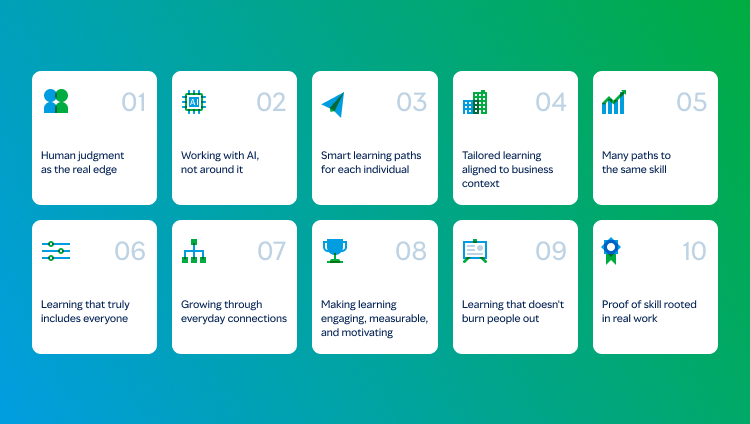
In workplaces full of automation, what really stands out is people who can question AI, connect the dots, and make decisions that balance risk, results, and people. In 2026, upskilling will focus more on critical thinking, clear communication, and doing the appropriate thing in complicated situations, using real scenarios, reflection, and feedback rather than generic soft skills training.
AI skills will become a part of basic workplace knowledge, like email or spreadsheets. The focus will be on teaching employees how to frame prompts, evaluate outputs and apply oversight so AI augments instead of overriding human expertise.
Instead of elaborate, one-size-fits-all courses, AI-based tools will adapt what each person needs, to their role and performance. This kind of live adjustment helps people spend less time on generic training and more time fixing the real gaps that block their performance or growth.
Companies want learning that matches their specific industry, roles, and daily challenges, not generic content disconnected from business needs. In 2026, upskilling will use customized paths with role-specific materials, internal case studies, and outcomes tied to objective performance metrics. This makes L&D a key strategic player that drives actual results.
In a world where career paths are fragmenting, employees will want more than one way to build the same capability, like a mix of short modules, live problem-solving, and peer collaboration. Learning and development teams will design modular experiences that people can access at different points, minimizing time away from work, while still supporting skill development.
Accessibility will become a default principle of how learning is designed beyond a mere checkbox. Formats that work well on mobile devices, along with flexible timing models, will enable front-line and shift workers to participate in learning rather than be excluded from it due to constraints.
The most powerful development happens in conversations people have while solving real problems together. By 2026, organizations will be intentionally developing peer communities, mentoring loops, and expert networks so that knowledge can move fast and informally across teams.
Gamification will be used less as decoration and more to make goals clear, show progress, and reward steady effort. Points, challenges, and social tools will connect to specific behaviors on the job, allowing data points to inform action taken by managers and learners themselves.
Sustainable learning will focus on realistic pacing and time for reflection to integrate new skills without sacrificing health.
Assessment will shift away from one-off quizzes that measure recall. Companies will use simulations, role-based tasks, portfolios, and day-to-day evidence to decide who is ready for more responsibility.

The market dynamics today call for flexibility and specialized upskilling to meet the specific needs of the labor market. Technological advancements and shifts in global labor needs have triggered dramatic changes worldwide. Upskilling has become an essential component of this new environment to stay ahead in the market and to keep learning and staying updated.
Shifts in the labor force, uncertain economic conditions, and increased employee demands drive the need to adopt flexible learning methodologies. Learning and development have never mattered more than they do now, as AI has revolutionized the industry.
Companies that commit to innovative, tailored learning solutions empower their employees to lead their own development while equipping leaders with the tools to identify and proactively close skill gaps.
By cultivating a culture of ongoing, customized learning aligned with a company’s strategies, organizations build a resilient workforce that is well-prepared for the future.
Originally published January 14 2026, Updated January 14 2026

Archita Bharadwaj has worked as a Content writer at Mercer | Mettl since April 2023. With her research background, she writes varied forms of content, including blogs, ebooks, and case studies, among other forms.
Skills assessment tests are used in the recruitment process to determine if a candidate possesses the necessary skills (analytical, technical, interpersonal, etc.) to thrive in a job role. Skills assessment tests are an essential component of recruitment today.


Thanks for submitting the comment. We’ll post the comment once its verified.








 Behavioral Competencies
 Cognitive Competencies
 Coding Competencies
 Domain Competencies

















Would you like to comment?