

For years, audit has remained the same, where efficiency was driven by scale, standardized procedures and rigorous compliance with accounting frameworks. Today, that foundation remains critical, but automation has streamlined reconciliations. Digital systems record and store transactions in real time. Advanced tools can scan an entire row of data in seconds.
As routine tasks become automated, the expectations placed on auditors are expanding. Stakeholders want more than confirmation that controls exist. They expect insight into emerging risks, clarity on complex transactions, and guidance on strengthening governance in a digital environment.
This evolution is redefining what effective audit talent looks like. Technical accounting knowledge remains essential, but it is now the starting point rather than the differentiator.
The modern auditor must be data-literate, technologically confident, and capable of translating complex findings into business-relevant insights.
Traditional audit methodologies relied heavily on sampling. Given practical constraints, auditors reviewed only a subset of transactions and drew conclusions about the broader population. That model served its purpose in a manual environment.
Digital transformation has changed that equation. Today, entire datasets can be analyzed quickly and efficiently. All the transactions, rather than a limited sample, are now used to draw out patterns, anomalies, and trends.
However, access to data does not automatically generate insight. The differentiator lies in interpretation.
Auditors must understand what the data is signaling and why it matters. An unusual transaction pattern may reflect fraud, a process gap, or simply a seasonal business shift. Determining which requires judgment, context, and analytical discipline.
Digital fluency also extends to working within enterprise systems, understanding automated controls, and engaging with technologies such as distributed ledgers. Auditors do not need to build these systems, but they must understand how they function and where risks may arise.
The focus is shifting from verifying entries to evaluating systems and interpreting signals.
The perception of audit as a purely compliance-driven function is evolving. Boards and executive teams increasingly view auditors as strategic partners in risk management.
This transition elevates the importance of communication. Audit findings must be clear, concise, and actionable. Technical conclusions should be translated into business implications that resonate with decision-makers.
Equally important is the ability to build trust. Effective auditors listen actively, understand operational realities, and frame recommendations in a way that encourages adoption.
The goal is not simply to highlight deficiencies, but to strengthen processes and controls.
Influence plays a critical role here. Identifying a risk is only the first step. Driving corrective action requires credibility and persuasive capability. As automation reduces time spent on routine testing, more attention shifts to dialogue, alignment, and advisory value.
In this environment, technical skills and interpersonal capability are no longer separate competencies. They are interconnected.
Regulatory landscapes evolve. Technology platforms advance. Business models shift rapidly. Audit teams must be prepared to respond to this in real time.
An agile mindset reflects openness to change and commitment to continuous improvement. It involves questioning legacy approaches, exploring new tools, and adapting audit methodologies to emerging risks.
For example, when organizations adopt new digital payment systems or integrate advanced data platforms, auditors must quickly understand the implications for control environments. Waiting for established guidance may not be an option. Professional judgment, supported by structured learning, becomes critical.
Agility also supports resilience. Professionals who embrace change are better positioned to navigate uncertainty and maintain effectiveness as expectations continue to rise.
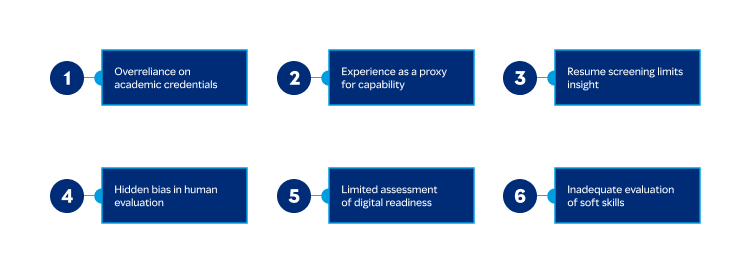
While the audit role has evolved significantly, many hiring models still reflect yesterday’s realities. The result is a widening gap between the capabilities firms need and the talent they select.
A closer look reveals where conventional approaches are falling short.
Professional qualifications and accounting degrees remain important. They signal foundational knowledge and technical grounding. However, they do not measure digital fluency, analytical depth, or adaptability.
Two candidates with identical certifications may perform very differently in a data-intensive audit environment. One may confidently navigate dashboards and extract insights from large datasets. The other may rely heavily on traditional manual approaches.
When credentials become the primary filter, firms end up mistaking eligibility for readiness.
Years of experience are often used as shorthand for competence. Yet tenure does not always translate into future-fit skills.
An auditor who has spent a decade in a stable, process-driven environment may struggle in a rapidly digitizing ecosystem. Conversely, a professional with fewer years but exposure to analytics tools and evolving systems may adapt more quickly.
While experience matters, without evaluating the nature of that experience, hiring decisions can misjudge true capability.
Resumes highlight roles, responsibilities, and achievements. What they rarely reveal is how a candidate thinks.
Audit increasingly demands structured reasoning, pattern recognition and comfort with ambiguity. These qualities cannot be inferred reliably from bullet points.
Manual screening also narrows the lens. Recruiters may prioritize familiar institutions, well-known firms, or linear career paths. In doing so, they may overlook candidates who have developed relevant skills through unconventional routes.
The result is a talent pool that appears strong on paper but may lack critical competencies.
Unstructured interviews and resume reviews introduce unconscious bias. Similar educational backgrounds, shared affiliations, or comparable career trajectories can unintentionally influence perception.
In a profession built on objectivity and independence, talent selection should reflect the same discipline. When hiring decisions rely heavily on subjective impressions, diversity of thought and background can suffer.
Beyond fairness, this has performance implications. Diverse teams tend to approach risk assessment more comprehensively. Homogeneous hiring limits perspective at a time when complex risks demand broader viewpoints.
Digital tools are now embedded across audit workflows. Yet many hiring processes still evaluate candidates primarily on accounting knowledge.
Questions about ‘comfort with analytics’ are often self-reported. Without structured testing or simulations, firms rely on perception rather than proof.
As audits become increasingly data-driven, failing to assess digital proficiency directly creates operational risk. Teams may appear adequately staffed but lack the depth required to leverage technology effectively.
Modern auditors must communicate findings clearly, influence stakeholders, and collaborate across functions. These skills are critical, yet they are rarely assessed systematically.
Traditional interviews may touch on communication ability, but they seldom simulate real-world scenarios where persuasion, clarity, and composure are tested under pressure.
As audit shifts toward advisory value, overlooking these competencies weakens long-term impact.
Building future-ready audit teams requires a deliberate shift toward skills-based hiring and development.
Modern audit work demands structured thinking, problem-solving capability, and cognitive flexibility. Psychometric assessments provide an objective lens into these attributes.
By evaluating critical reasoning, numerical ability, and behavioral tendencies, firms can better understand how candidates approach complex risk scenarios. This insight moves the conversation beyond credentials and toward capability.
Structured tests such as those by Mercer Assessments enable organizations to assess these dimensions consistently and at scale. The result is a more data-driven hiring process that aligns closely with the realities of modern audit work.
For all job roles and not just audit, digital proficiency should be demonstrated, not assumed.
Practical simulations can now replicate real audit scenarios. Candidates may be asked to interpret dashboards, identify anomalies within datasets, or present findings derived from visualized information. These exercises reveal not only technical comfort but also clarity of thought and communication.
Role-specific benchmarking ensures that hiring decisions reflect actual job requirements. Platforms such as Mercer Assessments support this approach by enabling customized evaluation frameworks aligned to defined competencies.
When technical skills are measured directly, confidence in hiring outcomes increases.
Transformation does not end with recruitment. As technology and regulations evolve, learning must become continuous.
Continuing professional education has long been embedded in the audit profession. However, the pace of change now demands a more proactive model. Firms should integrate ongoing digital training, cross-functional collaboration, and scenario-based learning into their development strategies.
Assessments can also play a role in identifying skill gaps within existing teams. This enables targeted development plans rather than generic training programs.
Organizations that treat learning as a strategic priority, rather than a compliance requirement, position themselves for sustained relevance.
As audit roles evolve, organizations need structured ways to evaluate both technical capability and behavioral strengths. This is where Mercer Assessments come in. Mercer Assessments’ Finance Aptitude Test helps assess a candidate’s understanding of financial concepts and their ability to interpret financial data. The Aptitude Test for Auditors, on the other hand, evaluates skills such as numerical ability, analytical reasoning and attention to detail. These skills are essential for identifying risks and anomalies in large datasets.
Both assessments can be used in tandem with the Psychometric Test for Auditors, which is used for measuring behavioral traits such as critical thinking, adaptability, and problem-solving.
When used together, these assessments enable organizations to move beyond resume-based screening and identify professionals with the skills needed to succeed in a modern, data-driven audit environment.
The core purpose of audit remains unchanged – safeguarding trust and strengthening governance. What has evolved is the context in which that purpose is delivered.
Automation has elevated the importance of insight over process. Data abundance has increased the need for judgment. Stakeholder expectations now extend beyond compliance toward advisory value.
The modern auditor operates at the intersection of accounting expertise, digital capability, and human judgment. Firms that align their talent strategies with this reality will not only address the current skills gap but also build a foundation for long-term resilience.
The profession is not moving away from its roots. It is building on them, ensuring that integrity keeps pace with innovation.
Originally published March 18 2026, Updated March 18 2026

Harsh Vardhan Sharma, with 6 years of content writing expertise across diverse B2B and B2C verticals, excels in crafting impactful content for broad audiences. Beyond work, he finds joy in reading, traveling, and watching movies.
The accelerated pace at which businesses are rushing toward digitization has primarily established that digital skills are an enabler. It has also established the ever-changing nature of digital skills, and created a need for continuous digital upskilling and reskilling to protect the workforce from becoming obsolete.


Thanks for submitting the comment. We’ll post the comment once its verified.








 Behavioral Competencies
 Cognitive Competencies
 Coding Competencies
 Domain Competencies


















Would you like to comment?