

Hiring in the Philippines blends incredible opportunity with real-world hurdles. Upcoming sectors need talent quickly, while remote work models are changing the legacy frameworks.
Companies operating out of the Philippines have a large talent pool to hire from but fail to identify candidates that fit the role.
Furthermore, skills gaps persist between education systems and modern job requirements, making it even more difficult for hiring managers to find the right candidate.
The Philippines boasts a large and youthful labor force. According to the Philippines Statistics Authority’s April 2024 Labor Force Survey, about 50.4 million Filipinos aged 15 and above were in the labor force, with a 96 percent employment rate. Youth participation accounts for roughly one-third of this group, providing a steady stream of new entrants to the job market.
However, many fresh graduates face delays in finding suitable roles. The July 2024 PSA Labor Force Survey reports that newly graduated college and K-12 students comprised 43 percent of the unemployed population. Underemployment affects over 5.7 million workers who seek more hours or better opportunities, revealing a clear gap between graduate supply and job-ready skills.
Remote and offshore hiring have surged in popularity. As per the Going Hybrid: The Future of Work survey conducted by Sprout Solutions, 91 percent of Filipino workers prefer either remote or hybrid work over purely office-based roles, making the country a natural hub for distributed teams. A direct result of remote and hybrid work is the continued growth of the BPO sector.
It employs 1.82 million people while contributing 9 percent to GDP, per the IT & Business Process Association of the Philippines (IBPAP) 2024 report, drawing global clients with cost efficiencies and English proficiency.
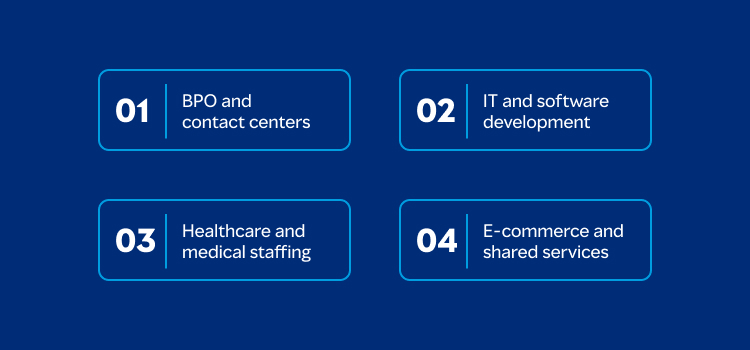
The BPO and IT-BPM industry is the backbone of Philippines employment growth. The BPO industry remains the engine of job creation. The IBPAP 2024 Industry Report notes 1.57 million full-time employees in 2023, with projections exceeding 1.7 million by year-end and nearing 2 million by 2026. English skills, cultural compatibility with Western markets, and lower costs sustain this momentum.
A key change being witnessed in the BPO industry is the shift from basic voice support to higher-value services. Banking, financial services, healthcare, retail, and technology are key demand drivers for more specialized BPO roles in customer experience, analytics, and back-office operations. This raises the bar for technical, communication, and problem-solving skills.
The IT sector is expanding steadily as a software hub. Initiatives by the Department of Information and Communications Technology (DICT) and TESDA focus on coding, cybersecurity, and digital skills, as outlined in the DICT Digital Transformation Plan 2023-2028. Remote projects for international clients boost the need for developers, QA engineers, and cloud experts.
Skills-based hiring dominates here. The World Economic Forum’s Future of Jobs Report 2023 indicates 73 percent of recruiters see skills-first approaches improving hire quality, with 44 percent of skills at risk of disruption in five years. Philippines tech firms prioritize practical assessments over degrees.
Healthcare outsourcing is a fast-growing BPO sub-vertical. Industry analyses link BPO headcount growth to rising demand from healthcare, finance, and retail clients. This includes medical coding, billing, remote nursing support, and clinical documentation.
The global healthcare workload, aging populations, and cost pressures in developed markets all drive more offshoring to the Philippines. For local providers, this means a need for talent with both medical knowledge and strong documentation, compliance, and communication skills.
Shared services and e-commerce back-office roles are proliferating. IBPAP data highlights non-voice growth in finance, HR, procurement, and digital operations supporting global retail and logistics. Remote models enable Philippines teams to manage international workflows seamlessly.
Employers sit at the intersection of high applicant supply and narrow skill requirements. They receive hundreds of applications for many roles, yet still struggle to find candidates who are job-ready. At the same time, remote and offshore models increase complexity in verification, consistency, and speed.
Resume overload: Popular roles in BPO, sales, and entry-level IT attract large volumes of applicants, creating bottlenecks in manual screening and slowing time-to-hire.
Keyword-stuffed CVs: Candidates increasingly tailor CVs to job descriptions, inserting keywords without clear evidence of actual skills or outcomes.
Difficulty identifying real skills: Traditional filters like GPA or job titles do not reliably predict performance, especially in high-volume, skill-based roles.
Theory-heavy education: Many degrees still emphasize theoretical learning rather than applied projects and industry tools, which limits graduates’ job readiness.
Lack of practical, role-ready skills: PSA survey shows that many fresh graduates enter unemployment because they cannot immediately match available roles.
Rapidly evolving skill requirements: WEF report shows that about 44 percent of workers’ skills will be disrupted within five years, as automation and digitization change job content.
BPO and sales churn: Customer service and sales roles traditionally have some of the highest turnover, driven by workload, stress, and misalignment between expectations and reality.
Impact on customer experience: High churn disrupts service continuity, erodes customer relationships, and forces constant retraining of new hires.
Over-reliance on alma mater reputation: Employers often use the school’s name or course as a proxy for ability, which can disadvantage capable candidates from less-known institutions.
Accent and communication bias: In BPO and client-facing roles, accent and surface-level fluency can overshadow deeper skills like empathy, problem-solving, and domain knowledge.
Inconsistent interviewer standards: Unstructured interviews vary by interviewer and often fail to consistently predict on-the-job performance.
Manual screening: Teams spend significant time reading resumes and screening, which slows response times and increases drop-off.
Multiple interview rounds: Traditional processes with serial interviews for each stakeholder extend hiring timelines and frustrate candidates.
Delayed business outcomes: Open roles reduce productivity and delay launches, customer onboarding, or service expansion, especially in rapidly scaling teams.
Verifying candidate authenticity: Remote recruitment limits in-person checks, raising risks around identity misrepresentation and inflated experience.
Assessing work ethic remotely: Managers struggle to evaluate reliability, focus, and accountability before candidates join distributed teams.
Risk of fraudulent profiles: The growth of online talent platforms has also increased fake credentials and proxy test-taking, which can weaken trust in remote hiring.

A poor hiring decision is not just a talent problem. It is a business problem with clear financial and strategic consequences.
Cost of a bad hire: Various studies have shown that pre-employment tests result in hiring success and a significant drop in hiring costs, implying sizable waste when hiring decisions go wrong.
Productivity loss: Underperformers drag team output and require extra supervision. Employees who pass validated tests tend to be more productive.
Training and rehiring expenses: When early attrition occurs, companies pay twice; once for initial training and onboarding, and again for the next hire’s ramp-up.
Employer brand damage: Frequent turnover, poor role fit, and inconsistent evaluation processes can hurt a company’s reputation among candidates and clients.
Traditional methods struggle when application volumes grow, and skills evolve quickly. Key reasons it falls short when hiring at scale are:
Resume-led filtering: Resumes emphasize past experience and credentials, which do not always predict future performance, especially in changing roles.
Unstructured interviews: Unplanned, conversational interviews are prone to bias and are less predictive than standardized evaluations.
Lack of predictive insights: Without data on how candidate traits link to performance, decisions rely on intuition instead of evidence.
Pre-employment assessments are standardized tests or simulations used to measure job-relevant skills, abilities, and behaviors before making hiring decisions. They move the focus from “what is on the CV” to “what the candidate can actually do.”
They are at the heart of assessment-based hiring, which contrasts with traditional resume-led hiring.
| Dimension | Resume-based hiring | Assessment-based hiring |
|---|---|---|
| Primary filter | Education, past job titles, tenure | Skills, cognitive ability, behaviors, job simulations |
| Bias risk | High; relies on school, brand names, and subjective impressions | Lower; standardized scoring and job-related content |
| Predictive validity | Often weak; credentials alone do not predict performance well | Higher; validated tests can improve hiring success by up to 90 percent |
| Scalability | Manual and slow for high-volume roles | Automated and scalable across large applicant pools |
Modern assessment platforms typically combine several test types to create a holistic view of each candidate.
Cognitive ability/aptitude tests: Measure reasoning, problem-solving, and learning speed, which are strong predictors of job performance across roles.
Technical and role-specific skill tests: Evaluate coding, tools, domain knowledge, and practical execution in tasks that mirror the job.
Behavioral and personality assessments: Explore work style, preferences, and behavioral tendencies that influence team fit and retention.
Situational judgment tests (SJTs): Present realistic work scenarios and ask candidates to choose or rate responses, revealing decision-making and judgment.
English and communication assessments: Check listening, reading, writing, and speaking skills, particularly critical for BPO, sales, and client-facing roles.
Thoughtful use of assessments can help Philippines employers respond to volume, skills gaps, and remote hiring needs, while keeping the candidate experience positive.
Automated screening: Platforms can automatically rank candidates based on test performance, cutting down manual CV review and freeing recruiters to focus on high-potential profiles.
Focus on top-performing candidates: Score-based shortlists highlight applicants with the right skills and potential, not just polished resumes.
Practical, role-based testing: Work samples, coding challenges, and simulations show how candidates handle real tasks, reducing reliance on self-reported skills.
Reduced false positives: Objective scoring lowers the chances of hiring candidates who interview well but lack the depth needed on the job.
Identifying stability and motivation: Behavioral and attitude assessments help flag candidates who are more likely to stay, cope with stress, and align with the company’s culture.
Predicting long-term performance: Studies link validated personality and aptitude tests to improved retention and training completion rates.
Standardized evaluation: Consistent test content and scoring reduce subjective differences between interviewers and sites.
Merit-based selection: Skills-first hiring is gaining traction across the Philippines, with global data showing 81% of employers use skills-based hiring in some form.
Fewer interview rounds: With reliable assessment data upfront, organizations can streamline interviews to focus on final fit and stakeholder alignment.
Faster hiring cycles: Pre-employment tests can cut time-to-hire while lowering hiring costs.
Proctored assessments: Remote proctoring and browser monitoring reduce cheating risks and improve trust in remote evaluations.
Identity verification: ID checks, selfie verification, and audit logs help confirm candidate identity.
Anti-cheating technology: Question randomization, time limits, and analytics help detect suspicious behavior.

For Philippines employers, a balanced assessment stack often works best. Listed below are some of the assessments that can be used for hiring in the Philippines:
English fluency and listening tests: Evaluate pronunciation, comprehension, and conversational skills critical for global customers.
Customer interaction simulations: Simulate live chats or calls to assess empathy, de-escalation, and problem-solving in real time.
Stress tolerance assessments: Measure resilience and coping style for high-volume, high-pressure contact center environments.
Coding challenges: Test language-specific skills, debugging, and algorithmic thinking in realistic environments.
Logical reasoning tests: Gauge general analytical ability and capacity to learn new frameworks and tools.
System design scenarios: Assess architecture thinking, trade-off decisions, and scalability awareness for senior roles.
Knowledge validation: Verify understanding of medical terminology, procedures, and documentation standards.
Compliance-focused testing: Ensure awareness of data privacy, patient safety, and regulatory requirements in healthcare BPO work.
Decision-making scenarios: Use case-based questions to evaluate judgment in clinical and non-clinical situations.
Persuasion and negotiation tests: Measure influencing skills, objection handling, and closing style.
Personality and motivation assessments: Identify drive, competitiveness, and alignment with performance-based environments.
Remote work readiness tests: Evaluate self-management, digital collaboration, and comfort with asynchronous communication.
Time management and accountability: Scenarios and behavioral questions highlight how candidates plan, prioritize, and report in remote setups.


Choosing the right talent assessment platform is strategic, not just a procurement decision. Some critical things to look out for when deciding on an assessment platform are:
Misconceptions still hold some companies back from using assessments fully.
The future of hiring in the Philippines is skills-first, digital, and data-driven.
Employers in the Philippines face a complex mix of high application volumes, skills gaps, attrition risks, and remote hiring challenges. Traditional, resume-led hiring methods struggle under this pressure and often produce inconsistent outcomes.
Pre-employment assessments offer a practical, evidence-based way to improve hiring accuracy, reduce bias, shorten time-to-hire, and strengthen retention. As skills-based hiring and AI-driven assessment become standard, organizations that adopt assessment-led hiring now will gain a lasting competitive edge in attracting, selecting, and growing Filipino talent for the future of work.
Originally published February 13 2026, updated February 26 2026

Aniket is a digital growth strategist specializing in SEO and content strategy for the hiring and assessment space. He combines technical SEO, automation, and search intent intelligence to drive qualified B2B demand across global markets.
Talent acquisition is all about strategizing for sourcing, hiring, and retaining the talent an organization needs. This blog offers more insights on the topic.


Thanks for submitting the comment. We’ll post the comment once its verified.








 Behavioral Competencies
 Cognitive Competencies
 Coding Competencies
 Domain Competencies










Would you like to comment?