

Remote hiring has moved from an experiment to the default mode for many organizations in Singapore, especially for roles where digital skills and agility are crucial. As hiring teams shift technical tests, coding challenges, and cognitive assessments online, one question keeps surfacing – can we really trust the results of remote exams enough to make critical hiring decisions?
This is not just a technology problem; it is a business risk. When the integrity of assessments is compromised, organizations risk bringing the wrong talent into critical roles, damaging team performance, and eroding trust in data-driven hiring. In a market where AI literacy and digital capabilities are scarce and highly contested, ensuring that every online assessment truly reflects a candidate’s own capabilities is now a strategic necessity, not a compliance box-tick.
AI-powered proctoring is emerging as a central pillar of online assessment security, offering a scalable, data-driven way to protect exam integrity without overwhelming recruiters or candidates.
In Singapore, where AI adoption in hiring is rapidly accelerating, AI proctoring is becoming a key enabler of fair, secure, and efficient remote hiring.
Singapore’s employers are already embracing AI and digital tools across the hiring lifecycle. A recent ManpowerGroup survey found that more than four in five organizations in Singapore (82%) are already using AI in hiring, onboarding, or training, above both the regional (81%) and global (67%) averages. This momentum has naturally extended to assessments, where online tests and simulations now sit at the core of many recruitment processes.
The rise of remote work and global talent strategies further accelerates this shift. Singapore’s large enterprises increasingly look beyond national borders for AI and digital talent, with half of major firms reportedly open to global hiring for AI roles. Online, proctored assessments make it possible to evaluate candidates in India, Vietnam, or Europe with the same rigor applied to local applicants, while keeping processes consistent and scalable.
While the migration to online assessments has clear efficiency and reach benefits, it also introduces new integrity challenges. The research ‘The Impact of Remote Online Proctoring versus No Proctoring: A Study of Graduate Courses,’ by Jill Oeding, Theresa Gunn and Aleisha Jones, has shown that candidates often perceive greater opportunities to cheat in online exams compared to traditional in-person tests, and some are more willing to exploit that perceived flexibility. Without effective controls, remote assessment environments can enable unauthorized collaboration, using external resources, or even impersonation.
For employers, the risk is straightforward but serious. If a candidate can cheat in an assessment for a data science, cybersecurity, or AI role, the organization is effectively basing a high-stakes hiring decision on corrupted data. This not only affects immediate role fit but also undermines strategic workforce planning, diversity efforts, and the credibility of AI-based assessment programs internally.
AI-assisted proctoring offers an answer to these challenges by combining advanced monitoring with intelligent risk detection to secure online exams at scale. Unlike traditional human-only invigilation, AI proctoring continuously analyzes video, audio, and behavioral signals to flag suspicious patterns in real time or for later review.
This approach is particularly valuable in Singapore’s context, where organizations are rapidly ramping up AI usage in recruitment but must also comply with stringent data protection and fairness expectations. An ETHR World SouthEast Asia article highlights that 64% of recruiters in Singapore believe AI supports fairer hiring decisions through more standardized evaluations, with 70% planning to increase AI use for pre-screening and evaluations. AI proctoring sits naturally in this stack, bringing consistency, auditability, and scalability to assessment integrity.
AI proctoring refers to the use of artificial intelligence to monitor and secure online exams, either completed through AI or in combination with human invigilators. Instead of relying solely on a person watching multiple live feeds, AI systems continuously scan video streams, audio, screen activity, and behavioral data to detect anomalies that may indicate cheating or rule violations.
Mercer Assessments, for example, combine AI-based and manual proctoring to offer comprehensive assessment credibility. This is further integrated with AI monitoring with secure browser technology and multi-level authentication.
The AI can automatically flag events such as multiple faces in the frame, frequent screen switching, the use of mobile phones, or suspicious gaze patterns, which are then reviewed by human experts if needed.
Modern AI proctoring solutions typically include a combination of the following features:
Together, these features transform remote exam proctoring from a passive monitoring exercise into an active risk-detection and prevention layer.
Types of proctoring: Automated, live, and hybrid
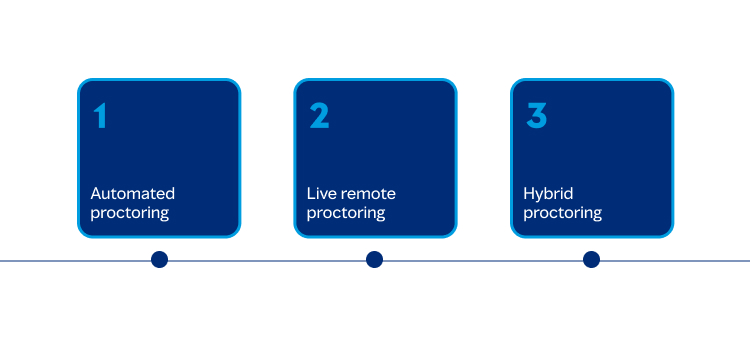
AI proctoring solutions are usually offered in three main models, allowing organizations to align security, cost, and candidate experience:
Automated proctoring
Live remote proctoring
Hybrid proctoring
For organizations building a remote hiring strategy in Singapore, hybrid proctoring often provides the best trade-off between security, cost, and flexibility.
The risks of cheating in online assessments are not theoretical. Research has repeatedly found that candidates believe it is easier to cheat in online environments and, in some cases, are more willing to do so when they feel opportunities exist. A study comparing proctored and unproctored online exams reported clear evidence that cheating was occurring in unproctored settings, and that proctoring helped reduce, though not completely eliminate, such behavior.
When cheating goes undetected, organizations are effectively rewarding rule-breaking and penalizing honest candidates. This undermines the very purpose of pre-employment testing, which is to predict job performance and cultural fit based on merit. A research on remote intelligence testing notes that proctoring is introduced precisely to ‘ensure that the test was completed independently and without impermissible aids,’ as cheating otherwise threatens the validity of test scores.
The reputational impact is equally significant. As Singaporean employers increasingly publicize their use of AI and data to enable fairer hiring, inconsistency in assessment integrity can erode trust among candidates, employees, and regulators. With 64% of recruiters in Singapore believing AI supports fairer decisions, failing to secure assessments can create a mismatch between brand promise and on-the-ground reality.
Singapore’s regulatory environment heightens the importance of trustworthy, compliant online proctoring software. The Personal Data Protection Act (PDPA) governs the collection, use, and disclosure of personal data and aims to ‘increase consumer trust and strengthen Singapore’s position as a trusted global data hub.’ Under PDPA, organizations must collect data for purposes that a reasonable person would consider appropriate and ensure safeguards for sensitive information like video recordings and biometric identifiers.
The Personal Data Protection Commission (PDPC) can investigate non-compliance and impose financial sanctions of up to SGD 1 million for serious breaches. For AI proctoring in Singapore, this means providers and employers must design processes that are privacy-by-design, transparent in how monitoring works, and careful in how long video, audio, and biometric data are retained and processed.
Solutions that can demonstrate international certifications (such as ISO 27001, ISO 9001, SOC 2, or GDPR-aligned practices) are better placed to meet both local expectations and global audit requirements.
Mercer Assessments’ AI proctoring capabilities are built specifically to address integrity, scale, and compliance challenges in remote hiring. The platform combines AI-based and manual proctoring, a secure browser, and multi-level authentication to deliver credible, secure, and globally deployable online assessments.
Mercer Assessments uses AI-driven monitoring to detect suspicious activities such as additional faces in the frame, use of mobile devices, and tab switching, alongside secure browser controls that lock down the candidate’s system. By pairing AI-based detection with trained human proctors, the platform strengthens fraud prevention and reduces false positives that could otherwise frustrate candidates.
This multi-layered approach aligns with best practices highlighted in other AI proctoring solutions used in Singapore, such as AI-powered monitoring of facial activity, device use, and tab switching, combined with live or recorded review. The result is a robust remote exam proctoring environment that substantially raises the cost and difficulty of cheating, while improving the credibility of exam results for hiring teams.
AI proctoring is inherently designed for scale. Automated monitoring allows a single solution to handle thousands of concurrent sessions, with AI flagging only a subset that requires human review. This is critical in the Singapore context, where 70% of recruiters report plans to increase AI use for pre-screening and early-stage evaluations.
Also, Mercer Assessments’ integration capabilities with major ATS and LMS platforms enable organizations to embed secure assessments directly into their remote hiring workflows. For high-volume campus hiring, off-cycle tech recruitment, or global role searches, this means consistent security standards regardless of geography or time zone.
One of the common criticisms of traditional remote proctoring is that it can feel intrusive and uncomfortable for candidates. Mercer Assessments’ approach focuses on creating a seamless candidate experience by:
By combining clear communication with unobtrusive technology, Mercer Assessments helps organizations protect exam integrity without adding friction that could deter top talent.
The combination of high demand for AI and digital skills, growing reliance on online assessments, and stringent data protection expectations creates a unique environment where security, fairness, and candidate experience must all be managed in tandem.
AI-assisted proctoring offers a practical way to achieve this balance. By blending AI-based monitoring, secure browser technology, multi-level authentication, and strong data privacy safeguards, organizations can confidently use remote exam proctoring to make better, fairer hiring decisions at scale. For HR and TA leaders designing their next-generation remote hiring in Singapore strategy, investing in AI proctoring is now foundational to building a trusted, future-ready assessment ecosystem.
Originally published March 31 2026, updated March 31 2026

Talent assessment is a structured process employers use to identify the most suitable job candidates. This test may comprise various questions, job simulations, etc., that employers can use to assess an applicant’s performance and competency for a particular role.


Thanks for submitting the comment. We’ll post the comment once its verified.








 Behavioral Competencies
 Cognitive Competencies
 Coding Competencies
 Domain Competencies









Would you like to comment?