

Singapore’s talent wars are intensifying. As digital transformation accelerates across tech, finance, healthcare, and manufacturing, employers face a stark reality: traditional degree-focused hiring cannot keep pace with the speed of change or the depth of skills required. With unemployment at low rates and companies reporting talent shortages, the pressure to find capable workers has never been higher.
Skill-based hiring in Singapore represents a fundamental shift. Rather than screening candidates by their degrees or years of experience, this approach uses talent assessment tools to identify people who can actually perform the job from day one while demonstrating potential to grow.
For organizations serious about staying competitive, moving beyond degree-based hiring is no longer a nice-to-have; it’s table stakes for building future-ready teams.
This shift is especially important in Singapore, where a tight labor market, rapid technological change, and ambitious national upskilling programs are redefining what effective hiring looks like. For employers that want to build resilient, future-ready teams, moving beyond degree-based screening toward skill-focused evaluation is a strategic imperative.

Skill-based hiring is a talent strategy that prioritizes demonstrated skills, capabilities, and potential over traditional proxies such as degrees, alma mater, or years in a previous role. In practice, it relies on tools like structured talent assessment solutions, skills testing, work samples, and pre-employment tests to evaluate whether candidates can perform the real tasks required in a job.
Instead of filtering applicants by rigid criteria, for instance, ‘must have a bachelor’s degree in computer science,’ employers define the core competencies that drive success in the role to assess applicants. This approach aligns closely with the global trend of employers using some form of skills-based hiring to improve the quality of hires.
The difference from traditional hiring approaches is profound. Conventional hiring often uses resumes and interviews to infer ability; skill-based hiring uses data from structured assessments to verify it. It also opens doors for candidates with non-linear career paths, mid-career switchers, and those who have built expertise through bootcamps, online learning, or on-the-job experience rather than formal degrees.

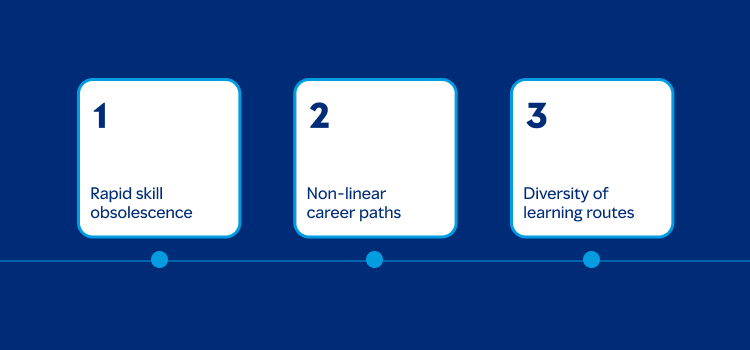
Three forces make skills the new currency of talent:
For employers in Singapore, this means skills-based hiring is the most progressive and practical way forward. It also widens talent pools by 19% while improving hire quality, according to LinkedIn’s report.
Singapore’s labor market remains tight and competitive. The Ministry of Manpower’s 2025 advance release shows that resident employment continued to grow, unemployment stayed low at around 2.9%, and job mobility remained healthy, even as global conditions softened. At the same time, 83% of employers in Singapore now report difficulty finding the skilled talent they need as per the ManpowerGroup’s 2025 survey, up from 79% a year earlier and double the figure in 2019. This makes the hiring solutions Singapore companies choose critically important.
The skills gap is one of the biggest drivers of this tension. ManpowerGroup’s 2025 survey also highlights that talent shortages are most acute in sectors such as Transport, Logistics and Automotive (91% reporting difficulty), Communication Services (90%), and Information Technology (88%), where digital skills and complex problem-solving are essential. Employers are responding by prioritizing workforce upskilling Singapore initiatives: 39% say they are focusing on upskilling and reskilling current employees, 28% are increasing wages, and 27% are targeting new talent pools to address the scarcity.
Digital transformation and Industry 4.0 are at the heart of these shifts. As per Singapore’s Infocomm Media Development Authority (IMDA), the tech sector now contributes roughly 17.7% to the country’s GDP and offers salaries about 1.5 times the median wage. As per the Singapore Fintech Talent Report 2025, demand for AI and data science roles is estimated to have risen by around 40%, while cybersecurity roles are growing by about 45%. Leading the government to set a goal of tripling the number of AI practitioners to 15,000 over the next five years. Finance, healthcare, logistics, and advanced manufacturing are experiencing similar pressures as they digitize operations and adopt new technologies.
These dynamics make it clear that hiring based solely on degrees or prior job titles is increasingly misaligned with reality. Job roles are evolving faster than traditional education pathways, and employers who continue to screen out nontraditional candidates risk shrinking their own talent pools.
Skill-based hiring Singapore strategies help solve this by focusing squarely on capabilities, potential, and readiness for change.

Skill-based hiring directly improves the match between role requirements and candidate capabilities. Globally, it has been seen that organizations using pre-employment tests and structured skills testing are significantly more likely to report high quality of hire and strong employee performance compared with those relying on resumes and unstructured interviews alone. In Singapore’s context, where 83% of employers face talent shortages, being able to confidently identify candidates who can ‘hit the ground running’ is a major advantage.
Better fit often translates into lower turnover. When people are hired for roles that align with their strengths and learning potential, they onboard faster, feel more engaged and are less likely to leave within the first year. This is crucial in a market where replacement costs are high and specialized skills are scarce, particularly in IT, logistics, and highly regulated industries such as finance and healthcare.
Skill-based hiring supports diversity hiring efforts by widening the aperture on who is considered ‘qualified.’ The Ministry of Manpower’s Job Vacancy Survey found that 74.9% of employers are now willing to consider applicants based on skills and experience rather than only academic qualifications, up from 73.6% in 2022. This shift helps candidates from polytechnics, ITE, midcareer switchers, and returning caregivers compete on a more level playing field.
By reducing reliance on pedigree and focusing on demonstrable ability, companies can tap underrepresented talent pools such as older workers retraining for new careers, individuals from lower-income backgrounds leveraging Skills Future programs, or professionals moving across industries. This not only strengthens inclusion but also improves business resilience, as diverse teams are consistently linked to better problem-solving and innovation outcomes in global research.
Traditional hiring processes can be slow, especially when large volumes of applications need to be manually screened. In a market where 38% of companies still plan to increase hiring for technical roles in 2025 despite budget pressures, speed is a differentiator. Skill-based hiring powered by structured talent assessment platforms in Singapore allows organizations to automate early screening through online tests, scenario-based tasks, and job-relevant simulations.
Candidates appreciate this clarity. Instead of wondering whether their CV will pass an arbitrary filter, they understand exactly what is being measured and can demonstrate their abilities directly through skills testing and pre-employment tests. Well-designed assessment journeys that are mobile-friendly, time-efficient and transparent, create a better candidate experience and reinforce the employer brand, even for applicants who are ultimately not selected.
Singapore’s SkillsFuture movement has reshaped how the country thinks about education and work. The SkillsFuture Credit (Mid-Career) program, launched in May 2024, provides S$4,000 to every Singaporean aged 40 and above to fund reskilling and upskilling. Engagement is rising fast: 260,000 Singaporeans used their SkillsFuture Credit in 2024, a 35% increase from 192,000 in the previous year, and 86% of individuals who attended SkillsFuture-funded training reported improved performance at work.
From an employer’s perspective, skill-based hiring dovetails naturally with this ecosystem. As Skills Future Career Transition Programs expanded from 179 in 2023 to 239 in 2024, more mid-career professionals are re-entering the market with new capabilities built through competency-based training.
Organizations that adopt this hiring solution in Singapore, which is centered on skills, are better positioned to recognize and absorb this newly skilled talent, strengthening Singapore’s upskilling goals while meeting their own business needs.

Mercer Assessments helps organizations operationalize skill-based hiring by providing a comprehensive suite of talent assessment tools, skills testing platforms, and pre-employment tests tailored to modern roles. Its library spans cognitive ability tests, domain-specific skills assessments (for example, coding, finance, sales, and customer service). It also provides language and communication evaluations, as well as personality and behavioral instruments designed for selection and development.
For Singaporean employers, one of the biggest strengths is customization. Assessments can be mapped to local job families and skills frameworks, ensuring that test content reflects the competencies actually required in the Singapore market, whether for technology roles in the digital economy, regulatory-heavy positions in finance, or patient-centric roles in healthcare. This enables HR teams to design role-specific test batteries that combine technical skills, cognitive ability, and behavioral fit into a single, coherent hiring solution.
Integration is another critical element. Mercer Assessments’ platforms can plug into common applicant tracking systems and HRIS tools, allowing assessment data to flow seamlessly into existing hiring workflows. Recruiters can initiate skills testing and pre-employment tests directly from their ATS, receive consolidated reports, and move candidates between stages without manual effort, which shortens recruitment cycles and reduces administrative load.
By combining local insight, a broad assessment library, and strong integration capabilities, Mercer Assessments positions itself as a strategic partner for organizations that want to move decisively toward skill-based hiring practices.
Singapore’s labor market will remain dynamic and demanding. Employers are contending with persistent talent shortages, rapidly evolving job roles, and an economy that is doubling down on digital innovation and lifelong learning. Traditional degree-based hiring simply cannot keep pace with this complexity, especially when it shuts out capable candidates whose skills have been built through non-linear paths.
Skill-based hiring offers a more precise, inclusive, and future-ready alternative. By anchoring decisions in a talent assessment solution, Singapore-based organizations can improve the quality of hire, accelerate recruitment, support diversity hiring goals, and align more closely with Singapore’s upskilling initiatives.
Originally published February 5 2026, updated February 5 2026

Talent assessment is a structured process employers use to identify the most suitable job candidates. This test may comprise various questions, job simulations, etc., that employers can use to assess an applicant’s performance and competency for a particular role.


Thanks for submitting the comment. We’ll post the comment once its verified.





 Behavioral Competencies
 Cognitive Competencies
 Coding Competencies
 Domain Competencies









Would you like to comment?