

Organizations are now operating in a dynamic, skill-driven, and employee-centric talent environment. This environment, along with rapid technological changes, has resulted in an increasing skills gap, making talent management a strategic priority and not just an HR function.
Most forward-looking organizations are rethinking how they attract, develop, engage, and retain talent to stay competitive. This blog explores what a talent management strategy really means today, why it matters, and the top talent management practices organizations should focus on in 2026.

A talent management strategy is a structured, long-term approach that is used for attracting, developing, engaging, and retaining employees in alignment with business goals. It goes beyond individual HR processes and connects workforce decisions to organizational priorities.
An effective talent management strategy typically covers the entire employee lifecycle, starting from workforce planning, to hiring, onboarding, performance management, learning and development, succession planning, and retention. The primary goal of a talent management strategy is to ensure the organization has the right people, with the right skills, in the right roles, at the right time.
In 2026, talent management strategies are set to become increasingly skills-based, data-driven, and personalized. Most organizations will be shifting from static job roles toward dynamic skill portfolios, internal mobility, and continuous development.
Implementing strong talent management practices is no longer optional. It is essential for business resilience and growth. Here’s why organizations must invest in structured talent management initiatives:
As new technologies, such as AI, continue to reshape jobs and the skills landscape, organizations need visibility into current and future skill requirements. Talent management helps identify skill gaps early and build capabilities proactively.
Employees are more likely to stay at an organization when they see clear career paths, development opportunities, and receive recognition. Effective talent management best practices directly impact both engagement and attrition.
Succession planning and leadership development are an integral part of talent management. They ensure continuity in critical roles and reduce dependency on external hiring.
When talent decisions are aligned with strategy, organizations can respond more quickly to market changes, expansion plans, or transformation initiatives.
Data-driven talent management strategies help organizations prioritize roles, skills, and initiatives that deliver the highest business impact.
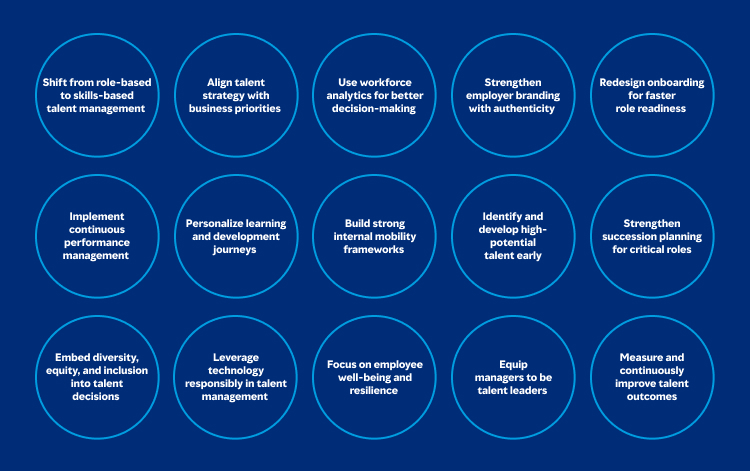
Below are the most effective talent management strategies organizations should focus on in 2026, based on evolving workforce realities and business needs.
Skills are now more valuable than static job titles. This has led to leading organizations mapping skills across the workforce and using them to guide hiring, development and internal mobility decisions.
Skills-based talent management initiatives allow organizations to deploy talent more flexibly and prepare for future roles that may not yet exist.
Talent management strategies should be directly linked to organizational goals such as growth, digital transformation or cost optimization. This requires close collaboration between HR and business leaders to define critical roles and capabilities.
Without this alignment, talent initiatives risk becoming disconnected from real business needs.
Data and analytics play an important role in modern talent management best practices. Organizations are leveraging it to predict attrition, assess readiness for key roles, and measure the effectiveness of talent programs.
Employees in 2026 value transparency and purpose. Employer branding should reflect real employee experiences, not just aspirational messaging.
Authentic storytelling, employee advocacy, and clear communication about growth opportunities are critical talent management strategies for attracting the right talent.
Effective onboarding is a key part of the employee journey and is no longer a one-week process. Organizations are designing structured onboarding journeys that extend over the first 90 days and focus on performance, culture, and connection. This improves productivity, engagement, and early retention.
Annual performance reviews are being replaced by ongoing feedback, coaching, and goal alignment. Modern talent management practices emphasize frequent check-ins and real-time performance insights. This approach supports agility and continuous improvement.
Employees now expect development opportunities tailored to their roles, skills, and career aspirations. In 2026, learning platforms will increasingly use data and assessments to personalize learning paths.
Targeted development is a core component of effective talent management initiatives.
Internal mobility helps organizations retain talent while filling roles faster and at lower cost. Clear career pathways, internal job marketplaces, and transparent skill requirements enable employees to move across roles and functions.
This is one of the most impactful talent management best practices for retention.
High-potential identification should be based on data, not just manager nominations. Assessments, performance trends, and behavioral indicators help identify future leaders more objectively.
Structured development programs ensure this talent is ready when needed.
Succession planning in 2026 goes beyond leadership roles. Organizations are identifying successors for critical technical and niche positions as well. Robust succession planning reduces risk and ensures business continuity.
DEI is most effective when embedded into everyday talent management strategies, not treated as a separate initiative. Fair hiring, unbiased assessments, and equitable development opportunities build stronger organizations. Inclusive talent practices also enhance innovation and decision-making.
AI and digital tools are increasingly being used for hiring, assessments, and workforce planning. However, responsible use is critical. Organizations must ensure transparency, fairness, and data privacy. Trust is a key pillar of sustainable talent management initiatives.
Burnout and stress remain major concerns in 2026. Talent management practices must include well-being, flexibility, and psychological safety , as organizations that support holistic well-being see higher engagement and performance.
Managers play a critical role in executing talent management strategies. Investing in manager capability building ensures better feedback, development conversations, and team engagement. Strong managers amplify the impact of all talent initiatives.
Effective talent management strategies are continuously reviewed and refined. Organizations should track metrics such as time-to-productivity, internal mobility rates, engagement scores, and leadership readiness. Regular evaluation ensures talent investments deliver measurable business value.

In 2026, talent management is no longer about isolated HR programs. It is a strategic, data-driven, and human-centered discipline that directly influences business success.
Organizations that adopt modern talent management strategies, follow proven talent management best practices, and invest in integrated talent management initiatives will be better positioned to navigate uncertainty, build future-ready capabilities, and create meaningful employee experiences in 2026.
The most successful organizations will be those that treat talent not just as a resource, but as a long-term strategic advantage.
Originally published January 22 2026, Updated January 22 2026

Harsh Vardhan Sharma, with 6 years of content writing expertise across diverse B2B and B2C verticals, excels in crafting impactful content for broad audiences. Beyond work, he finds joy in reading, traveling, and watching movies.
Talent assessment is a structured process employers use to identify the most suitable job candidates. This test may comprise various questions, job simulations, etc., that employers can use to assess an applicant’s performance and competency for a particular role.


Thanks for submitting the comment. We’ll post the comment once its verified.








 Behavioral Competencies
 Cognitive Competencies
 Coding Competencies
 Domain Competencies

















Would you like to comment?