
The world of work is changing faster than ever. Automation, AI, and technological disruptions are rewriting how teams operate, how decisions are made, and what employers value in their people. In this kind of environment, companies no longer want employees who simply follow a job description. They look for people who can adapt, think on their feet, and create value in situations that may lack a ready-made answer.
In 2026, interview conversations will move beyond ‘What degree do you have?’ or ‘How many years of experience do you have?’ Employers will pay closer attention to how someone learns, how they use technology, and how they respond when things change without warning. They will lean towards professionals who stay curious, work confidently with AI and digital tools, and bring sound judgment to complex, human situations.
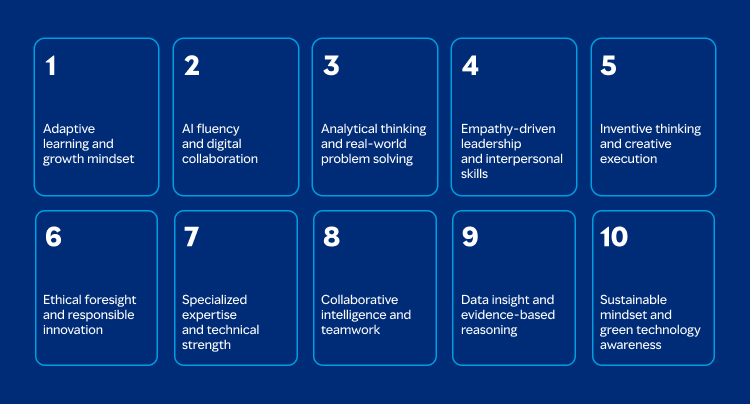
This shift affects everyone. Businesses will seek those who can do high-quality technical work while also thinking creatively and making responsible decisions. It won’t matter whether someone works in design, data science, or leadership; what will matter is the ability to solve problems well, bring fresh ideas to the table, and consider the impact of their work. The ten skills below capture this new expectation. They reflect the practical abilities that will shape strong teams, innovative companies, and careers that stand the test of time.

Businesses will look for experts who can navigate volatility and promote advancement by combining human insight with technological know-how. Highly skilled professionals detect issues early and readily embrace new technology, successfully solving complex problems. They build strong trust with people from diverse backgrounds and cultures and act with strong moral principles. Their deep understanding and expertise in their own field are their key strengths, and their interdisciplinary skills enable them to perform even better. They use data to guide their choices, but they also consider the long-term effects on people, businesses, and the environment.
These skills can’t be measured solely by degrees. They reflect how someone works, thinks, and leads. The sections ahead break down each skill and offer practical, actionable steps for teams and organizations to build them intentionally.
The professionals who develop an adaptive learning and a growth mindset can survive in a constantly changing environment. They show enthusiasm and rapid adoption of new information. They are optimistic and believe that challenges are tools for improvement rather than roadblocks. The skill is cherished in businesses because it helps companies quickly adjust to changes driven by AI. In practice, adaptive learning and a growth mindset play out differently across roles. Some of the examples are:
Individuals can develop this skill by taking up one area they are not familiar with every quarter. This involves real projects with real-time applications. This helps individuals get feedback from mentors to improve their ways.
Professionals who have expertise in AI fluency and technology collaboration can effortlessly work with intelligent systems to enhance productivity and tackle complex issues. They work with AI systems as an addition to their skills, rather than as alternatives, and make queries with the purpose of maximizing results. Businesses require this skill to accelerate decision-making and innovation in rapidly changing industries. Across departments, AI fluency translates into faster decisions and more collaborative ways of working. Some of the examples include:
Professionals who improve their critical thinking and problem-solving skills to analyze issues, identify hidden patterns, and deliver results-oriented solutions are essential. The skill is in high demand because it differentiates capable leaders from those who are confused by information overload and unclear situations. This capability is demonstrated through how different roles apply analysis to real-world challenges.
People can improve this skill through organized exercises. They can solve case studies from different sectors. Debate sessions among groups for actual business-related puzzles can also improve logical skills. Monitoring success rates from previous predictive endeavors helps them strengthen their intuitions for upcoming challenges.
Professionals who have the ability to provide empathy-based leadership and people skills by effectively leveraging emotional currents and persuasive guidance to drive team achievement are an important part of the team. The skill involves active listening, validating ideas, and resolving conflicts impartially. Businesses value the skill because mere technical expertise is insufficient to foster business loyalty. In workplaces, empathy-driven leadership shapes how professionals respond to human dynamics. For example:
People develop this strength through practice. They can set up a series of weekly one-on-one sessions to practice listening without interrupting. This creates the skill of delivering critical feedback through role-playing with others.
Professionals leverage their creative thinking and execution skills to develop innovative solutions and turn them into real-world products. They tend to think unconventionally and work on prototypes and iterations based on honest feedback. Corporations are chasing these skills to outdo their competitors in highly saturated markets. This skill comes to life through how different roles translate ideas into action. Some of the examples include:
Professionals must exercise ethical foresight and innovation to anticipate the ripple effects of technologies and develop solutions aligned with ethics and sustainability. This skill is what companies need to manage risks and comply with new regulations and technological developments related to consumer trust. Its importance becomes evident in how organizations embed ethics into everyday systems and processes. Some of the examples are:
Professionals must develop deep expertise by delving into their areas of interest and expanding the boundaries they set for themselves in their respective fields. Companies hire experts to solve problems beyond the limits of generalists. Different fields require this skill to be applied at varying levels of technical depth. Some of the examples are:
Writing case analysis or working on open-source projects validates and extends existing knowledge.
Professionals who mobilize collective intelligence and teamwork by removing silos, integrating diverse expertise, and achieving results together, grow far beyond what can be accomplished alone. This is a strength to any business, as interdependent problems require coordinated responses. Collaborative intelligence and teamwork take shape through role and team-based applications. Some of the examples are:
Teams can increase the power of collaboration through rituals. Leadership positions can also be rotated to enhance understanding of other functions and gather insights.
Professionals who use their insight and logical reasoning to tease out strategies from massive amounts of data, are the forces behind confident decisions. They carefully clean datasets, present trends attractively, and check conclusions against facts. This is what businesses need -far-sighted distribution and precision in outsmarting uncertainty. Across teams, this skill enables clearer priorities and faster responses. Some of the examples are
This skill is improved systematically. Developing personal dashboards to inform future decisions increases efficiency. Analytical code reviews conducted by peers help improve thoroughness.
Professionals must achieve integration of the sustainable mindset and understanding of green technology by incorporating the concept of eco-efficiency into strategies, operations, and innovation for long-term sustainability on the planet. They should measure environmental impact, explore circular economy concepts, and promote environmentally regenerative approaches. This mindset is reflected in how various functions embed sustainability into everyday decisions. Some of the examples are:
Sustainability activists begin with modest initiatives. Key internal audits help identify easy fixes within an organization.

The professionals who possess the above skills position themselves to become a vital force in the business landscape. Businesses stop looking for people who can perform within a fixed capacity and instead hire employees who can adapt, ensuring innovation, resilience, and integrity in growth.
Individuals take control by comparing their skills to these indicators. They practice regularly, receive exposure to different activities, and track their improvement using concrete results. This attitude of taking control turns uncertainty into an opportunity.
The future rewards the actions of the present. The leaders are professionals with skills in adaptive learning, artificial intelligence, analytics, empathy, creativity, ethics, expertise, collaboration, data knowledge, and sustainability.
Originally published January 22 2026, Updated January 22 2026

Archita Bharadwaj has worked as a Content writer at Mercer | Mettl since April 2023. With her research background, she writes varied forms of content, including blogs, ebooks, and case studies, among other forms.
Skills assessment tests are used in the recruitment process to determine if a candidate possesses the necessary skills (analytical, technical, interpersonal, etc.) to thrive in a job role. Skills assessment tests are an essential component of recruitment today.


Thanks for submitting the comment. We’ll post the comment once its verified.








 Behavioral Competencies
 Cognitive Competencies
 Coding Competencies
 Domain Competencies
















Would you like to comment?