

Globally, higher education systems are producing more graduates than ever before. Despite the increasing number of students graduating every day, employers continue to voice a familiar concern: most struggle to transition smoothly from campus to the workplace. This growing gap between academic achievement and employability has become one of the most pressing challenges for educators, institutions, and employers alike.
Degrees, while important, often fail to tell the full story of a graduate’s readiness for work. Employers find that sometimes a first-class degree or a strong GPA fails to translate into real-world capability.
This is where assessments play a critical role. When designed scientifically, assessments help translate academic learning into job-ready skills. They provide a bridge between education qualifications and employment, making capabilities visible, measurable, and actionable for all stakeholders involved.
Today, employability has become one of the most discussed yet least clearly defined outcomes of higher education. While universities, employers, and students all agree on its importance, they often mean different things when they use the term.
To bridge this disconnect, it is essential to first understand how employability is defined in today’s job market and why employer expectations have evolved beyond traditional academic indicators.
Employability today goes far beyond subject expertise. Employers are looking for graduates who can adapt quickly, apply knowledge in unfamiliar contexts, and contribute productively from early in their careers. An employable graduate is not someone who knows everything, but someone who can learn quickly and perform in real-world situations.
In short, organizations want a graduate who can handle ambiguity, collaborate with diverse teams, and make informed decisions, even when the path forward is not clearly defined.
While technical or domain knowledge remains important, it is rarely sufficient on its own. According to the World Economic Forum’s Future of Jobs Report 2025, skills such as analytical thinking, creative thinking, problem-solving, adaptability, empathy and active listening consistently rank high on employer priority lists. These are the skills that allow graduates to translate what they know into meaningful action.
Digital literacy, data interpretation, and the ability to work alongside technology are also becoming essential, regardless of industry. Importantly, these skills cut across disciplines and cannot be inferred reliably from grades alone.
Traditional academic assessments often reward recall, structured responses, and performance under controlled conditions. While these abilities have value, they do not fully reflect the complexity of workplace challenges. High academic performance does not always equate to strong workplace performance, and employers have learned this through experience.
As a result, organizations increasingly seek additional signals beyond academic transcripts to evaluate graduate readiness.
Closing the employability gap requires more than adding new courses or short-term training modules. It calls for a deliberate alignment between what universities intend students to learn and what employers expect graduates to demonstrate.
This alignment becomes possible when academic outcomes are interpreted into clearly defined, measurable job-ready skills.
Most academic programs already define learning outcomes, but these outcomes are not always explicitly linked to employability. Mapping curriculum goals to real-world skills helps bridge this gap. For example, a learning outcome focused on research can be aligned with analytical thinking, data interpretation, and structured communication.
When institutions make these connections explicit, students gain clarity on how their academic efforts translate into workplace value.
Without structured measurement, skill gaps often remain invisible until graduates enter the job market. Assessments enable institutions to identify where students are excelling and where they are falling short, not just individually, but across cohorts and programs.
This insight allows institutions to take proactive steps rather than reacting to employer feedback after the fact.
Well-designed assessments provide objective, comparable data on skills that are otherwise difficult to measure. They move beyond assumptions and perceptions, offering evidence-based insights into readiness and potential. This data becomes the foundation for meaningful improvement at both the student and institutional levels.
Once employability skills are clearly defined, the next challenge lies in how they are measured. Traditional examinations were not designed to assess real-world readiness, which is why institutions must rethink assessment design.
Purpose-built employability assessments help evaluate not just knowledge, but the ability to apply, judge, and perform in realistic work situations.
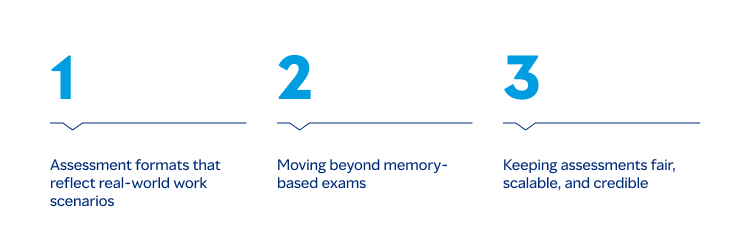
To support employability, assessments must mirror the realities of work. Case studies, simulations, situational judgment tests, group exercises, and scenario-based questions all help evaluate how students apply knowledge in context.
These formats assess not just what students know, but how they think, decide, and act.
Memory-based exams have limitations when it comes to employability. Modern assessments increasingly focus on application, judgment, and problem-solving. They test the ability to analyze information, weigh trade-offs, and arrive at defensible decisions.
This shift encourages deeper learning and better prepares students for the kinds of challenges they will face beyond campus.
For assessments to be effective at scale, they must be fair, unbiased, and psychometrically sound. Standardization, validation, and robust design ensure that results are credible and trusted by students, faculty, and employers alike.
Scalability also matters. Institutions need solutions that can be implemented consistently across programs without compromising quality.
Assessments deliver value only when their results are acted upon. For students, raw scores mean little unless they are translated into clear insights about readiness and growth. Turning assessment data into meaningful skill narratives helps students see how their capabilities align with workplace expectations and where focused development is needed.
Assessment results are most powerful when they are clearly communicated. Students benefit from understanding not just their scores, but what those scores mean in practical terms. Insights into strengths, gaps, and development areas help students take ownership of their growth.
This clarity transforms assessments from abstract evaluations into meaningful feedback.
When positioned correctly, assessments become tools for development rather than judgment. They guide students toward targeted learning opportunities, internships, projects, and experiences that build missing skills.
Over time, this approach fosters a growth mindset and greater confidence as students prepare for the workforce.
Assessment insights are not just valuable for students and employers; they are equally powerful for educators. Assessment data provides faculty with evidence of how effectively programs are building employability skills. These insights enable institutions to move from intuition-based teaching improvements to data-informed curriculum and pedagogy decisions.
Assessment data offers valuable feedback for educators as well. It highlights which skills students are developing effectively and which areas require stronger instructional support. This evidence complements traditional academic metrics.
Looking at results across cohorts reveals patterns that individual evaluations cannot. Institutions can identify systemic strengths and weaknesses, enabling informed decisions about curriculum design and resource allocation.
These insights allow faculty to refine teaching methods, introduce applied learning experiences, and adjust content sequencing. Over time, this creates a virtuous cycle of continuous improvement aligned with employability outcomes.
Mercer Assessments supports institutions in bridging the gap between education and employability through scientifically designed assessment solutions. By measuring cognitive abilities, behavioral traits, and job-relevant skills, Mercer Assessments helps make graduate potential visible and comparable.
Its assessments are designed to reflect real-world requirements while remaining fair, scalable, and credible. Mercer Assessments also provides actionable insights that help institutions align curriculum, enhance teaching effectiveness and support student development.
By embedding assessments across the academic journey, institutions can build a clear, skills-based narrative that benefits students, educators, and employers alike.
The transition from campus to career is no longer a simple handoff. It requires deliberate alignment between what students learn and what the world of work demands. Assessments play a central role in making this alignment possible.
When used thoughtfully, assessments translate academic achievement into employable capability. They help students understand their readiness, enable faculty to improve teaching, and give employers confidence in graduate potential.
Ultimately, they shift the focus from credentials alone to skills that truly matter, creating graduates who are not just qualified but genuinely prepared for the future of work.
Originally published March 25 2026, Updated March 25 2026

Harsh Vardhan Sharma, with 6 years of content writing expertise across diverse B2B and B2C verticals, excels in crafting impactful content for broad audiences. Beyond work, he finds joy in reading, traveling, and watching movies.
Pre-employment tests, also known as pre-hiring tests, are online and offline assessments to ascertain candidate fitment for a particular job role. The assessments can be conducted to measure a candidate's technical skills, aptitude, personality traits or on-the-job behavior.


Thanks for submitting the comment. We’ll post the comment once its verified.








 Behavioral Competencies
 Cognitive Competencies
 Coding Competencies
 Domain Competencies

















Would you like to comment?