 English







HR trends in 2027: What’s shaping the next phase of HR
Summary
Trends in HR are being shaped by developments that are changing established approaches to talent and people management. From decision-making to employee support, these trends indicate where HR practices are gaining relevance and how the function is adapting.
Introduction
HR trends are reshaping how organizations manage talent, enhance employee experience, and make workforce decisions. As new practices emerge, they influence established processes, leadership priorities, and expectations throughout the employee lifecycle. For HR leaders, keeping pace with these developments is vital for assessing current practices, finding opportunities to adapt, and aligning HR strategies with changing organizational needs.
Emerging HR trends every leader should know
HR is prioritizing measurable outcomes, informed decision-making, and responsiveness to workforce needs. The trends below show how these priorities drive new approaches across the HR function.
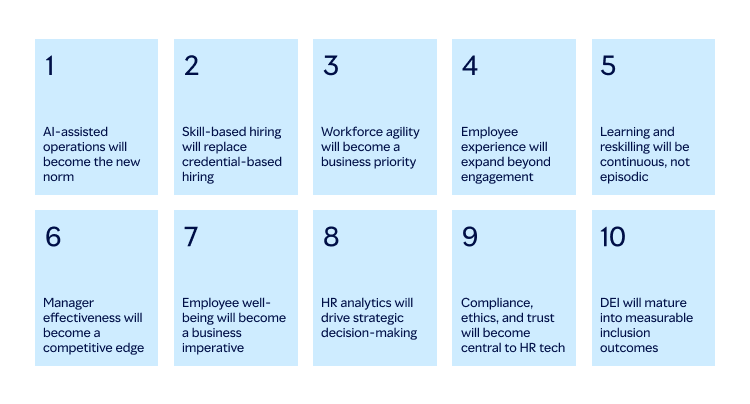
1. AI-assisted operations will become the new norm
According to Grand View Research, the global AI in HR market was valued at USD 3.2 billion in 2023 and is expected to grow to USD 15.2 billion by 2030, at a CAGR of 24.8% from 2024 to 2030.
AI is expected to become increasingly integrated into everyday HR operations, from recruitment and onboarding to employee support and workforce planning. By automating repetitive administrative tasks, AI will allow HR teams to dedicate more time to strategic and people-focused priorities. It will also enable faster, data-driven decisions across the employee lifecycle.
How HR leaders can leverage this trend:
- Upskill HR teams to work effectively alongside AI tools.
- Build AI literacy across HR to improve adoption and confidence.
- Continuously measure AI’s impact on employee experience and HR outcomes.
2. Skill-based hiring will replace credential-based hiring
According to LinkedIn’s The Future of Recruiting 2025 report, 93% of talent professionals believe accurately assessing a candidate’s skills is crucial to improving the quality of hire.
As organizations place greater emphasis on practical capabilities, hiring decisions are expected to shift beyond traditional degrees and qualifications. Employers will increasingly assess candidates based on relevant skills, demonstrated expertise, and their ability to adapt to changing job requirements. This approach can also help organizations access a broader and more diverse talent pool.
How HR leaders can leverage this trend:
- Define clear skill requirements for every role.
- Use skills assessments and practical evaluations during hiring.
- Build talent pipelines around capabilities rather than academic credentials.
3. Workforce agility will become a business priority
As per Deloitte’s 2025 Talent Agility Leadership Survey, 95% of executives consider talent agility and cross-border skills essential, with their importance expected to grow over the next five years.
Rapid changes in technology, market conditions, and business models will require organizations to adapt their workforce more quickly. HR will play a central role in ensuring employees can move across roles, teams, and priorities as business needs evolve. Building a flexible workforce will become essential for maintaining productivity and organizational resilience.
How HR leaders can leverage this trend:
- Build internal mobility pathways to move talent where it is needed most.
- Develop cross-functional capabilities through continuous learning.
- Use workforce data to anticipate changing talent requirements.
4. Employee experience will expand beyond engagement
Employee experience will increasingly encompass the entire employee journey, going beyond traditional engagement surveys and workplace satisfaction. HR leaders will focus on how employees experience technology, leadership, workplace culture, career growth, and everyday processes. A more holistic approach will help organizations create workplaces that support both employee needs and business objectives.
How HR leaders can leverage this trend:
- Map key employee touchpoints to identify experience gaps.
- Personalize workplace experiences based on employee needs and preferences.
- Use continuous feedback to improve policies, processes, and workplace culture.
5. Learning and reskilling will be continuous, not episodic
The World Economic Forum reports that employers expect 39% of workers’ core skills to change by 2030, highlighting the growing need for reskilling to help employees adapt to evolving job demands.
As skills evolve rapidly, organizations will need to move away from occasional training programs toward continuous learning and development. Employees will increasingly need opportunities to build new capabilities as roles, technologies, and business requirements change. Training needs assessment and continuous reskilling will therefore become an integral part of workforce planning and career development.
How HR leaders can leverage this trend:
- Embed learning into everyday workflows and employee development plans.
- Create personalized learning paths based on evolving skill requirements.
- Link reskilling initiatives with internal mobility and career progression.
6. Manager effectiveness will become a competitive edge
Managers will play an increasingly important role in shaping employee performance, development, and experience. As organizations adopt AI-assisted tools and hybrid work models, managers will need to balance technology with human connection while leading teams across different work environments. Their ability to navigate change, build trust, and enable collaboration will increasingly influence workforce and business outcomes.
How HR leaders can leverage this trend:
- Equip managers to lead AI-assisted and hybrid teams effectively.
- Strengthen coaching, communication, and change-management capabilities.
- Use feedback and performance data to identify manager development needs.
7. Employee well-being will become a business imperative
Employee well-being will increasingly be viewed as a core business priority rather than a standalone HR initiative. Organizations will take a more holistic approach that considers mental, physical, financial, and social well-being alongside workload and workplace conditions. Supporting employee well-being can contribute to sustainable performance, stronger retention, and a healthier workplace culture.
How HR leaders can leverage this trend:
- Integrate well-being into broader people and workplace strategies.
- Identify workload and workplace factors that may affect employee well-being.
- Equip managers to recognize and respond to employee needs effectively.
8. HR analytics will drive strategic decision-making
Mordor Intelligence projects the HR analytics market to rise from USD 4.89 billion in 2025 to USD 10.82 billion by 2031, growing at a CAGR of 13.64% from 2026 to 2031.
HR analytics will become a critical tool for understanding how workforce dynamics influence business performance. Instead of relying primarily on historical reports, HR leaders will use real-time and predictive insights to identify talent risks, workforce gaps, productivity patterns, and emerging skill needs. This shift will position HR analytics as a strategic capability that helps leaders make more informed decisions about people, costs, and organizational growth.
How HR leaders can leverage this trend:
- Connect workforce data with key business and financial outcomes.
- Use predictive analytics to identify talent risks and future workforce needs.
- Equip HR leaders with actionable insights for faster, evidence-based decisions.
9. Compliance, ethics, and trust will become central to HR tech
As HR technology becomes more data-driven and AI-assisted, organizations will face greater expectations around privacy, transparency, and responsible use of employee data. HR leaders will need to ensure that technology-driven decisions are explainable, secure, and aligned with evolving regulations. Building trust will become essential for encouraging employees to adopt and engage with new HR technologies.
How HR leaders can leverage this trend:
- Establish clear governance frameworks for HR technology and employee data.
- Conduct regular reviews of AI systems for transparency and compliance.
- Communicate clearly with employees about how their data is collected and used.
10. DEI will mature into measurable inclusion outcomes
Diversity, Equity, and Inclusion (DEI) will evolve from representation-focused initiatives into measurable inclusion outcomes. Organizations will increasingly assess whether employees across diverse groups have equitable access to career growth, pay, leadership opportunities, learning, recognition, and advancement. This shift will make inclusion a measurable component of workforce strategy, employee experience, and organizational performance.
How HR leaders can leverage this trend:
- Track equity metrics across hiring, promotion, pay, and retention.
- Use employee feedback to identify inclusion gaps and barriers.
- Embed inclusion outcomes into leadership accountability and workforce planning.
Conclusion
HR leaders need to look beyond simply following new trends. The focus should be on understanding which changes are relevant to their organization and how they can create practical value. This means using data to make better decisions, building the right capabilities, and adapting HR practices as needs change. A thoughtful approach to emerging trends can help organizations make stronger talent decisions, support employees more effectively, and keep their HR strategies aligned with business priorities.
FAQs
What are the key HR trends to watch?
How is AI changing the HR function?
Why are assessments and data becoming important in HR?




Get awesome marketing content related to Hiring & L&D in your inbox each week
Stay up-to-date with the latest marketing, sales, and service tips and news
By using our offerings and services, you are agreeing to the Terms of Services and License Agreement and understand that your use and access will be subject to the terms and conditions and Privacy Notice