

In 2025, the United Arab Emirates (UAE) recorded the fastest hiring growth worldwide, showcasing a 39% year-over-year increase in hiring activity as per the 2025 Remote Hiring Report by RemotePass. This growth is driven by several factors, including increased cross-border hiring, post-pandemic business recovery, and a growing preference for remote and hybrid work, which have fundamentally changed how organizations recruit.
Unproctored online assessments carry risks, such as impersonation, answer sharing, and unauthorized resource use, which can negatively impact hiring decisions. At the same time, an overly invasive proctoring experience can frustrate candidates and negatively impact employer brand perception.
One of the core challenges faced by UAE hiring teams today is maintaining assessment security without degrading candidate experience.
Recruiters in the UAE can choose from three distinct proctoring models to address this challenge – live proctoring (real-time human monitoring), AI proctoring (automated behavioral analysis), and recorded proctoring (session capture for later review). Each model comes with its own implications in terms of cost, security, and candidate experience.
This guide examines all three proctoring models to help you determine the right fit for your organization, based on your specific hiring objectives.
Online proctoring refers to the use of AI-powered technology, human supervision, or both to monitor job candidates during remote assessments, tests, or video interviews. It acts as a secure digital replacement for in-person invigilation and helps ensure that the test has been completed under fair, controlled conditions. In terms of recruitment, proctoring usually involves webcam access, screen monitoring, identity verification, and behavioral analysis to detect possibilities of misconduct.
This involves a human invigilator monitoring the candidates in real-time through a webcam feed. The invigilator verifies a candidate’s identity at the start, observes the candidate’s behavior, and intervenes directly if they detect suspicious behavior.
Key features:
Pros:
Cons:
This uses machine learning algorithms for monitoring candidates in real-time or near real-time. The system analyzes webcam feeds, audio inputs, and browser behavior to detect irregularities.
Key features:
Pros:
Cons:
Best use cases in the UAE:
In 2025, a peer-reviewed study reported that AI-based proctoring systems achieved an F1-score of 91.4% for eye-movement detection and 93.7% for hand-movement detection, which demonstrates a high level of accuracy in automated monitoring.
This model captures the candidate’s webcam feed, screen activity, and audio throughout the assessment session. Instead of enabling real-time monitoring, this type of proctoring stores the recording for review by a designated team member at a later point.
Key features:
Pros:
Cons:
Best use cases in the UAE:
Here is a comparative snapshot of the different types of online proctoring across parameters that are most relevant to UAE hiring teams.
| Parameter | Live proctoring | AI proctoring | Recorded proctoring |
|---|---|---|---|
| Cost-per-session | High | Low to medium | Low |
| Scalability | Low | High | Medium |
| Scalability | Highest | High | Medium |
| Human intervention | Realtime | Post-assessment review | Post-assessment review |
| Candidate experience | Intensive oversight | Moderate oversight | Least intrusive |
| Turnaround time | Immediate (with minimal review lag) | Fast (after flagging) | Delayed (pending review) |
| Best for | High-stakes, compliance roles | Volume and campus hiring | Mid-level, flexible hiring |
It is imperative to understand that there is no ‘one-size-fits-all’ approach to proctoring. The right choice will depend on your organization’s specific requirements and hiring goals.
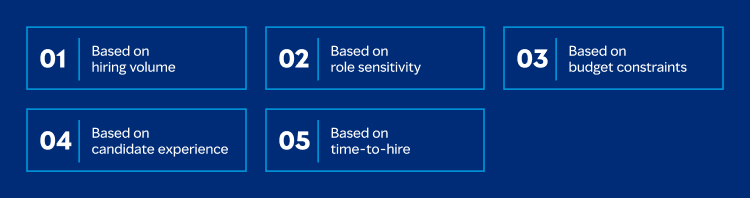
Volume is one of the most important considerations for choosing the right proctoring model for your organization. When hiring at scale, live proctoring becomes operationally untenable. For mass recruitment drives in the UAE, AI proctoring is the only model that can provide high-integrity results at the required speed. On the other hand, when hiring for a small number of critical roles where each appointment carries a lot of organizational risk, live proctoring provides the level of assurance that justifies the investment.
Finance, banking, compliance, and government-adjacent job roles in the UAE operate within strict regulatory guidelines that demand documented, defensible assessment processes. Live proctoring offers clear audit trails and real-time intervention capabilities, which align well with these requirements. For operational or entry-level job roles, where the primary screening objective is efficiency, AI proctoring or the recorded model provides adequate integrity assurance.
The costs associated with live proctoring can be substantial, especially when applied at scale. With budgetary constraints, a hybrid of AI and recorded proctoring can provide cost efficiency while also maintaining assessment integrity. On the other hand, organizations that have greater budget flexibility, especially when hiring for senior or compliance-sensitive roles, will find the investment in live proctoring to be justified, given the reduced risk of a costly bad hire.
Recruiters in the UAE must manage a growing trust deficit. According to a 2025 Gartner survey, only 26% of candidates trust AI to evaluate them fairly, while 25% of candidates said that they trust employers less if they use AI to evaluate their applications. While live proctoring is ideal for senior and high-compliance roles where candidates expect rigorous testing, for junior roles or high-volume hiring, AI or recorded proctoring models are better for a candidate-friendly experience.
For the right balance of assessment integrity and candidate experience, organizations must calibrate surveillance to the stakes involved.
AI proctoring, integrated with automated flagging and escalation logic, supports the quickest time-to-hire. In this model, candidates complete the assessments, incidents are automatically flagged, and only borderline cases are marked for human review. Live proctoring also provides immediate results, but may require scheduling coordination, which can add time to the overall hiring cycle. Recorded proctoring is the slowest of the three and involves a review lag.
Most sophisticated hiring operations do not rely exclusively on one proctoring model. Combining AI monitoring with selective live or recorded review for a hybrid approach to online proctoring is increasingly being recognized as the most pragmatic solution for organizations that need both scale and security. In corporate hiring, AI can handle the volume, while human review can be reserved for critical job roles or flagged cases.

The hybrid model is particularly well-suited to the UAE’s hiring environment, where organizations must simultaneously manage high-volume screening across varied candidate pools as well as high-stakes hiring for job roles in regulated industries.
This ‘human-in-the-loop’ strategy offers recruiters the best of both worlds:
The UAE operates under the Federal Decree-Law No. 45 of 2021 on the Protection of Personal Data (PDPL), which governs the collection, processing, and retention of personal data. Organizations deploying proctoring technology in their hiring process must ensure that candidates provide informed consent before any recording begins, that the data is stored in compliant environments, and that retention periods are clearly defined and observed.
Beyond local law, UAE-based multinationals must also respect international privacy regulations, especially when candidates are EU nationals or may have their data stored on European infrastructure. This means that organizations must remain bound by the stringent guidelines that govern how data travels across borders, the right to erasure, and the maintenance of transparency in personal data processing.
Organizations that treat compliance as a strategic priority instead of a checkbox exercise also benefit from improved candidate trust, which is a compelling value proposition in a market where top talent has multiple options.
Best practices for UAE-based hiring teams:
Organizations acting as data controllers are obligated to use technical and organizational measures, such as role-based access and data encryption, to ensure that data is protected from unauthorized access.
Mercer Assessments provides an end-to-end proctoring infrastructure that can support all three models – live, AI, and recorded – within a single platform. This allows hiring teams to configure the ideal level of oversight for each type of assessment, instead of having to apply a one-size-fits-all approach.
Beyond proctoring, Mercer Assessments offers validated psychometric, cognitive, and domain-specific test libraries, so organizations can combine scientifically validated candidate evaluations with rigorous integrity controls.
According to Mercer 2025 Global Talent Trends, 74% of HR leaders who use psychometric assessments in recruitment processes have reported better-quality hiring decisions, which underscores the value of pairing strong assessments with equally strong integrity infrastructure.
Key differentiators
In the quest for hiring top talent, the most sophisticated proctoring model may not always be the best choice for your organization. You should choose a model that calibrates the level of monitoring with the risk profile of the job role. While live proctoring is the industry benchmark for security, AI proctoring provides the scalability that high-volume UAE hiring demands, and recorded proctoring is the practical, budget-conscious option for mid-level and flexible hiring contexts where real-time monitoring is not essential.
Often, the most effective approach is a combination of the models – AI-powered monitoring at scale, reserved live proctoring for later stages and high-stakes job roles, and recorded review as a convenient solution for roles that need flexibility of schedule more than prompt intervention.
In a market as competitive and diverse as the UAE, the organizations that will hire most effectively are those that match their assessment infrastructure to their actual hiring needs, not those that apply the most intensive controls by default. Proctoring, when configured thoughtfully, is not a barrier to candidate experience; it is a signal to candidates that the assessment they are completing is fair, rigorous, and worth their time.





 Behavioral Competencies
 Cognitive Competencies
 Coding Competencies
 Domain Competencies