 English
 Portuguese







Ensuring test integrity in the age of GenAI platforms
Summary
Generative AI has made it easier for candidates to receive instant, hard-to-detect assistance during online assessments, putting the validity and credibility of test results at risk. This blog outlines a layered approach to protecting test integrity through clear AI policies, stronger candidate verification, secure testing controls, AI-resilient assessment design, human review, and data-driven monitoring.
Introduction
As generative AI becomes increasingly accessible, organizations are rethinking how they design and secure assessments. Candidates can now use AI platforms to generate answers, solve problems, write code, or refine responses within seconds, making it harder to determine whether a test result reflects their own abilities. This creates a critical challenge: how can organizations ensure that assessments continue to measure genuine knowledge and skills? Test integrity in the age of AI requires organizations to rethink traditional approaches and find more effective ways to protect the validity and credibility of assessment results.
Evolving challenges to test integrity in the AI era
Test integrity has always focused on ensuring that assessments accurately measure a candidate’s knowledge and skills. As testing has moved from physical exam rooms to online and AI-enabled environments, the ways in which assessment integrity can be compromised have also evolved.
Unauthorized access and assistance
Online assessments expanded the possibilities for cheating. Candidates could use additional devices, access external resources, or receive help from someone outside the testing environment.
Bypassing digital controls
As online testing became more widespread, candidates developed ways to work around basic security measures. This created new challenges for monitoring activity and maintaining a controlled assessment environment.
AI-generated answers
Generative AI has significantly changed the cheating environment. Candidates can now use AI platforms to generate answers, solve problems, write code, or explain concepts within seconds.
Questioning assessment validity
When unauthorized AI assistance is used, test results may not accurately reflect a candidate’s actual knowledge or skills. This can affect the justness and reliability of the assessment.
Question content shared and circulated
Test items can be captured and shared quickly, reducing the lifespan of question banks and increasing repeat exposure. This forces organizations to refresh content more often and use larger item pools or randomization to maintain exam credibility.
Why AI detection tools alone cannot ensure test integrity
AI detection tools can help identify potentially AI-generated responses, but they cannot provide a complete solution for protecting test integrity. Detection results can be inconsistent, and AI use is only one of several ways an assessment can be compromised.
Detection is not always reliable
AI detection tools can sometimes flag human-written responses or fail to identify AI-assisted work. A detection score alone does not prove that a candidate cheated.
AI keeps evolving
Generative AI platforms are becoming more advanced and producing increasingly natural responses. Detection methods must continually adapt to keep pace with these changes.
Cheating goes beyond AI
Candidates can also use unauthorized devices, external resources, or assistance from another person. Focusing only on AI detection leaves these other forms of cheating unaddressed.
Context still matters
A detection tool may indicate that a response appears AI-generated, but it cannot always determine how the tool was used. Human review can provide the context needed to make a just decision.
Overreliance can undermine trust
Relying too much on automated detection can result in genuine candidates being wrongly flagged. This can reduce trust in the assessment process and its ability to remain impartial.
The new framework for maintaining test integrity in the AI age
The rise of generative AI is changing how organizations approach assessment security. A strong framework should go beyond detecting AI use and combine technology, assessment design, clear policies, and human oversight to support impartial and trustworthy assessments in the AI era.
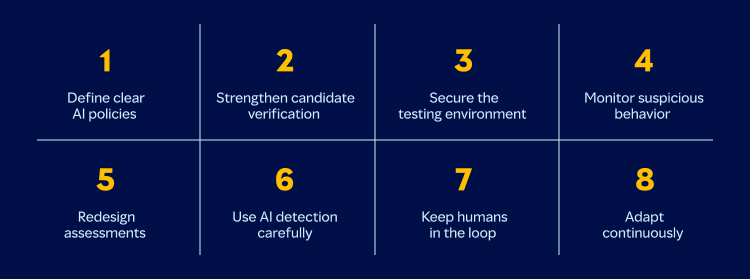
Define clear AI policies
Clearly explain when AI tools are allowed, restricted, or prohibited. Candidates should understand these expectations before beginning an assessment.
Strengthen candidate verification
Use reliable identity checks to confirm that the right person is taking the test. Strong verification helps protect remote assessment integrity throughout the assessment process.
Secure the testing environment
Limit access to unauthorized websites, applications, devices, and external resources. AI-enabled proctoring can add another layer of oversight by monitoring the assessment environment and identifying potentially suspicious activity.
Monitor suspicious behavior
Look beyond the final answers and consider unusual activity during the assessment. Changes in behavior, unexpected navigation, or other anomalies can provide useful signals for further review. Organizations can also use Mercer’s safe browser to detect and monitor suspicious on-screen activities and maintain test integrity.
Redesign assessments
Use a behavioral assessment that requires reasoning, practical application, and problem-solving, making it harder for candidates to rely solely on AI-generated answers.
Use AI detection carefully
AI detection can provide an additional signal when reviewing potentially AI-assisted work. However, it should support other security measures rather than serve as the sole basis for decisions.
Keep humans in the loop
Technology can identify potential concerns, but human judgment remains essential. Reviewers can consider the context, available evidence, and assessment rules before reaching a conclusion.
Adapt continuously
AI capabilities and cheating methods will continue to evolve. Organizations should regularly review their approach to AI-enabled cheating prevention and update their safeguards accordingly.
The role of data and analytics in protecting test integrity
Data and analytics can give organizations a clearer view of what happens during an assessment. Instead of relying on one warning sign, they can analyze multiple signals to identify unusual activity, investigate potential concerns, and strengthen assessment security over time.
- Spotting unusual behavior: Analyze response times, answer patterns, and navigation to identify activity that differs from normal test-taking behavior.
- Tracking test activity: Monitor interactions within the assessment environment to identify unexpected actions or changes in behavior.
- Connecting multiple signals: Combine different data points to build a clearer picture of potential integrity concerns.
- Identifying behavioral patterns: Compare current activity with established patterns to highlight significant deviations that may need review.
- Detecting repeated anomalies: Look for recurring patterns across assessments that could indicate weaknesses in existing security controls.
- Supporting faster reviews: Use analytics to prioritize cases that require closer attention instead of reviewing every assessment manually.
- Reducing false concerns: Consider multiple indicators before flagging a candidate, rather than relying on a single unusual action.
- Improving assessment design: Use insights from assessment data to identify questions, formats, or processes that may be easier to compromise.
- Strengthening security measures: Use historical insights to improve online exam security and adapt controls to emerging threats.
- Enabling proactive prevention: Analytics can help organizations identify emerging patterns and strengthen AI-enabled cheating prevention before new risks become widespread.
Conclusion
Ensuring test integrity in the age of AI requires more than detection tools or technology restrictions. A comprehensive approach, combining thoughtful assessment design, robust security measures, transparent AI policies, and continuous monitoring, is essential. Educators and institutions must understand both the opportunities and challenges of AI and adapt strategies accordingly. Most importantly, assessments should measure genuine understanding, not just the ability to produce correct answers. By taking proactive steps, institutions can minimize AI-related risks and build assessment systems that remain honest, credible, and future-ready.
FAQs
What is test integrity in the age of AI platforms?
Why is ChatGPT no longer the only AI risk in assessments?
How do AI platforms affect online exams and certifications?
Can AI-generated answers be reliably detected?
What is the best way to protect assessment integrity?


 Skills Assessment Test



Get awesome marketing content related to Hiring & L&D in your inbox each week
Stay up-to-date with the latest marketing, sales, and service tips and news
By using our offerings and services, you are agreeing to the Terms of Services and License Agreement and understand that your use and access will be subject to the terms and conditions and Privacy Notice