
Logo
X

Get awesome marketing content related to Hiring & L&D in your inbox each week

Stay up to date with the latest marketing, sales, and service tips and news

Recruitment | 7 Min Read

How to improve employee retention in the Philippines using assessments

Employee retention refers to an organization’s ability to keep its employees over time while minimizing voluntary and involuntary turnover. In fast-growing economies like the Philippines, retention has become a strategic priority rather than just an HR metric. Companies across industries, from BPO to IT and retail, are facing increasing pressure to retain skilled talent in a highly competitive job market.

One of the most effective ways to address this challenge is through employee assessments.

When used correctly, assessments improve hiring quality, enable targeted development, and enhance employee engagement; the three critical levers of retention.

Today, many organizations are adopting comprehensive assessment platforms, such as Mercer Assessments, to bring structure, scalability, and data-backed decision-making into their talent strategies.

Why employee retention is a major challenge in the Philippines

High attrition rates in key industries (BPO, IT, Retail)

The Philippines is one of the world’s leading outsourcing hubs, but with this growth comes significant workforce churn.

  • In the Philippines, voluntary attrition hovers around 17% as per Mercer’s Total Remuneration Survey.
  • The IT-BPM sector reports annual attrition rates of 30–45%, according to the IT & Business Process Association of the Philippines (IBPAP).
  • Retail and frontline roles often experience turnover, especially in urban centers.
  • Manufacturing and logistics sectors also face rising attrition due to skill shortages and migration to higher-paying industries.

Typical attrition patterns include:

  • Early exits within the first 3–6 months, often due to role mismatch.
  • High dropout rates in night shift roles in BPOs.
  • Mid-tenure attrition driven by better compensation offers or career stagnation.

Common reasons employees leave include:

  • Misalignment between job expectations and actual role.
  • Heavy workload and burnout.
  • Limited career growth opportunities.
  • Lack of manager support.
  • Competitive job offers in a talent-scarce market.

Traditional retention methods, such as salary increases or generic engagement programs, are no longer sufficient. Organizations need a more precise and predictive approach to understand why employees leave and how to retain them. This is where structured assessment frameworks help.


Cost of employee turnover for Philippine employers

Employee attrition is not just an HR issue; it is a business risk with measurable financial impact.

  • Costs of Employee Turnover by Duda & Žůrková, 2013, found that replacing an employee can cost up to 150% of their annual salary, factoring in productivity loss, hiring, and transition costs.
  • The International Labor Organization estimates that a significant proportion of turnover globally (between 42% to 63%) is preventable through better job matching and working conditions.
  • Disengagement and poor job fit continue to be among the leading contributors to productivity loss, as highlighted in multiple global workforce studies.

When calculating these expenses, direct costs usually include:

  • Recruitment and hiring expenses.
  • Onboarding and training investments.
  • Lost productivity during ramp-up.

While indirect costs include:

  • Decline in team morale.
  • Poor customer experience due to inexperienced staff.
  • Increased workload on remaining employees.
  • Managerial time spent on rehiring instead of strategic work.

In high-volume hiring environments like the Philippines, these costs multiply rapidly. Most importantly, poor hiring and development decisions are often at the root of high turnover, making structured, assessment-led decision-making critical.


What Filipino employees value most at work

Understanding employee expectations is essential to improving retention. PwC’s Global Workforce Hopes and Fears Survey 2025 shows that 67% of employees consider opportunities to learn new skills a key factor in job decisions, while job security remains a central concern amid ongoing workplace disruption.

For Filipino employees, key drivers of retention include:

  • Career growth and upskilling opportunities.
  • Clear role expectations and stability.
  • Fair, data-driven performance evaluation.
  • Supportive managers and leadership.
  • Work-life balance, especially in shift-based roles.

Organizations that fail to align with these expectations often experience higher attrition.


Understanding employee assessments

What are employee assessments?

Employee assessments are structured tools used to evaluate an individual’s:

  • Skills and competencies
  • Cognitive abilities
  • Personality and behavior
  • Job performance and potential
  • Engagement and satisfaction

Unlike subjective judgment, assessments provide objective, data-backed insights that improve decision-making across hiring, development, and performance management.

The adoption of assessments is increasing rapidly. Organizations adopting data-driven approaches are better positioned to improve business outcomes and decision-making effectiveness. Platforms like Mercer Assessments enable organizations to operationalize these practices through standardized, scalable assessment frameworks.


Types of employee assessments used by employers

Organizations typically use a combination of assessment types:
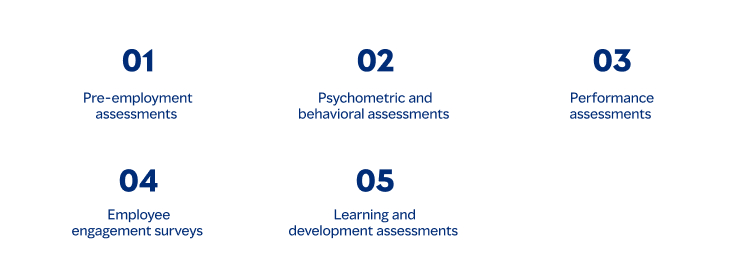
  • Pre-employment assessments
    • Skills tests
    • Aptitude tests
    • Job simulations (often delivered via platforms like Mercer Assessments to ensure consistency at scale)
  • Psychometric and behavioral assessments
    • Personality profiling
    • Work style and cultural fit analysis
  • Performance assessments
    • Goal tracking
    • KPI-based evaluations
  • Employee engagement surveys
    • Satisfaction levels
    • Motivation and morale indicators
  • Learning and development assessments
    • Skill gap analysis
    • Readiness for future roles

Each of these plays a unique role in improving retention by ensuring alignment between employee capabilities and organizational expectations.


Why assessments matter for long-term retention

Assessments directly impact retention in multiple ways:

  • Reduce bad hires by ensuring job-role fit.
  • Identify strengths and development needs early.
  • Improve fairness and transparency in evaluations.
  • Build employee trust through structured processes.

Using assessments to improve retention at every employee lifecycle stage

Improving hiring decisions with pre-employment assessments

Hiring is the first and most critical stage where retention can be influenced.

  • Skills and aptitude tests ensure candidates can perform the role.
  • Behavioral assessments evaluate cultural and team fit.
  • Realistic job previews reduce expectation mismatch.
  • This is especially important in the Philippines, where high-volume hiring is common in the BPO and retail sectors.

Strengthening onboarding with early-stage assessments

The onboarding phase is a high-risk period for attrition.

Assessments help by:

  • Evaluating skill levels at the time of joining.
  • Personalizing onboarding and training programs.
  • Identifying early signs of disengagement.

By aligning training with individual needs, often through skill-gaps assessments, employees gain confidence faster and are more likely to stay.


Boosting engagement through continuous employee assessments

Retention is not a one-time effort, and it requires ongoing monitoring. Continuous listening strategies are increasingly being adopted globally to identify disengagement early and improve employee experience. Some common practices are:

  • Regular performance assessments that track progress.
  • Pulse surveys that measure engagement and morale.
  • 360-degree feedback that provides a holistic evaluation.

Using continuous assessment data allows HR teams to:

  • Identify disengagement early.
  • Take proactive action before employees resign.
  • Improve communication between managers and employees.

Modern assessment ecosystems like the Mercer Assessments allow organizations to integrate performance and engagement insights into a single view, enabling more timely interventions.


Supporting career growth and internal mobility

Lack of growth is one of the top reasons employees leave.

Assessments enable:

  • Identification of high-potential employees.
  • Mapping of skills to future roles.
  • Creation of personalized career paths.

According to the LinkedIn Workplace Learning Report, 94% of employees would stay longer at companies that invest in their careers.

In the Philippine context, where upskilling is highly valued, this becomes a powerful retention strategy, especially when supported by structured skill assessments and role-based benchmarking.


How assessments address key retention drivers in the Philippines

Career development and upskilling

Assessments help organizations:

  • Identify skill gaps accurately.
  • Align training programs with business needs.
  • Link learning outcomes to career progression.

Upskilling reduces job-hopping by giving employees a clear growth trajectory within the organization, particularly when supported by continuous skill assessments and learning pathways.


Manager–employee alignment

Manager quality is one of the strongest predictors of retention.

  • Behavioral assessments help managers understand team dynamics.
  • Insights into communication styles reduce conflicts.
  • Better alignment leads to stronger relationships.

Assessment-driven insights can also support manager capability building, helping leaders better engage and retain their teams.


Fair and transparent performance evaluation

Perceived unfairness is a major cause of attrition.

Assessments ensure:

  • Objective benchmarks for evaluation.
  • Reduced bias in performance reviews.
  • Consistent feedback across teams.

Structured assessment frameworks help institutionalize fairness, making performance management more transparent and credible.


Employee recognition and motivation

Recognition plays a critical role in engagement.

  • Assessments identify top performers objectively.
  • Performance data can be linked to rewards.
  • Employees feel valued when contributions are acknowledged.

When recognition is backed by data, it strengthens trust and reinforces a performance-driven culture.


Best practices for implementing employee assessments in the Philippines

Best practices for implementing employee assessments in the Philippines

Choose culturally relevant and validated assessments

  • Use assessments adapted to local workforce dynamics.
  • Ensure scientific validation and reliability.
  • Avoid generic or unproven tools.

Combine assessment data with human judgment

  • Use assessments as decision-support tools.
  • Train HR and managers to interpret assessment results.
  • Balance data with empathy and context.

Ensure transparency and employee trust

  • Clearly communicate the purpose of assessments.
  • Share results constructively.
  • Maintain data privacy and confidentiality.

Use assessment insights to take action, not just measure

  • Act on engagement survey results.
  • Close feedback loops with employees.
  • Avoid collecting data without follow-through.


How HR leaders in the Philippines can get started

Identify retention pain points

  • Analyze early attrition trends.
  • Identify skill gaps and disengagement signals.
  • Map issues to employee lifecycle stages.

Map assessments to HR goals

The key is to align assessments with:

  • Hiring quality improvement
  • Leadership development
  • Engagement measurement
  • Succession planning

Track retention metrics and outcomes

Measure success using:

  • Attrition rate trends
  • Engagement scores
  • Performance improvements
  • ROI of assessment-driven decisions


Conclusion

Employee retention in the Philippines requires a shift from reactive fixes to a more strategic, data-driven approach.

Assessments enable organizations to make better hiring decisions, personalize employee development, and ensure fairness in performance management, addressing the root causes of attrition rather than just the symptoms. As workforce expectations continue to evolve and competition for talent intensifies, organizations that embed assessments across the employee lifecycle will be better positioned to create meaningful employee experiences, drive engagement, and build a stable, future-ready workforce.


FAQs

1. What is employee retention, and why is it important in the Philippines?

2. What are the main causes of employee attrition in the Philippines?

3. What types of employee assessments are most effective for retention?

Originally published April 15 2026, updated April 15 2026

About This Topic

Talent acquisition is all about strategizing for sourcing, hiring, and retaining the talent an organization needs. This blog offers more insights on the topic.

Related Posts

Would you like to comment?

X
X

Thanks for submitting the comment. We’ll post the comment once its verified.

Get awesome marketing content related to Hiring & L&D in your inbox each week

Stay up to date with the latest marketing, sales, and service tips and news