

This article explains how organizations must align technology, skills, and leadership to turn AI pilots into lasting business value. It shows practical steps to measure skills, redesign workflows for human and AI teams, and upskill leaders to scale AI responsibly.
Organizations are past the point of asking whether AI will change work. The real question is whether they are redesigning fast enough to capture its value.
AI tools accelerate decision-making, automate repetitive tasks, and transform data into actionable insights. Yet, technology alone rarely delivers lasting impact. Lasting results require alignment across three areas: people with the right AI skills, workflows redesigned for human–AI collaboration, and leaders who can guide change and make clear decisions under uncertainty.
Pressure for greater agility, productivity, and efficiency is growing, and investors favor AI-enabled, digital-first cultures. To meet these expectations, organizations must move beyond pilots and redesign work, processes, and operating models so human and AI capabilities reinforce each other at scale.
This theme was explored in depth through Mercer’s recent webinars, Preparing the Workforce for the Age of AI and Managing Leadership Paradoxes in AI Adoption, where leaders discussed the practical shifts needed in work design, skills, and leadership to scale AI successfully.
Organizations will not realize AI’s full value through deployment alone; they must reshape how work is designed and how people and AI operate together.
Many organizations have increased AI usage, but scaling it into measurable business value remains challenging. The core issue is not access to tools, but whether organizations are redesigning work, roles, and operating rhythms so AI can be embedded into daily operations.
A key insight from executive discussions is that realizing value from AI requires orchestrating effective human–machine collaboration. This depends on clear objectives, measurable outcomes, and coordinated changes to roles and processes.
Work redesign is therefore not optional. It requires deconstructing jobs and workflows to identify where AI can substitute, augment, or transform tasks. It also involves building new ways of working that blend AI’s technical strengths with human judgment, creativity, empathy, and critical thinking.

Organizations build human–AI agility by changing how work is designed and led, not by adding tools to the same operating model. They are prioritizing a clear set of people initiatives that they believe will drive ROI:
While organizations recognize the value, capability remains a gap. According to Mercer’s Global Talent Trends 2026 report, only 32% believe their workforce can optimize the combination of human and machine capabilities today. The same report indicates that organizational change is a near-term priority, with 98% of executives planning organizational design changes within the next two years.
Harnessing AI to drive agility, scalability, and stronger performance requires leaders to think beyond isolated use cases or simply expanding access to tools. The shift is from a technology-first mindset to a work-first approach, where work is redesigned to optimize human–AI collaboration while accounting for changing skill needs and agility requirements.
This starts with redefining how work is structured. Instead of relying on fixed jobs, rigid processes, and narrowly defined roles, work should be treated as a fluid system of tasks that can be handled by humans, machines, or a combination of both.
Organizations should then deconstruct tasks to understand what can be substituted, what should be augmented, and what can be transformed using AI, while carefully assessing risks as decision-making authority shifts.
The intent is clear: return on AI investments depends on intentional work design, not passive adoption. Yet priorities are not always aligned across the organization. While senior leaders increasingly view work redesign as a major ROI lever, fewer HR leaders are planning to make it a top priority, even though HR has a distinct opportunity to lead.
Work design must become a core organizational competency, with HR stepping into the role of work architect to help reshape roles, workflows, and talent practices for a world where humans and AI work side by side.
To build a strong culture of AI enablement, leaders should support adoption by providing unbiased access to tools, transparent communication, and practical support that help employees use AI confidently and participate in reshaping how work is done.
In addition, learning must be built into day-to-day work through continuous upskilling and reskilling. Progress needs to be measured and shared by tracking productivity, talent movement, and workforce outcomes so momentum is sustained and what works can scale.
Leading this shift also requires a different kind of leadership. In Mercer’s webinar on Managing leadership paradoxes in AI adoption, HR leaders explored how successful AI transformation depends on leaders balancing demands that appear to conflict but must coexist in practice. These paradoxes are not choices; they are ongoing balances leaders must manage as human and AI work side by side.
Here are the top five paradoxes that leaders need to look for:
Lead with clear direction when decisions are urgent, and step back to give people autonomy when they need space to learn and innovate.
Balance personal accountability and drive with collaboration and stakeholder alignment so results are delivered without sacrificing teamwork.
Push for performance and measurable outcomes while protecting team wellbeing and development to sustain long-term productivity.
Keep reliable processes and risk controls in place yet stay flexible enough to experiment and respond quickly to new information.
Hold a long-term vision while also focusing on the short-term actions and milestones that turn strategy into results.
AI specialists will continue to need strong technical depth, but an AI-enabled organization cannot rely just on specialists.
HR plays a central role in building human–AI agility because workforce decisions must keep pace with changing business demands. Many organizations still struggle to use workforce intelligence effectively.
According to Mercer’s Global Talent Trends 2026 report, 55% of HR executives believe their organizations are not making full use of the workforce intelligence already available to them. Closing this gap requires HR to strengthen people analytics, improve skills visibility, and translate insights into practical actions for leaders, managers, and employees.
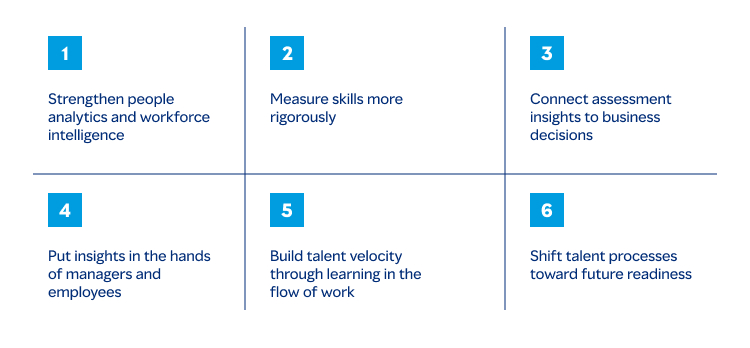
Improve integration across HR data sources and strengthen the quality of insights so workforce information is timely, reliable, and usable for decision-making.
Improve technical skill measurement and introduce more valid assessment methods. This includes psychometrics and simulations to build a clearer view of current capability and future needs.
Combine assessment results with other workforce data (such as engagement and rewards) and convert insights into clear inputs for hiring, development, deployment, and role design.
Ensure managers can use skills insights to allocate work and coach effectively and enable employees to use the same insights to collaborate better and plan development.
Prioritize AI-enabled internal mobility, short-term projects, and experiential learning pathways, especially as experiential learning has shown the biggest rise in effectiveness for closing skills gaps.
Design talent practices that identify future leaders, not just current top performers, and encourage leaders to develop and export talent rather than hoard it within teams.
Long-term value from AI will be defined by how well an organization reshapes work, strengthens workforce capability, and sustains effective leadership through ongoing change. The strongest results come when AI capability is paired with human strengths such as judgment, ethics, and collaboration, and when roles and workflows are designed for true human–machine teaming. Organizations that invest with equal rigor in technology, people, and leadership are best positioned to turn AI adoption into sustained performance and competitive advantage.
Originally published August 11 2026, Updated August 12 2026

Varsha specializes in tech and SaaS storytelling, crafting clear, high-impact blogs, social media content, ad copy, and thought leadership content. She brings structure, clarity, and a sharp brand voice to every piece. Outside work, she enjoys painting, sketching, and reading novels.
Learning agility is the ability and willingness to learn quickly and easily and incorporate new learnings in daily and first-time tasks. Learning agility is among the most wanted skills in employees in today’s fast-changing work environment.


Thanks for submitting the comment. We’ll post the comment once its verified.





 Behavioral Competencies
 Cognitive Competencies
 Coding Competencies
 Domain Competencies

















Would you like to comment?