

Singapore organizations are increasingly adopting comprehensive 360‑degree feedback to gain impartial, multi‑source talent insights for promotions, succession, and development. This blog explains how a 360‑degree review cycle works, outlines practical best practices, details vendor selection criteria, and highlights Mercer’s capabilities to support secure, scalable rollouts.
Organizations in Singapore are rethinking how performance and potential are assessed. Teams are more fluid, work spans multiple locations, and career paths are less linear. As a result, manager-only appraisals often miss important perspectives.
A comprehensive 360‑degree feedback tool in Singapore addresses that gap by gathering structured input from managers, peers, direct reports, and other stakeholders. When paired with robust data protections and skilled facilitation, it transforms reviews into constructive development conversations focused on growth and coaching.
This approach supports evidence‑based people decisions. It yields clearer development priorities, more defensible promotion and succession choices, and targeted learning investments that strengthen organizational capability.
360-degree feedback is a structured, multi-rater assessment. An employee receives confidential input from managers, peers, direct reports, and other stakeholders. It gathers diverse views on behaviors, competencies, and leadership impact. Unlike manager-only appraisals, it highlights both strengths and shortcomings.
Organizations use 360-degree feedback for leadership development, succession planning, and performance calibration. Responses are aggregated and anonymized to protect raters. These responses are compiled into reports that include radar charts, gap analyses, and clear development suggestions. Those visuals guide coaching and measurable growth. With clear objectives and open communication, 360-degree feedback supports impartial, data-driven talent decisions.
Singapore’s workplace is changing rapidly—hybrid work, frequent role changes, and greater demand for objective people decisions are the norm. The points below explain the practical drivers behind organizations in Singapore adopting 360‑degree feedback and how it addresses current challenges.
Traditional manager-only reviews miss work done outside the office, so 360-degree feedback brings perspectives from remote and on‑site colleagues to give a fuller view of contribution. This surfaces collaboration, influence, and delivery that occur across locations and time zones, beyond what a single manager observes.
Manager opinions may be narrow or partial; multiple raters (peers, direct reports, stakeholders) reveal how behavior is perceived across different working relationships. Consistent themes from diverse rater groups highlight genuine strengths and blind spots that inform development.
As employees move roles more quickly, organizations need faster, reliable signals of readiness – multi‑rater data highlights consistent performers who are ready for promotion. Therefore, 360-degree feedback insights shorten time-to-promotion and support stronger succession decisions.
One-off reviews often miss patterns; aggregated 360-degree feedback surfaces repeat strengths and gaps, so development can be focused and practical. That clarity enables targeted, measurable learning plans addressing the highest-impact behaviors.
Subjective judgments lead to inconsistent outcomes; reports provide evidence and visuals that support impartial promotions, succession, and calibration choices. By aggregating responses and highlighting trends, these reports make it easier to explain and defend people decisions to stakeholders.
Employees expect personal feedback to be handled securely, so organizations running 360‑degree programs in Singapore favor Personal Data Protection Act (PDPA)‑compliant vendors that require explicit consent and have clear data‑retention policies. Transparent privacy notices, strong encryption, and role‑based access controls limit who can view sensitive responses and reduce legal and reputational risk.
Singapore’s multicultural, multilingual workforce benefits from translated content, culturally framed competencies, and local facilitation so feedback is interpreted correctly. Localization improves response quality and ensures development actions align with cultural norms and workplace expectations.
Organizations can consider a 360-degree feedback assessment as a staged process rather than a one‑off survey. The roadmap below breaks the cycle into clear, practical steps: from design and rater selection to reporting and follow‑up with the key decisions and quality checks at each stage. Use these steps to run compliant cycles that yield reliable insights and drive measurable development across the organization.
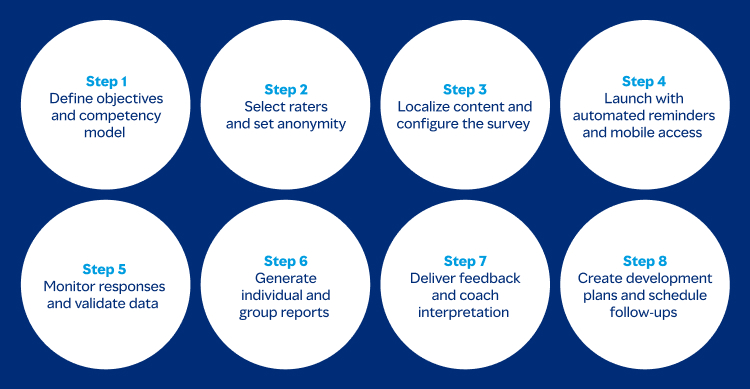
360-degree feedback creates a consistent, trustworthy process that encourages honest, complete responses and makes results more reliable. This consistency improves comparability over time, so insights can be trusted for development planning and impartial talent decisions.
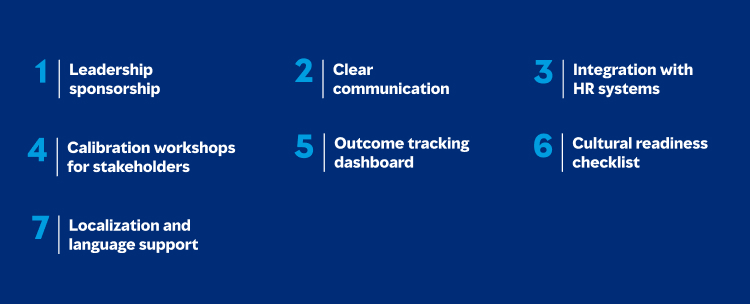
Secure visible support from senior leaders and position the program as development‑first to build credibility and ensure resources for coaching and follow‑up.
Explain purpose, anonymity, who sees results, and data handling in simple terms to boost trust and response rates.
Ensure the feedback outputs feed into LMS, performance review tools, or succession planning systems so insights become part of ongoing talent workflows, not a one‑off report.
Run short group sessions where people leaders review aggregated themes (not names) to align talent implications and remove interpretation of variance across teams.
Publish a simple dashboard that links feedback themes to measurable outcomes (promotion rate, retention, performance shifts) so the program’s impact can be tracked over time.
Assess team readiness for open feedback (psychological safety, leader modeling, communication norms) and surface any interventions needed before launching broadly.
Provide translations, culturally appropriate question phrasing, and local facilitation norms to ensure responses are meaningful and comparable across diverse Singapore teams.
Selecting the right tool is essential as it determines program quality, trust and long‑term impact. The checklist below helps compare options without getting bogged down in technical detail. Use it to pick a vendor that reliably runs the program, protects participant data, and helps turn feedback into measurable people outcomes.
Mercer offers regional tests, structured implementation and enterprise security to ensure 360-degree feedback cycles deliver reliable insights and measurable people outcomes in Singapore.
On‑ground implementation and coaching ensure a smooth regional rollout. Local facilitators help adapt the program to Singapore context.
Research‑backed competency sets are ready to use. Question templates can be edited for role or culture fit.
Anonymity protects identities by masking rater names and showing only aggregated scores and comments, preventing responses from being linked to any individual.
Surveys, reminders, and reports work on phone, tablet, and desktop. This boosts completion rates for remote and deskless staff.
Invitations, reminders, and rater assignments run automatically. Therefore, administrative effort and manual follow‑up are reduced.
Visuals include radar charts, trend views, and team heatmaps. Exportable reports support calibration and decision‑making.
Connectors for Human Resources Information System (HRIS) and Single Sign-On (SSO) simplify workflows. Secure feedback data with ISO‑certified providers, strong encryption, and PDPA controls to protect participant privacy and meet legal requirements.
360‑degree feedback gives Singapore organizations a clear, impartial view of talent that supports smarter people decisions. When running with strong privacy safeguards and local expertise, it builds trust and yields higher‑quality input from diverse teams. The most important outcomes are measurable: better‑justified promotions, faster readiness for key roles, improved retention, and clearer signals for where to invest in development. Over time, aggregated insights reveal trends that strengthen workforce planning and reduce talent risk. Framed as a development tool and supported by local facilitation and secure data practices, 360-degree feedback becomes a practical enabler of resilience and sustainable growth.
Originally published July 8 2026, updated July 23 2026

Talent assessment is a structured process employers use to identify the most suitable job candidates. This test may comprise various questions, job simulations, etc., that employers can use to assess an applicant’s performance and competency for a particular role.


Thanks for submitting the comment. We’ll post the comment once its verified.





 Behavioral Competencies
 Cognitive Competencies
 Coding Competencies
 Domain Competencies










Would you like to comment?