 English







Reimagining talent development to shape future-ready leadership
Summary
From moving beyond traditional leadership programs to building a sustainable leadership pipeline, this article examines the role of holistic talent development in shaping future-ready leaders. It highlights the key pillars and business value of taking a more comprehensive approach to talent development.
Introduction
The future of leadership is being shaped by changes that organizations cannot afford to overlook. Digital transformation, evolving employee expectations, and increasing business uncertainty are redefining what it takes to lead effectively. In this environment, leadership development cannot remain limited to building managerial or functional capabilities. Organizations need a more comprehensive approach that develops the individual, strengthening their skills, mindset, adaptability, and ability to navigate complexity. Holistic talent development offers a pathway to achieve this, enabling organizations to build leadership capabilities that are not only relevant today but resilient enough for the challenges of tomorrow.
Why traditional leadership development is not enough
The expectations from today’s leaders are evolving rapidly. Organizations need leaders who can navigate complexity, adapt to change, and develop people while delivering sustainable business outcomes.
Complex leadership requirements
Leaders must manage digital transformation, diverse teams, uncertainty, and shifting business priorities. This requires a broader combination of strategic, interpersonal, and adaptive capabilities.
Generic plans fall short
A one-size-fits-all approach may overlook individual strengths, skill gaps, career aspirations, and leadership potential. Development must be tailored to each leader’s unique needs and organizational role.
Skills alone aren’t enough
Technical and managerial skills are important, but effective leadership also depends on emotional intelligence, resilience, communication, and self-awareness. These capabilities help leaders build trust and make sound decisions.
Development must continue
Leadership cannot be developed through occasional workshops or annual training programs alone. Continuous coaching, mentoring, feedback, and experiential learning are essential for sustained growth.
Adaptability is essential
Future leaders must be prepared to respond to emerging challenges and changing business environments. Building a growth mindset enables them to learn, unlearn, and adapt effectively.
What holistic talent development really means
Holistic talent development takes a broader approach to building leadership capabilities. Rather than focusing only on individual skills or training programs, it considers the complete development journey, including knowledge, experience, mindset, and future potential.
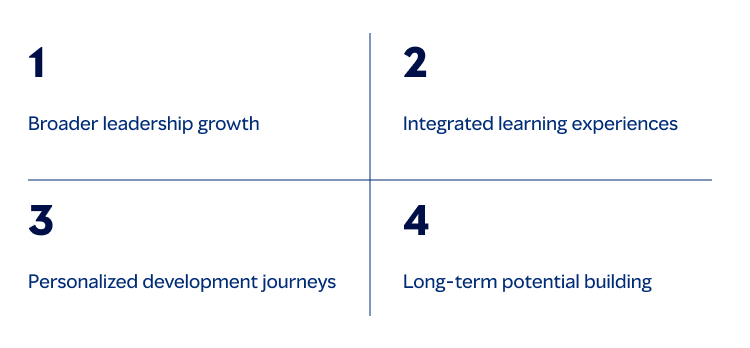
Broader leadership growth
Holistic development builds well-rounded leaders by strengthening professional skills, behavioral capabilities, personal strengths, and leadership potential.
Integrated learning experiences
Development becomes more effective when formal learning is combined with real-world experiences, challenging assignments, and opportunities to apply new skills.
Personalized development journeys
Every individual has unique capabilities, aspirations, and learning needs. Tailored development plans can align individual growth with evolving organizational requirements.
Long-term potential building
Holistic talent development looks beyond current performance to identify and nurture future capabilities. This enables organizations to build a stronger and more sustainable leadership pipeline.
The core pillars of holistic talent development
A strong holistic talent development strategy combines multiple dimensions of growth rather than relying on training alone. These pillars help organizations build leadership capabilities that are relevant, measurable, and aligned with future business needs.
Skills and capability development
Building functional, strategic, and leadership skills enables individuals to perform effectively in their current roles while preparing them for greater responsibilities.
Behavioral and mindset development
Leadership effectiveness also depends on qualities such as emotional intelligence, communication, resilience, adaptability, and a growth mindset. Strengthening these behaviors helps individuals lead people and navigate complex situations.
Assessment-driven insights
Skill assessments provide valuable insights into individual strengths, development gaps, leadership styles, and potential. These insights help organizations create more focused and personalized development plans.
Experiential learning opportunities
Real-world experiences, behavioral assignments, cross-functional projects, and leadership challenges allow individuals to apply what they learn. This helps translate knowledge into practical leadership capabilities.
Continuous coaching and feedback
Regular coaching, mentoring, and constructive feedback reinforce learning and encourage continuous improvement. They also help individuals stay accountable for their development journey.
Career and succession alignment
All leadership development tests and initiatives should connect individual aspirations with organizational talent needs. This creates a stronger leadership pipeline and ensures the right capabilities are available for future roles.
The business value of holistic talent strategy
A holistic talent strategy is not only about developing individual employees; it directly contributes to organizational performance and long-term growth. By aligning talent development with business priorities, organizations can build stronger capabilities and a more future-ready workforce.
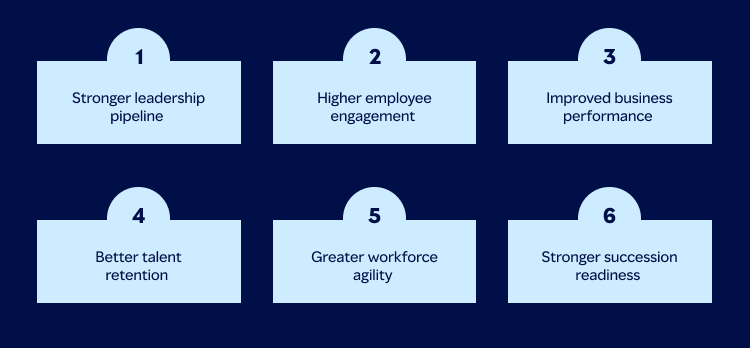
Stronger leadership pipeline
A structured development approach identifies and prepares high-potential talent for critical leadership roles. This creates a steady pipeline of capable leaders for future business needs.
Higher employee engagement
When employees see clear opportunities for learning and career growth, they are more likely to feel valued and invested in the organization. This can strengthen engagement, motivation, and retention.
Improved business performance
Developing the right skills and leadership capabilities enables employees to make better decisions, collaborate effectively, and respond faster to changing business demands.
Better talent retention
Personalized development opportunities give employees a stronger reason to grow within the organization. This can reduce talent loss and preserve valuable organizational knowledge.
Greater workforce agility
Continuous development and learning agility assessment helps employees adapt to new technologies, evolving roles, and changing market conditions. Organizations can therefore respond to disruption with greater confidence and speed.
Stronger succession readiness
A holistic talent strategy helps identify future-ready talent and address capability gaps before critical roles become vacant. This supports smoother transitions and greater business continuity.
Conclusion
The leaders that organizations need tomorrow cannot be developed through yesterday’s approaches. As businesses go through constant disruption, shifting workforce expectations, and increasing complexity, leadership must evolve from being a position of authority to a capability built through continuous growth and experience. Holistic talent development provides the foundation for this shift by preparing individuals not only to lead today, but to anticipate, adapt, and create what comes next. Organizations that make this investment today will be better positioned to build leadership pipelines that are resilient, future-ready, and capable of turning uncertainty into opportunity.
FAQ
1. When should organizations start developing future leaders?
2. Why is traditional leadership development no longer enough?
3. What are the key pillars of holistic talent development?
4. How does holistic talent development benefit organizations?
5. How can organizations implement a holistic talent development strategy?


Talent acquisition is all about strategizing for sourcing, hiring, and retaining the talent an organization needs. This blog offers more insights on the topic.



Get awesome marketing content related to Hiring & L&D in your inbox each week
Stay up-to-date with the latest marketing, sales, and service tips and news
By using our offerings and services, you are agreeing to the Terms of Services and License Agreement and understand that your use and access will be subject to the terms and conditions and Privacy Notice