 English







Efficient, secure, and scalable: Mercer assessments’ transformative approach to test management
In today’s hyper-competitive talent landscape, assessments have evolved into indispensable tools for hiring, upskilling, academic evaluation, and certification. Yet, as organizations scale and the complexity of assessments intensifies, the demand for operational efficiency at every stage of the assessment lifecycle has never been greater. From initial test creation to final deployment and analysis, each step must be executed with precision, agility, and clarity to drive meaningful talent decisions.
Assessment platforms need to deliver efficiency across all steps, particularly when it comes to the test creation experience—a pivotal phase that fundamentally shapes the quality, relevance, and fairness of talent evaluation. Often relegated to a secondary concern, test creation is too frequently encumbered by fragmented workflows, limited customization, and cumbersome interfaces that sap productivity and introduce risk.
Mercer Assessments recognizes that true operational excellence in talent evaluation requires a holistic approach—one that delivers efficiency, control, and user empowerment at every juncture. By reimagining the test management platform with a sharp focus on clarity, structure, and usability, Mercer ensures that organizations can not only manage growing assessment inventories with ease but also craft high-quality tests seamlessly and intuitively.
Whether you are orchestrating large-scale recruitment campaigns, managing diverse academic programs, or driving enterprise-wide learning initiatives, the ability to build, organize, and monitor assessments with precision and speed is a strategic imperative. Mercer Assessments’ latest enhancements deliver on this imperative by embedding efficiency into the very fabric of the assessment process—transforming what was once a complex, fragmented task into a streamlined, scalable, and user-centric experience.
Re-thinking assessment organization for increased efficiency: Folder-based test management process that improves control
Managing a growing repository of assessments often requires extra effort from test creators to maintain structure amidst expanding test inventories. As the volume and diversity of these tests expands, locating, categorizing, and managing assessments becomes increasingly challenging.
Mercer Assessments’ intuitive organizational framework can help declutter and improve efficiency, especially for administrators overseeing multiple assessments across varied subjects, departments, or hiring processes.
Seamless folder-based organization enables structured test creation
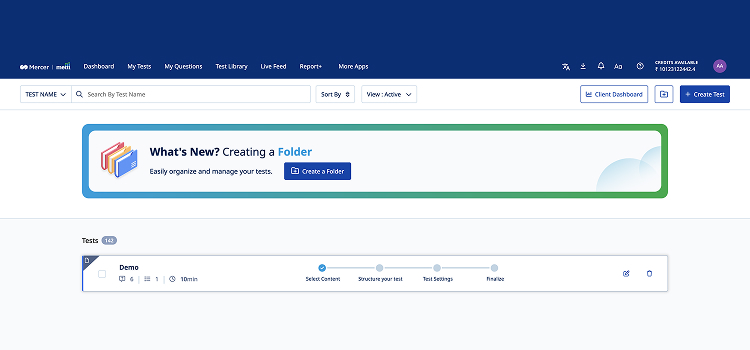
The implementation of a folder-based organization system has fundamentally improvesd this experience. Now, users can create dedicated folders to logically group related assessments based on criteria such as subject matter, job role, department, or testing cycle. This hierarchical structure supports both primary folders and nested subfolders, enabling a granular and scalable classification system that adapts to the complexity of organizational needs.
Flexible assessment management to support clear decision-making
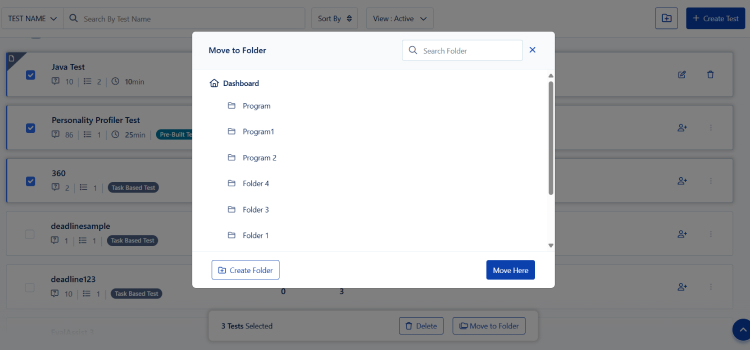
A key feature of this system is its flexibility in managing assessments. Users can seamlessly move assessments into folders, individually or in bulk, facilitating effortless reorganization as requirements evolve.
Simple, user-friendly sorting options
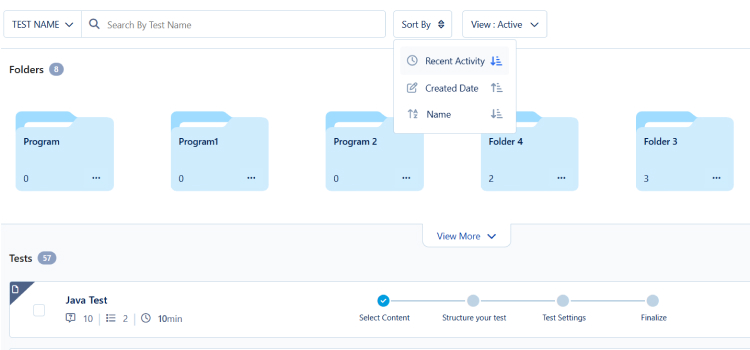
To further simplify accessibility and navigation, the platform offers advanced sorting capabilities, allowing both folders and individual assessments to be organized based on recent activity, name, or creation date. This empowers users to quickly locate relevant tests and maintain a repository regardless of scale.
An intuitive test creation experience: Streamlined workflows, draft management, and interactive UI to unlock productivity
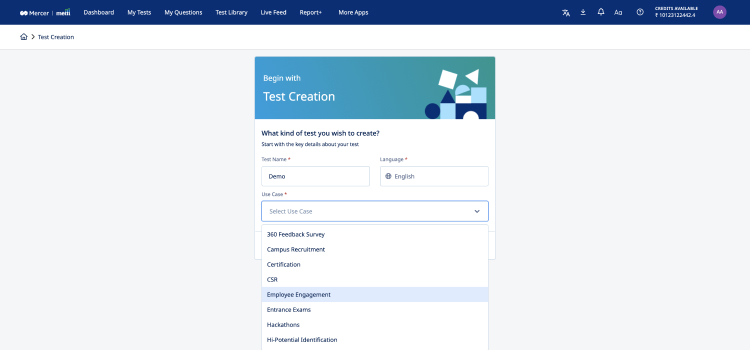
Creating a test should be simple, clear, and efficient. The new test creation experience is meticulously designed to offer a streamlined workflow that simplifies the process while maintaining the flexibility required for diverse assessment needs.
At the core of this new experience is a four-step workflow:
Select the content
Users begin by choosing questions from Mercer Assessments’ expansive repository using the Content Explorer, which allows seamless browsing of pre-built questions and modules, as well as the option to create custom content.
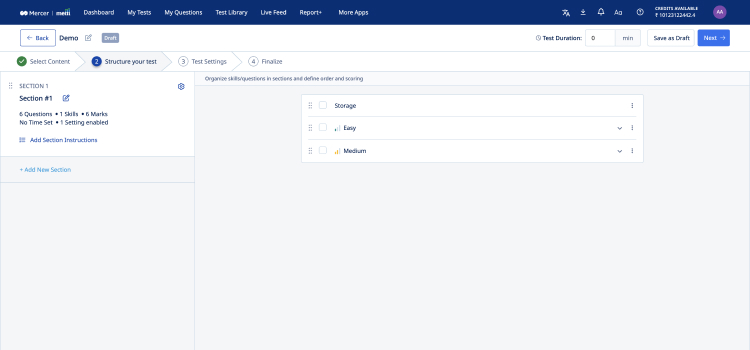
Structure the test
Once content is selected, users can organize questions into appropriate sections, define scoring schemes, and determine test flow to ensure it aligns with assessment goals.
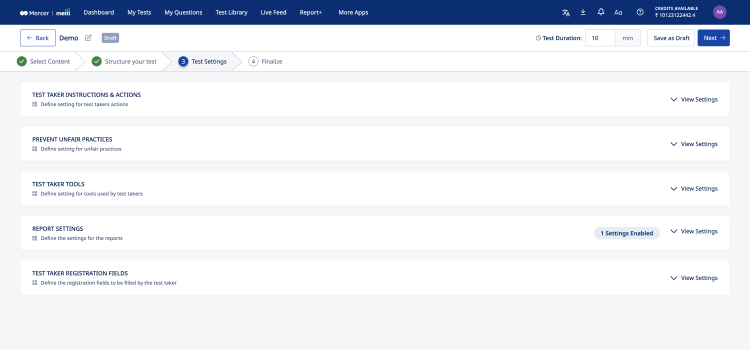
Test settings
Administrators can configure advanced parameters, such as time limits, proctoring settings, access restrictions, and scoring logic to meet specific assessment requirements.
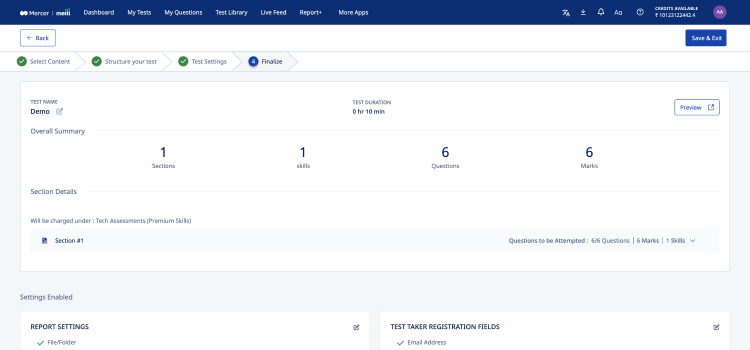
Finalize the test
After review, tests can be finalized and published for deployment. Alternatively, the Save as Draft feature allows tests to be saved midway, enabling flexible, iterative development.
The Save as Draft feature helps users pause and return to their work without losing progress. Each draft is displayed on the My Tests page with a progress bar, showing the amount completed at a glance.

Complementing the functional enhancements, the platform offers several UI/UX refinements that elevate the overall experience:
Conclusion
Efficient assessment management is no longer just a convenience—it’s a strategic imperative for organizations aiming to scale testing operations, uphold rigorous quality standards, and minimize administrative burden. As test libraries expand and use cases diversify, leveraging the right tools to organize, create, and monitor assessments becomes a critical driver of operational performance and talent outcomes.
Mercer Assessments’ key innovations, including the robust folder-based organization system, deliver unparalleled clarity and control—even within the most complex and expansive assessment portfolios. The redesigned test creation experience transforms what was once a cumbersome process into a streamlined, intuitive workflow that empowers users to build high-quality assessments with speed and precision. Complemented by a modernized interface, real-time test status indicators, and advanced sorting capabilities, these enhancements elevate both the efficiency and user experience to new heights.
By simplifying complexity and embedding intelligence throughout the platform, Mercer Assessments enables organizations to work smarter, reduce friction, and focus on what truly matters—making talent evaluation more effective, scalable, and impactful.




Get awesome marketing content related to Hiring & L&D in your inbox each week
Stay up-to-date with the latest marketing, sales, and service tips and news
By using our offerings and services, you are agreeing to the Terms of Services and License Agreement and understand that your use and access will be subject to the terms and conditions and Privacy Notice