

Psychometric tests improve the quality of hire in the UAE by adding objective, role-focused data to the recruitment process. The article defines hire quality, outlines UAE-specific hiring challenges, and shows how validated, localized assessments help predict performance and reduce turnover. It also covers industry examples, simple best practices for tests, and how to choose the right platform.
The UAE’s labor market is shaped by large expatriate talent pools, with 92 % of their workforce being foreign workers. Combined with local employment policies and regulatory obligations, this makes recruiting a complex management challenge.
Screening methods such as CV review and unstructured interviews reveal credentials and presentation but do not reliably indicate who will perform, learn, and remain productive over time. Psychometric assessments provide objective, role-relevant insights that complement human judgment and help hiring teams make defensible decisions.
When assessments are validated for the local context and integrated into a structured hiring process, they reduce mismatches, shorten time-to-productivity, and improve retention.
This blog examines the quality of hire in the UAE, the market forces that complicate recruitment, and how psychometric testing can lift hiring outcomes across industries.
Quality of hire is a composite measure that captures how well a new employee performs and integrates after joining an organization. It goes beyond simply filling a vacancy; it measures whether the hire meets role-specific performance expectations, aligns with team and company culture, stays long enough to justify the recruitment investment, and makes a productive contribution quickly.
Measuring quality of hire connects recruiting decisions directly to business outcomes (revenue, productivity, retention costs and team effectiveness), so hiring becomes a strategic investment rather than an administrative task.
Quality of hire is best understood through measurable indicators that link recruitment to business outcomes.
| Metric | Definition | Impact on business |
|---|---|---|
| Performance | Role success metrics such as KPIs, targets, and output quality | Drives revenue, customer satisfaction, and operational output |
| Retention | Employee tenure and early attrition rates | Lowers cost-per-hire, preserves institutional knowledge, and reduces onboarding time |
| Cultural fit | Alignment with company values, team norms, and working style | Improves collaboration and morale; reduces interpersonal conflict and turnover |
| Time-to-productivity | Time taken for a new hire to reach expected performance levels | Shortens ramp-up costs and accelerates contribution to business goals |
The UAE labor market presents distinct hiring challenges, such as a multicultural population and Emiratization, with 92 % of the workforce being foreign employees.
These factors influence how organizations source, assess, and retain talent. Understanding these dynamics helps employers design recruitment strategies that reduce risk and improve outcomes.
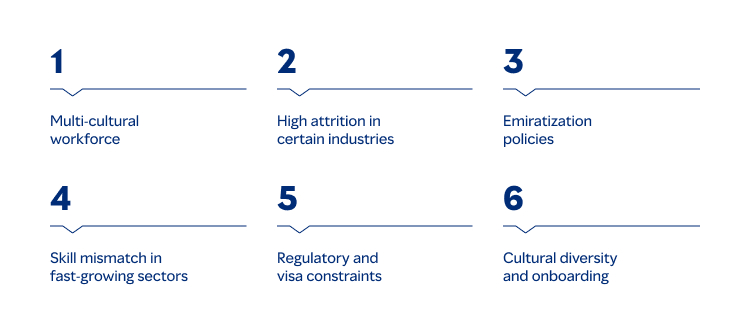
Wide variation in nationalities, languages, and work norms complicates candidate assessment and increases the risk of miscommunication during hiring. This diversity can lead to inconsistent interview interpretations and difficulty benchmarking soft skills across different cultural norms.
Retail, hospitality and BPO face rapid turnover and repeated hiring cycles that strain sourcing, screening and onboarding capacity. Frequent churn drives operational costs and forces recruiters to prioritize speed over thorough evaluation.
Mandatory national employment targets add complexity to workforce planning and create competing priorities in recruitment. Organizations must balance quota-driven hiring with the need to meet role-specific capability and productivity requirements.
Rapid expansion in tech, logistics and fintech has produced gaps between advertised qualifications and locally available, job‑ready talent. Recruiters often receive CVs that appear relevant but lack demonstrated practical experience for specialized roles.
Work permits, visa processing times and labor regulations frequently delay start dates and limit candidate mobility. These delays create uncertainty for business planning and can lead to lost offers or prolonged vacancies.
Diverse cohorts require tailored onboarding approaches; inconsistency in onboarding risks slower integration and early disengagement. Without culturally sensitive onboarding, new hires may struggle with norms, communication styles, and team collaboration.
In the competitive UAE labor market, hiring decisions must be fast, impartial, and predictive. Psychometric tests help by adding objective, job-relevant data to traditional screening methods, so employers can make evidence-based choices.
In the UAE’s multicultural labor market, psychometric tests provide standardized, comparable data for every candidate. Therefore, reducing reliance on subjective impressions influenced by nationality, CV format, or language and creating impartial shortlisting.
Validated cognitive and situational judgment tests help UAE employers identify candidates who can learn quickly, solve problems, and meet local role demands. This is especially valuable where on‑the‑job training time is costly. Mercer offer different types of cognitive and SJTs tests to measure the candidate capabilities.
Personality and values assessments reveal how candidates will behave in multinational teams and align with company norms. This helps to reduce friction in diverse UAE workplaces and improve team collaboration.
By matching strengths and role requirements, tests lower the risk of mismatched hires in high‑churn sectors such as retail, hospitality and BPO, cutting repeat recruitment and onboarding costs common in the UAE market.
Online assessments allow UAE organizations to screen large, expatriate-heavy applicant pools consistently and quickly, helping maintain hiring quality during peak recruitment drives or seasonal demand.
Test results give UAE hiring teams concrete evidence to tailor interviews, onboarding, and development plans for diverse hires. This improves consistency across offices and reduces subjective judgment calls.
For UAE employers navigating regulatory constraints, multicultural teams and sectoral skill gaps, psychometric testing reduces bias, improves performance prediction and fit. This helps lower turnover, accelerate time to productivity, strengthen business outcomes, and employer competitiveness.
In the UAE, sector-specific assessments help employers screen large, diverse applicant pools and make more consistent hiring decisions.
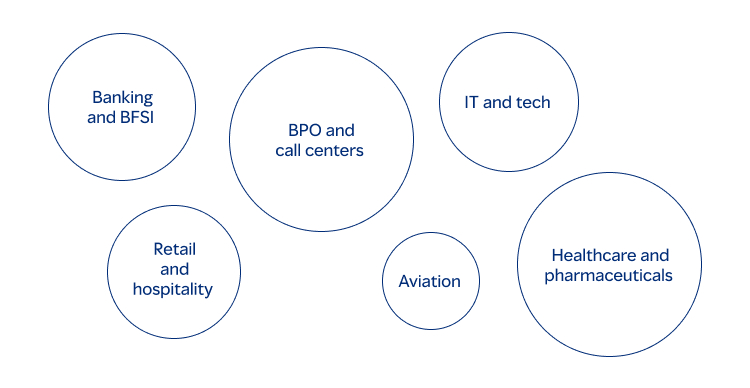
Psychometric tests measure analytical reasoning, risk tolerance, and decision-making under pressure to identify candidates who can handle compliance, credit decisions, and complex financial tasks in the UAE.
Psychometric assessments evaluate service orientation, problem-solving, and situational judgment to find staff who deliver consistent customer experiences in diverse, high-volume environments.
Cognitive and aptitude tests check logical reasoning, coding ability, and learning agility to identify candidates who can adapt quickly to new projects and technologies.
Cognitive and situational judgment assessments measure attention, spatial reasoning, and decision-making to ensure candidates meet strict safety and operational standards.
Behavioral and communication tests assess empathy, stress tolerance, and clarity to select agents who perform reliably with multinational customer bases.
Situation judgment assessments evaluate attention to detail, ethical judgment, and teamwork to ensure clinicians and support staff meet patient safety, compliance, and collaboration requirements.
In the UAE, where workforces are multicultural and compliance and candidate expectations matter, following targeted best practices ensures assessments are impartial, relevant, and useful for hiring decisions.
Map each test to the specific skills and behaviors a role requires, so results directly inform shortlisting, interview focus and final hiring decisions.
Select assessments with documented reliability and validity to ensure scores meaningfully predict job performance and stand up to scrutiny.
Adapt language, examples and cultural references, according to the UAE’s multilingual, multinational candidate pool.
Use test results to shape structured, competency-based interview questions rather than replace human judgment.
Obtain informed consent, limit access to results, and store assessment data securely in line with UAE data protection and employment rules.
Equip recruiters and hiring managers with guidance and examples, so they interpret reports correctly and apply results consistently.
Combine psychometric scores with references, work samples and interviews to create a holistic view of candidate suitability.
Tell candidates why tests are used, how results influence decisions, and what the next steps are to build trust and improve response rates.
Regularly track quality-of-hire metrics, validity checks, and candidate feedback to refine test selection, scoring thresholds, and process integration.
Choosing the right psychometric platform is a strategic decision that affects hiring quality, cost efficiency, and employer reputation.
An inadequate choice can lead to misleading results and a slower time-to-hire, while the right partner supports scalable, data-driven recruitment and measurable ROI.
Psychometric testing offers UAE employers a pragmatic route to better hiring outcomes and stronger workforce performance. When assessments are validated, localized, and used with structured interviews, they reveal job-relevant strengths and development needs that resumes alone miss. This clarity reduces the risk of costly mismatches and enables more effective onboarding and targeted training. Starting with pilot projects and clear success metrics allows organizations to prove impact and scale assessment use where it drives the most value. Over time, this approach improves recruitment ROI, supports leadership development and local hiring initiatives, and positions employers to compete more effectively for top talent.
Originally published July 1 2026, updated July 23 2026






 Behavioral Competencies
 Cognitive Competencies
 Coding Competencies
 Domain Competencies