

Culture fit in Filipino teams is shaped by harmony, respect, and teamwork, which influence how people collaborate day to day. Psychometric assessments help evaluate these behaviors in a structured and consistent way, beyond interviews alone. The blog also shares a step-by-step framework for integrating assessments into hiring to support better team alignment.
Hiring for culture fit in the Philippines goes beyond checking role skills and experience. Teams should also consider whether a candidate’s working style matches the team environment, and how they collaborate, communicate, manage pressure, and respond to direction. These factors greatly influence team effectiveness and service quality, especially in roles that require coordination and regular stakeholder interaction.
Culture fit is also highly vulnerable to inconsistency. Interview outcomes can differ depending on the interviewer, time limitations, and personal interpretation. This makes consistent evaluation even more important. Psychometric assessments add structure by converting work behaviors into consistent, comparable insights.
When combined with interviews and role-based validation, psychometrics support more consistent hiring decisions, smoother onboarding, and stronger engagement and retention over time.
In Filipino teams, culture fit is more about how a person contributes to healthy working relationships and strong teamwork. The workplace tends to value respect, consideration, and a shared commitment to helping the group succeed. Two cultural concepts often shape this team dynamic: Pakikisama and Bayanihan.
Psychometric assessments are standardized tools designed to measure aspects of an individual’s work-related capabilities, such as personality traits, behavioral tendencies, communication style, and problem-solving approach. Organizations commonly use them to support hiring, team development, and leadership programs by adding structured, comparable insights to the selection process.
Unlike unstructured interviews, psychometric tests use consistent questions and scoring methods, which can improve objectivity and the quality of hiring decisions.
With the employment rate reported at 95.2% in May 2026 as per the Labor Force Survey by the Philippine Statistics Authority, competition for reliable, culture-aligned talent will increase. This makes consistent evaluation even more important. Psychometric assessments add structure by converting work behaviors into consistent, comparable insights.
Psychometric assessments provide a structured way to evaluate work-related behavior, such as communication approach, teamwork preferences, and decision-making style. This helps hiring teams move beyond instinct-based judgments by adding consistent, data-backed insights.
Because every candidate is assessed using the same format and scoring approach, results are easier to compare across applicants, roles, and interview panels.
In Filipino teams, culture fit is often reflected in how people work with others and contribute to collective outcomes. Psychometric evaluation can help identify candidates who are naturally oriented toward teamwork and harmony (often linked to pakikisama), who demonstrate respectful and thoughtful interpersonal style, and who can adapt to different stakeholders and working conditions.
They can also surface indicators of service mindset, which is important in many Philippines-based roles that require reliability, responsiveness, and strong client or internal customer support.
Culture fit can become subjective when assessed primarily through informal impressions or personal preference. Psychometric tools introduce structured scoring and common evaluation criteria, which support more consistent decision-making across interviewers.
When aligned to role requirements and used as one input among several, assessments can improve justness. It can also help organizations maintain diversity while still hiring people who will collaborate effectively within the team.
Psychometric insights can help hiring managers anticipate how a candidate may work within a specific team environment. For example, assessments can highlight whether a person is more collaborative or independent, how they typically handle disagreement and tension, and what communication style they prefer in day-to-day work.
This makes it easier to plan onboarding, manager support, and team integration, particularly for roles that depend on close coordination and stakeholder interaction.
When employees join a team where work styles, communication norms, and expectations are aligned, their transition is usually smoother and more motivating. Psychometric evaluations support this alignment by identifying role-relevant preferences and behavioral tendencies early in the hiring process.
As a result, organizations can reduce early friction, strengthen manager–employee working relationships, and improve clarity on how work is done within the team. Over time, this structured matching of candidates to team requirements can support higher job satisfaction and engagement, particularly in roles where teamwork and service delivery are central.
In industries with large hiring volumes, maintaining consistency in culture-fit evaluation can be challenging when many recruiters and hiring managers are involved. Psychometric assessments provide a repeatable way to measure relevant behavioral traits at scale while maintaining consistent criteria across locations and hiring processes. This approach is particularly useful in sectors such as BPOs, retail, and logistics, where reliability, service orientation, teamwork, and adaptability directly influence performance and customer experience.
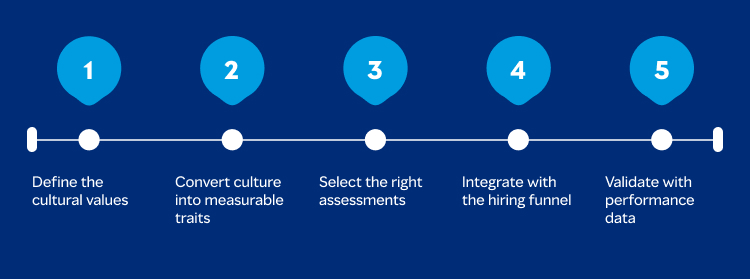
A strong culture fit strategy for Filipino teams works best when it is clearly defined, measured consistently, and used alongside interviews. The goal is to reflect how teams actually work (collaboration norms, respect for structure, and service expectations) and translate that into objective, job-relevant signals.
Mercer’s psychometric assessments enable structured, evidence-based talent decisions across hiring and development. They are designed to improve job relevance, strengthen evaluation consistency, and turn assessment results into practical insights for hiring teams.
Designed with regional language nuances and workplace norms in mind, which improves relevance for candidates and clarity for evaluators. This helps teams interpret results within the appropriate cultural context.
Assessments can be aligned to industry expectations and role requirements, so the evaluation focuses on job-critical behaviors and capabilities. This supports more precise selection and more targeted interview validation.
It offers reports that can be tailored to specific roles, industries, and business priorities, ensuring hiring teams see the most relevant competencies and signals. This makes outputs easier to apply directly in selection decisions.
Integrates with widely used recruiting and HR platforms so teams can initiate assessments, track completion, and access reports within their existing workflow. Flexible integration options support different technology environments and reduce manual effort.
Presents results by individual competencies, clearly indicating areas of demonstrated strength and areas requiring development. This enables role-specific development planning, targeted coaching, and progress tracking against defined competency standards.
Building strong Filipino teams means hiring intentionally, not just for capability, but also for the behaviors that support collaboration and service quality over time. Psychometric assessments help organizations set clear, measurable expectations and apply them consistently, even when many stakeholders are involved. The most effective approach is to treat assessments as a decision support tool: define the culture you want to strengthen, assess for role-relevant behaviors, and validate results through structured conversations. When organizations do this, culture fit becomes a repeatable hiring standard rather than an individual opinion.
Originally published August 12 2026, updated August 12 2026

Talent acquisition is all about strategizing for sourcing, hiring, and retaining the talent an organization needs. This blog offers more insights on the topic.


Thanks for submitting the comment. We’ll post the comment once its verified.





 Behavioral Competencies
 Cognitive Competencies
 Coding Competencies
 Domain Competencies












Would you like to comment?