 English







How talent assessments help organizations find high-potential interns
Summary
Talent assessments strengthen internship hiring by evaluating intern potential, role-fit skills, and workplace readiness beyond resumes and academic scores. It outlines the key skills and assessment types to use, how to integrate them into the hiring workflow, and the metrics to track for better outcomes.
Introduction
Intern selection plays a critical role in shaping future talent pipelines, but identifying the right candidates can be challenging when experience-based indicators are limited.
Organizations need evaluation methods that highlight capabilities beyond academic achievements and application profiles.
Talent assessments help bridge this evaluation gap by providing structured insights into candidates’ abilities, strengths, and readiness for professional responsibilities. When integrated into the hiring process, they support better candidate selection and improve the overall effectiveness of internship programs.
Why do organizations need a specialized approach for hiring interns?
Hiring interns requires a different evaluation strategy because most candidates have limited professional experience and are at the beginning of their careers. Instead of relying solely on academic credentials or resumes, organizations need objective methods to assess potential, skills, and workplace readiness.
- Interns often lack professional experience, limiting the value of resume-based screening.
- Academic performance alone does not accurately predict workplace success.
- Hiring decisions should focus on learning potential rather than past achievements.
- Practical and soft skills require structured evaluation beyond interviews.
- Many candidates possess transferable skills that resumes fail to demonstrate.
- Internship roles prioritize adaptability and willingness to learn over existing expertise.
- Recruiters must identify candidates with the highest potential to succeed in professional environments.
Skills every organization should assess before hiring interns
Assessing the right capabilities helps organizations identify interns who can perform effectively, learn quickly, and adapt to professional environments. A well-rounded evaluation should focus on both technical competencies and workplace behaviors required for successful internships.
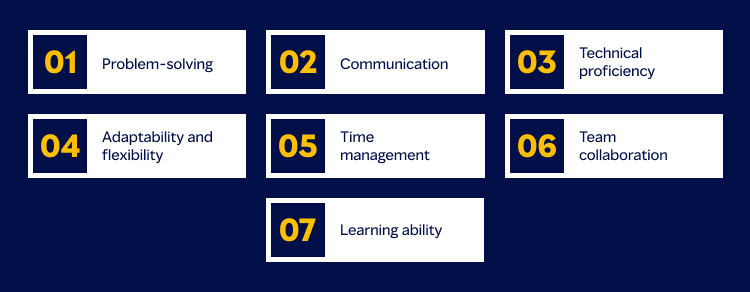
Problem-solving
Evaluate candidates’ ability to analyze challenges, think logically, and develop effective solutions in practical situations using problem-solving assessments.
Communication
With the help of communication assessments, assess how clearly a candidate expresses ideas, collaborates with teams, and shares information in professional settings.
Technical proficiency
By assessing candidates through technical assessments, organizations assess role-specific knowledge and foundational expertise required to handle internship responsibilities effectively.
Adaptability and flexibility
Identify candidates who can adjust to new tasks, processes, and changing workplace expectations.
Time management
Understand candidates’ ability to prioritize tasks, meet deadlines, and manage multiple responsibilities efficiently.
Team collaboration
Evaluate how candidates contribute to group efforts, communicate with peers, and build positive working relationships.
Learning ability
Assess candidates’ willingness and capability to acquire new knowledge and develop relevant expertise quickly with the learning agility assessment.
Types of talent assessments used for internship hiring
Different internship roles require different evaluation methods to identify candidates with the right capabilities and potential. Organizations can combine multiple assessment approaches to gain insights into a candidate’s technical knowledge, cognitive abilities, and workplace readiness.
Aptitude assessments
Aptitude tests such as numerical reasoning, logical reasoning, and verbal reasoning assessments measure analytical thinking and problem-solving capabilities.
Technical assessments
Role-based technical tests evaluate candidates’ practical knowledge and ability to apply technical concepts to specific internship responsibilities.
Communication assessments
Written communication tests and language proficiency assessments examine candidates’ ability to express ideas clearly and collaborate effectively.
Cognitive ability assessments
Cognitive ability tests measure learning capacity, information processing, and the ability to understand complex concepts quickly.
Behavioral assessments
Personality tests and behavioral assessments provide insights into work preferences, collaboration patterns, and professional behaviors.
Situational judgment tests
Situational judgment assessments evaluate how candidates respond to workplace situations and make effective decisions.
Coding assessments
Programming and coding assessments evaluate technical knowledge, logical reasoning, and problem-solving abilities for technology-focused internships.
How to integrate talent assessments into your internship hiring process
Integrating talent assessments into the internship hiring process helps organizations create a structured and efficient evaluation approach. When used at the right stages, assessments provide deeper candidate insights while complementing resumes, interviews, and other selection methods.
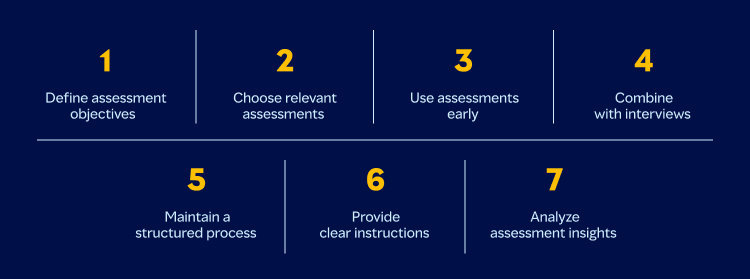
Define assessment objectives
Identify the specific skills, competencies, and traits required for each internship role before selecting an assessment approach.
Choose relevant assessments
Select evaluation methods that align with role requirements and accurately measure the capabilities needed for successful internship performance.
Use assessments early
Introduce assessments during initial screening to efficiently identify candidates who match the internship requirements.
Combine with interviews
Use assessment results alongside interviews to gain a complete understanding of candidates’ abilities and potential.
Maintain a structured process
Create consistent evaluation steps to ensure every candidate is assessed impartially and objectively.
Provide clear instructions
Communicate assessment expectations, timelines, and evaluation criteria to create a transparent candidate experience.
Analyze assessment insights
Review assessment results carefully to make informed hiring decisions based on measurable candidate capabilities.
Key metrics to measure the success of talent assessments
Measuring the effectiveness of talent assessments helps organizations understand whether their evaluation process is improving internship hiring outcomes. Tracking relevant metrics enables recruiters to optimize assessments and make more informed selection decisions.
- Track assessment completion rates to measure candidate engagement and process efficiency.
- Compare assessment scores with internship performance to evaluate predictive accuracy.
- Monitor time-to-hire improvements achieved through streamlined candidate evaluation.
- Measure the quality of hires based on intern productivity and contribution levels.
- Analyze candidate feedback to improve assessment experience and relevance.
- Evaluate conversion rates of interns progressing into full-time roles.
- Review diversity metrics to ensure impartial candidate evaluation.
Conclusion
Talent assessments play an important role in creating a more effective and structured internship hiring process. By providing deeper insights into candidate capabilities, they help organizations identify interns who are better prepared to learn, adapt, and contribute.
The impact of these assessments extends beyond initial hiring decisions. They help organizations build stronger talent development practices, improve internship experiences, and create a foundation for nurturing skilled professionals over time.
FAQs
Why are talent assessments important for hiring interns?
What skills should companies assess when hiring interns?
Which types of assessments are suitable for internship hiring?
Can talent assessments replace interviews during intern hiring?
How do talent assessments improve the intern hiring process?
 Pre-Employment Test
 Psychometric Test/Assessment
Related Products






Get awesome marketing content related to Hiring & L&D in your inbox each week
Stay up-to-date with the latest marketing, sales, and service tips and news
By using our offerings and services, you are agreeing to the Terms of Services and License Agreement and understand that your use and access will be subject to the terms and conditions and Privacy Notice