 English







Communication skills assessment in campus hiring: How to identify job-ready talent
Summary
Learn why assessing communication skills is essential in campus hiring and how it enhances selection quality. It helps identify graduates who speak clearly, listen carefully, follow instructions, and write professional workplace messages.
Introduction
Communication skills are one of the key indicators of how effectively graduates transition into the workplace. The ability to articulate ideas clearly, engage in meaningful discussions, and collaborate with confidence influences not only individual performance but also team effectiveness and overall business outcomes. Despite their significance, these skills are often overlooked or assessed subjectively during campus hiring.
A structured communication skills assessment provides organizations with a more objective way to evaluate job readiness, enabling informed hiring decisions and helping build a stronger pipeline of high-potential early-career talent.
Why communication skills matter in campus hiring
Communication has become one of the strongest indicators of early success for campus hires. It shapes how quickly freshers learn, collaborate, and deliver in real workplace environments. Further, it also extends beyond spoken confidence to include active listening, clear writing, and accurate understanding of instructions.
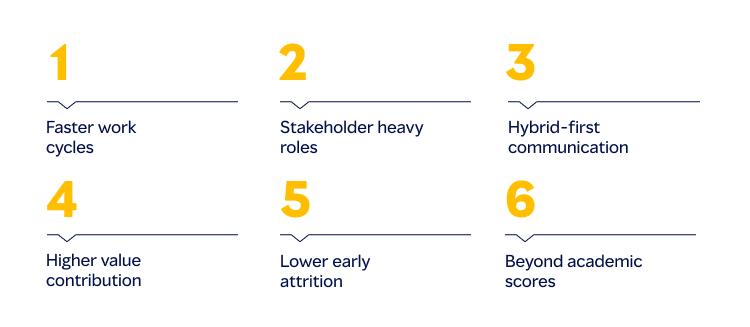
Faster work cycles
Work moves quickly across teams, so freshers must share clear updates, ask focused questions, and prevent misunderstandings that can slow delivery.
Stakeholder heavy roles
Many entry-level roles involve clients or internal stakeholders, so communication quality shapes trust, service experience, and overall brand perception from day one.
Hybrid-first communication
Hybrid work increases writing demands, so candidates must draft crisp emails, chats, and status notes that are easy to scan and act on.
Higher value contribution
Automation reduces routine tasks, so value comes from explaining insights, summarizing outcomes, and influencing next steps through clear communication.
Lower early attrition
Many early exits stem from expectation gaps. The assessment helps identify candidates who seek clarity, accept feedback, and integrate into teams faster.
Beyond academic scores
Grades do not always reflect workplace readiness; the communication assessment provides a practical lens for predicting training success and day-to-day execution.
Key communication skills to evaluate in campus hiring
A strong campus hiring assessment should measure communication as a set of practical workplace skills. The aim is to identify candidates who accurately follow instructions, provide clear updates, write professional messages, and respond confidently in real workplace situations.
1) Speaking fluency
What it means: Smooth spoken delivery that helps the listener follow ideas without effort.
What to look for:
- Maintains a steady pace
- Uses simple transitions to connect points
- Completes answers without losing direction
- Handles follow-up questions with stability
2) Pronunciation and clarity
What it means: Clear speech that makes the message easy to understand in everyday workplace conversations.
What to look for:
- Pronounces key words clearly and consistently
- Keeps volume and pace at a level that supports understanding
- Stresses important words to highlight meaning
- Avoids mumbling and rushed delivery
3) Active listening
What it means: Pays attention to what is said and can respond to the real requirement.
What to look for:
- Responds to the exact question
- Clarifies when the question is unclear
- Reflects key details before answering
- Avoids interrupting and rushing to respond
4) Reading comprehension
What it means: Understanding written information and extracting the correct meaning and next steps.
What to look for:
- Identifies the main message
- Spots key requirements and constraints
- Summarizes accurately in simple language
- Separates facts from assumptions
5) Grammar and vocabulary
What it means: Language accuracy that supports professional communication and prevents confusion.
What to look for:
- Uses basic grammar correctly
- Chooses words that fit a professional setting
- Avoids errors that change meaning
- Explains technical or complex points in simple terms
6) Business writing basics
What it means: Writing that is clear, structured, and professional in email and chat.
What to look for:
- States purpose early
- Keeps writing structured and easy to scan
- Uses professional tone and respectful language
- Includes clear actions and ownership
- Avoids vague statements and incomplete requests
7) Workplace communication scenarios
What it means: Practical communication behavior in realistic work situations.
What to look for:
- Shares progress updates with clarity
- Escalates risks early with a solution mindset
- Asks for help with a clear context
- Responds to feedback professionally
- Manages disagreement with respect and calm
Best practices for designing a campus communication assessment
A strong campus communication assessment should be practical and role-aligned. It must be consistent across candidates and easy to score.
Define role-specific benchmarks
Set clear proficiency levels by role and level. Align to daily tasks like updates, client calls, and documentation.
Combine aptitude with communication
Evaluate both reasoning and expression. Strong logic without clarity, or clear speech without thoughtful content, both create risk.
Use adaptive difficulty levels
Start simple, then increase complexity. This separates basic readiness from high potential without overwhelming candidates.
Keep assessments under 30–40 minutes
Short assessments improve completion and reduce fatigue. Focus on high signal tasks that predict job success.
Include real workplace scenarios
Use manager updates, client emails, delay escalations, and clarification questions. This reveals practical workplace readiness.
Use proctoring for secure remote hiring
Enable identity verification, browser-level controls, and flagged behavior alerts through remote proctoring. This strengthens test integrity and keeps evaluation consistent across locations.
Mercer’s communication skills assessments for campus hiring
Mercer’s communication skills assessments bring structure and consistency to an area that is often evaluated subjectively in campus hiring. They enable recruiters to measure communication through practical workplace contexts. They also support more consistent comparisons across candidates from different colleges and regions.
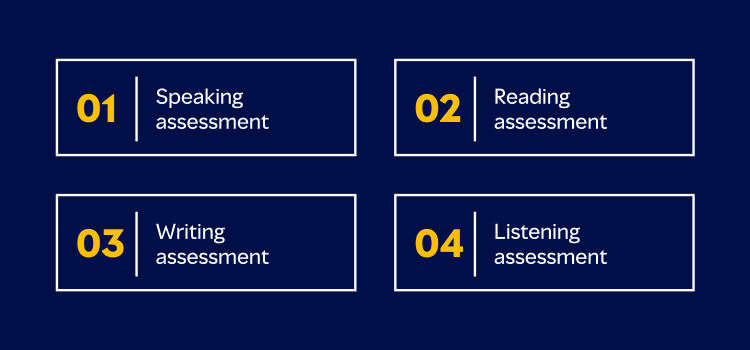
Speaking assessment
Offers SpeechX to assess four core competencies for spoken communication. It evaluates pronunciation for speech clarity, fluency for pace and flow, grammar for language accuracy, and listening comprehension for accurate responses to spoken prompts.
Reading assessment
Features comprehension passages of varying lengths and complexities. The reading test also offers questions designed to match global GMAT and SAT standards for accuracy and critical understanding.
Writing assessment
Offers a writing skills test that uses automated scoring to review coherence, grammar, spelling, and vocabulary. It also checks overall readability across common written formats and how effectively candidates communicate ideas in a professional tone.
Listening assessment
Measures listening comprehension and response accuracy, including the ability to understand both native and non-native English accents. Listening skill assessment also offers auto-grading for objective scoring and quicker hiring decisions.
Conclusion
Effective campus hiring requires organizations to look beyond academic qualifications and evaluate the skills that influence workplace success. Communication skills assessment provides valuable insights into a candidate’s ability to collaborate, express ideas, and adapt to professional environments. By incorporating a structured approach to assessing communication capabilities, organizations can make more informed hiring decisions and identify fresh talent with the potential to contribute from the beginning.
As the demand for job-ready graduates continues to grow, communication skills assessment will remain a critical part of building a strong and capable workforce.
FAQs
Why should recruiters assess communication skills before interviews?
Which communication skills are most important for fresh graduates?
How long should a campus communication assessment be?
Can communication assessments predict workplace readiness?
What roles require a communication assessment in campus hiring?
Can communication tests be customized for different campuses?
How can recruiters benchmark communication skills across colleges?


 Cognitive Test/Assessment
 Talent Assessment
Related Products




Get awesome marketing content related to Hiring & L&D in your inbox each week
Stay up-to-date with the latest marketing, sales, and service tips and news
By using our offerings and services, you are agreeing to the Terms of Services and License Agreement and understand that your use and access will be subject to the terms and conditions and Privacy Notice