 English







Sales hiring strategy: The fastest way to boost your bottom line
Summary
This article provides a practical, step-by-step guide to hiring salespeople. It defines a sales hiring strategy, outlines proven tactics to improve hiring quality, and explains how to implement a sales hiring workflow. It highlights the core skills that predict sales success and concludes by identifying key hiring metrics and describing how Mercer Assessments can help operationalize the process.
Introduction
When a sales hire fails to perform, the organization loses much more than the cost of a salary; it loses valuable market opportunities, prospective clients, and irreplaceable time. This frequent turnover usually traces back to a single, addressable issue: the lack of a proper sales-hiring strategy.
Without a structured strategy, consistently finding and keeping top-performing reps is nearly impossible. A dedicated hiring strategy solves this problem by bringing clarity, structure, and predictability to the talent search.
To help organizations optimize their recruitment process, this article introduces the different strategic options your business can explore and breaks down the essential components of a strong sales hiring workflow.
What does a sales hiring strategy mean?
A sales hiring strategy is a deliberate plan to attract, evaluate, and onboard salespeople who accelerate revenue growth. It aligns hiring decisions with business goals, sales targets, and go-to-market priorities. The strategy defines role outcomes, competency requirements, and measurable success metrics for each position. It prescribes sourcing channels, assessment methods, interview formats, and onboarding milestones.
Why a strategy-first hiring boosts sales revenue
Adopting a strategy-first approach ensures hiring choices directly advance revenue objectives and remain effective as the business scales. Here are some reasons why strategic sales hiring is important:
- Aligns recruiters and sales leaders on revenue priorities and role outcomes.
- Targets candidates with the specific selling skills needed to close deals.
- Reduces costly mis‑hires by matching competencies to role requirements.
- Shortens ramp time so new hires contribute to the pipeline and revenue sooner.
- Improves hiring predictability using standardized assessments and scorecards.
- Raises the share of hires who meet quota through evidence-based selection.
- Scales hiring reliably across teams and geographies without quality loss.
- Enables continuous improvement by feeding performance data back into selection rules.
The top highest impact strategies for hiring sales talent
According to research by Gartner, 74% of B2B sales leaders say closing deals has become significantly more difficult in the era of AI, a reality that raises the stakes for hiring the right sellers. Recruiting top sales professionals, therefore, requires targeted strategies that go beyond standard hiring. The following strategies can help organizations identify, evaluate, and secure sales representatives who will drive revenue, build customer relationships, and scale go‑to‑market performance.
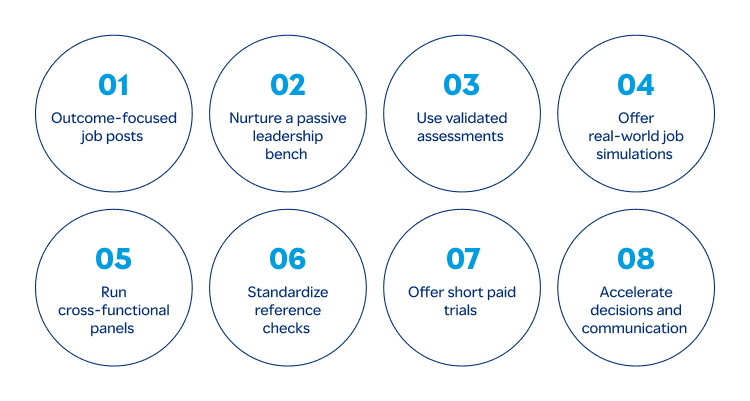
Outcome-focused job posts
Write job descriptions that open with the measurable results the role must deliver (e.g., quota, pipeline growth, territory expansion). Be explicit about essential versus preferred qualifications and use inclusive, gender-neutral language. Include a short “success in 12 months” section so candidates can quickly assess fit.
Nurture a passive leadership bench
Regularly engage potential leaders through brief check-ins, relevant content, and informal conversations. Maintaining this bench shortens time‑to‑fill, improves cultural fit, and provides vetted options when leadership roles open unexpectedly.
Use validated assessments
Incorporate brief, research-backed psychometric assessments for finalists to reveal decision style, resilience, and coachability. Consistent use of validated tools reduces reliance on charisma and increases the predictive accuracy of hiring decisions. Organizations can leverage Mercer Assessments to recruit and retain talent for sales profiles using different types of tests available.
Offer real-world job simulations
Ask selected candidates to present a 30/90‑day plan, lead a mock coaching session, or solve a go‑to‑market case. Simulations surface practical judgment, communication, and execution skills under pressure. These are capabilities that resumes and conventional interviews may not reveal.
Run cross-functional panels
Include stakeholders from product, marketing, finance, and operations in the interview process to assess collaboration, strategic alignment, and stakeholder influence. Cross‑functional panels reveal different perspectives, reduce blind spots, and help evaluate a candidate’s ability to work across the organization.
Standardize reference checks
Use a consistent reference questionnaire that requests specific, quantifiable examples of outcomes such as quota improvements, turnover reductions, and coaching results. Structured reference checks validate candidate claims and produce comparable evidence across finalists.
Offer short paid trials
Consider paid 4–8 week advisory or consulting engagements for top finalists to observe real performance, influence, and cultural fit in a low-risk setting. Short trials provide direct evidence of how a candidate operates in your environment before committing to a full hire.
Accelerate decisions and communication
Establish a firm Service Level Agreement (SLA) for interview scheduling, feedback, and offer timelines, and maintain transparent communication at every stage. Speed and clarity demonstrate respect for candidates’ time, increase offer acceptance rates, and protect the employer brand.
Sales hiring procedure: Step-by-step roadmap
A clear, repeatable 10-step roadmap helps talent teams move from ad‑hoc hiring to a predictable sales recruiting engine that directly supports revenue goals. Organizations can follow this guide to shorten ramp time, improve hire quality, and link recruitment outcomes to business performance.
Step 1: Define the sales context
The sales context guides who to hire and how they should sell. It also determines the skills, experience, and hiring approach needed for each role.
- Identify product complexity as transactional, moderate, or highly consultative.
- Map the typical sales cycle length and number of decision stakeholders.
- Profile buyer types such as SMB, mid‑market, enterprise, or B2C personas.
- Note channel and repeat purchase dynamics that affect seller skills.
- Translate findings into recruitment priorities, such as knowledge and stakeholder management.
Step 2: Decide the hire versus reskill strategy
Decide whether to recruit externally or reskill existing staff based on business priorities and skill gaps. This choice balances time, cost, and long‑term capability building for the sales organization.
- Audit current team capabilities against future go‑to‑market needs.
- Define clear criteria for hiring versus reskilling based on gap severity and timeline.
- Prioritize roles that directly impact revenue growth and customer retention.
- Plan learning investments and career paths to support retention.
- Reassess hire-versus-reskill decisions on a regular cadence.
Step 3: Build a competency framework
A competency framework ensures hiring focuses on behaviors and skills that predict job success. It works as a common criterion for recruiters and hiring managers to evaluate candidates consistently.
- List core behavioral traits such as coachability, drive, and empathy.
- Define functional skills, including prospecting, qualifying, and negotiation.
- Specify cognitive and technical skills, such as numeric reasoning and CRM fluency.
- Set proficiency levels for each sales role from SDR to Key Account.
- Use the framework to build scorecards and selection rubrics.
Step 4: Prepare sourcing groundwork
Develop employer messaging and the role brief before sourcing. Strong preparation makes outreach more targeted and improves the quality of responses.
- Create a one-line role brief stating outcomes and top skills.
- Draft an inclusive job description with must-haves and nice‑to‑haves.
- Identify target industries, companies, and titles for sourcing focus.
- Prepare employer value propositions that matter to sales candidates, such as On-Target Earnings (OTE) clarity.
- Set sourcing KPIs and candidate follow‑up SLAs.
Step 5: Target high-yield sourcing channels
Focus on sourcing channels that deliver quality and passive candidates rather than volume. Using the right mix of channels improves pipeline resilience and conversion rates.
- Leverage employee referrals and customer networks as primary sources.
- Run targeted LinkedIn outreach to proven passive performers.
- Use niche job boards and industry communities for specialized roles.
- Tap alumni networks and professional associations to fill leadership roles.
- Track channel conversion rates and optimize based on performance.
Step 6: Screen with objective filters
Use early, objective filters to remove unqualified candidates and prioritize interview time for top‑fit profiles. Objective screening preserves interviewer capacity for the most promising applicants.
- Use brief aptitude or sales fitness assessments during pre-screening.
- Verify role-relevant experience and measurable outcomes on resumes.
- Conduct structured phone screens aligned to the competency map.
- Score candidates against minimum thresholds before advancing them.
- Shortlist only those meeting objective benchmarks.
Step 7: Conduct competency-based interviews
Structured interviews keep the evaluation impartial and comparable. They surface behavioral evidence and role‑relevant scenarios that better predict on‑the‑job performance.
- Build interview guides from the competency framework for consistency.
- Ask STAR behavioral questions tied to key competencies.
- Include a role‑play or live pitch to observe skills in action.
- Use a consistent numeric scorecard for every interviewer.
- Calibrate interviewers regularly to maintain scoring alignment.
Step 8: Develop compensation and incentives
Create offers that attract talent and align incentives to desired behaviors. Transparent compensation reduces negotiation delays and clarifies candidates’ expectations.
- Define OTE splits between base and variable pay by role and experience.
- Create ramp deals and quota adjustments for the first six months.
- Include accelerators for overachievement and retention levers for key hires.
- Communicate total earning potential and performance metrics clearly.
- Prepare offer templates and approval workflows to move quickly.
Step 9: Execute structured onboarding and ramp
Onboarding should convert hiring investment into on‑the‑job performance through structured learning and guided practice. Well‑designed ramp plans accelerate contribution and improve retention.
- Provide product, process, and buyer training during the first 30 days.
- Pair new hires with mentors for call shadowing and guided feedback.
- Set activity and revenue milestones for 30, 60, and 90 days tied to coaching.
- Hold weekly one‑on‑ones to surface blockers and adjust plans.
- Certify readiness before expecting full quota performance.
Step 10: Measure outcomes and improve retention
Retention preserves the return on hiring investment and sustains sales performance over time. Ongoing measurement and feedback let organizations refine hiring and development practices.
- Monitor KPIs including time‑to‑fill, time‑to‑ramp, quota attainment, and early attrition.
- Conduct stay and exit interviews to identify retention drivers and risks.
- Invest in ongoing coaching, promotions, and career development programs.
- Feed performance data back into competency and assessment design.
- Audit hiring outcomes periodically and refine the process accordingly.
High‑impact sales competencies for recruitment decisions
Core sales skills and competencies determine whether a hire will perform, ramp fast, and stay productive. For TA leaders, clear competency definitions help recruiters and hiring managers evaluate candidates consistently. Below are the primary competency groups with suggested assessment methods.
Behavioral competencies
- Coachability and learning agility: Adapts quickly to feedback and new processes; assess using past change examples and situational questions.
- Results orientation and resilience: Sustains activity and recovers from rejection; assess using behavioral probes and stress scenarios.
- Empathy and active listening: Uncovers customer needs and builds trust; observe using role-plays and panel interviews.
- Integrity and accountability: Owns outcomes and follows through; verify using reference checks and failure response questions.
Functional competencies
- Prospecting and pipeline creation: Initiates qualified leads consistently; test using outreach exercises or recent metrics review.
- Qualification and discovery: Identifies true opportunities and decision criteria; assess via simulated discovery calls.
- Negotiation and closing: Moves deals to signed contracts and favorable terms; evaluate using role‑plays and deal walkthroughs.
- Account and territory management: Grows and retains accounts over time; assess with account planning tasks.
Cognitive competencies
Numeric reasoning and commercial judgment: Interprets data, models pricing, and makes sound commercial decisions; test with short business cases or numerical problems.
- Strategic thinking (senior roles): Develops go‑to‑market plans and prioritizes resources; assess with a 30/90‑day strategy exercise or case study.
- Problem solving and decision making: Analyses ambiguous situations and selects practical solutions; evaluate with situational judgment tests or real‑world scenarios.
- Learning agility and adaptability: Learns new products, markets, and processes quickly and adjusts approaches as conditions change; assess with past learning examples and situational questions.
Technical competencies
- CRM and sales tool fluency: Manages pipeline, updates activities, and uses sales tools effectively; verify with practical CRM tasks or scenario questions.
- Data and reporting literacy: Reads dashboards, interprets KPIs, and acts on insights; test with a short reporting exercise or data interpretation task.
- Presentation and demo skills: Delivers clear product demos and persuasive presentations using virtual tools; assess with a live demo or recorded presentation.
- Prospecting and automation tool proficiency: Uses outreach and sequencing tools, enrichment data, and automation effectively to generate qualified leads; verify using practical exercises or tool‑based scenarios.
Measure hiring success: Top sales metrics
Measuring hiring success turns recruitment activity into business insight. For TA leaders, a focused set of metrics shows whether the process finds salespeople who ramp quickly, hit quota, and stay long enough to justify recruiting investment. Below are the top sales hiring metrics, what they measure, and how teams should use them.
Time to fill
- What it measures: Days from requisition to accepted offer.
- Why it matters: Long fills delay coverage and revenue; short fills can indicate shallow pipelines.
- How to use it: Track by role type and channel; aim to reduce without sacrificing quality.
Time to ramp (time to productivity)
- What it measures: Average days from start date to meeting a defined productivity milestone (first closed deal, % of quota).
- Why it matters: Shorter ramps convert hiring into revenue faster.
- How to use it: Set role-specific ramp milestones (30/60/90) and monitor cohort performance.
Quality of hire (composite score)
- What it measures: A weighted index combining performance (quota attainment), manager rating, and retention.
- Why it matters: Captures long-term value beyond initial hiring metrics.
- How to use it: Build a simple formula (for example, 50% quota attainment + 30% manager rating + 20% retention) and benchmark over time.
Percentage hitting quota at 6 and 12 months
- What it measures: Proportion of hires reaching quota milestones within defined windows.
- Why it matters: A direct signal of the predictive validity of assessments and interviews.
- How to use it: Compare cohorts hired under different processes or sources.
First-year attrition (or early churn)
- What it measures: Percentage of hires who leave within 12 months (or probation period).
- Why it matters: High early churn erodes hiring ROI and highlights onboarding or fit issues.
- How to use it: Analyze reasons via exit/stay interviews and adapt selection/onboarding.
Candidate experience metrics (cNPS and drop-off rates)
- What it measures: Candidate Net Promoter Score and application/assessment drop-off at each funnel stage.
- Why it matters: Poor experience reduces conversion and harms the employer brand.
- How to use it: Track per role and channel, and optimize assessment length and communication.
Evaluate critical sales competencies using Mercer Assessments
Mercer Assessments offers a competency‑based assessment suite that helps organizations hire sales talent with confidence. They map the behavioral, cognitive, and role-specific competencies that predict selling success, then measure candidates against those competencies using validated tests, simulations, and scorecards.
These assessments are adaptable across contexts, from retail and FMCG to channel sales and complex B2B deals, so hiring teams can apply a consistent, evidence‑backed approach to every sales role.
How it helps
- Aligns hiring to role outcomes by translating product, process, and buyer context into a competency framework.
- Provides objective data on personality, sales skills, aptitude, learning agility, communication, and motivation to complement interviews and references.
- Reduces time spent on unqualified candidates and improves predictive accuracy, so new hires ramp faster and perform more reliably.
- Scales selection consistently across locations and volume hiring needs while enabling role‑level customization for senior and entry positions.
Representative assessments and use cases
Conclusion
The right sales hiring strategy is a revenue multiplier: it reduces costly mis-hires, speeds new hires to productivity, and increases quota attainment across the team. Better hires and higher retention turn recruiting from a recurring expense into a measurable investment with clear ROI, fewer disruptions, lower replacement costs, and steadier pipeline coverage. Predictability improves forecasting, frees resources for growth, and compounds over time, making hiring one of the most powerful levers for profitable, sustainable growth.
FAQs
How does a sales hiring strategy differ from standard recruiting?
What resources are needed to run a successful sales hiring pilot?
Which metrics matter most to measure hiring success?
Who should be involved in designing and running the sales hiring process?
How do validated assessments improve sales hiring outcomes?





Get awesome marketing content related to Hiring & L&D in your inbox each week
Stay up-to-date with the latest marketing, sales, and service tips and news
By using our offerings and services, you are agreeing to the Terms of Services and License Agreement and understand that your use and access will be subject to the terms and conditions and Privacy Notice