

Succession planning may look complete on paper, yet it often fails when it is not executed with clear ownership, defined readiness standards, and consistent development actions. This execution gap drives higher transition costs, slower ramp-up, weaker bench strength, and avoidable leadership disruption. With practical root-cause fixes, readiness-focused measures, and a structured execution framework, succession plans can translate into prepared successors and stronger continuity.
Leadership transitions are a normal part of business, but the disruption they create need not be. Succession planning helps prevent leadership changes from becoming disruptive by ensuring critical roles are filled quickly with capable leaders, so decisions and performance remain steady.
However, many organizations experience a gap between planning and execution. Potential successors may be identified, yet the work required to make them ready often does not happen with the same rigor. Development is delayed, role-relevant experience is not prioritized, and readiness is assumed rather than demonstrated.
As a result, when a leader leaves or a key role becomes vacant, the organization still faces uncertainty and last-minute decisions.
Closing this execution gap requires a shift in ownership and discipline. Succession planning cannot sit solely with HR; senior leaders must actively own successor readiness. With clear readiness standards, consistent development through real assignments and coaching, and structured handovers, succession planning becomes an active pipeline of prepared leaders rather than a static list of names.
When succession planning is not carried out in day-to-day work, the impact shows and grows over time. The financial cost rises first – organizations spend on search and recruiting fees, interim leadership coverage, and sign-on bonuses, and often pay more to hire externally than to promote internally. At the same time, business value is lost when key decisions slow down, and revenue-driving work is delayed.
The operational impact is just as serious. Teams lose speed while a new or unprepared leader learns the role, priorities, and stakeholders. This extends the time it takes to reach expected performance levels and delays important projects.
The cultural impact follows. When employees see that leadership roles are filled through last-minute decisions or outside hires, confidence drops. High-potential talent is more likely to disengage or leave, which creates more vacancies and higher replacement costs.
These problems get worse when successors are not developed in a structured way. Without coaching, real role-relevant assignments, and active sponsorship from senior leaders, readiness does not improve. As a result, the leadership pipeline remains weak, and role changes create disruption instead of a smooth handover.
Succession planning depends on consistent execution, not just documented names. When ownership is unclear, readiness standards vary, development actions are not completed, and reviews are irregular, successor readiness does not improve. The root causes below highlight the main execution breakdowns and the practical adjustments that strengthen follow-through.
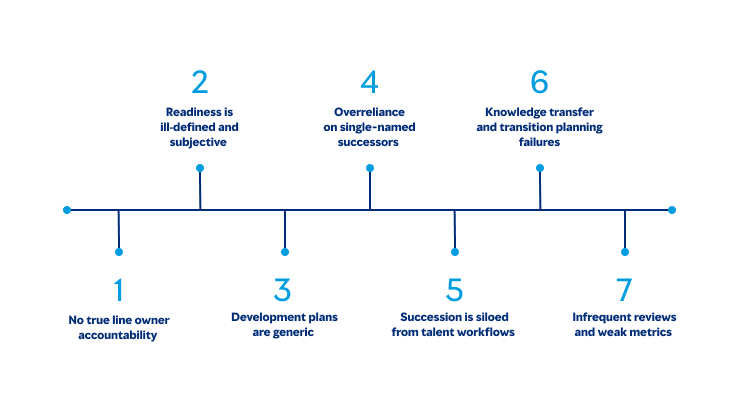
HR may create the plan, but line leaders often do not own successor readiness. Without manager sponsorship, successors rarely receive stretch assignments, exposure, or prioritized time to develop.
How to fix it: Shift ownership to managers. Make succession outcomes part of leader objectives and performance reviews (for example, the percentage of critical roles with active, approved development plans). Require manager sign‑off on successor plans and set quarterly check‑ins with HR to review progress.
Labels such as ‘ready now’ are frequently applied without consistent criteria, relying on opinion rather than evidence. That inconsistency creates false confidence and inadequate placement decisions.
How to fix it: Define readiness with clear, competency‑based criteria tied to role outcomes, such as required scope, stakeholder complexity, and P&L experience. Use calibrated assessments (peer panels, 360 feedback, or short simulations) and document the evidence behind each readiness rating.
Development often becomes a checklist of courses rather than a sequence of measurable experiences. Without milestones, owners, or a budget, development plans stall.
How to fix it: Create time-bound, measurable development plans for each successor, with 90‑day milestones, an accountable owner, and a budget line. Organizations can also use Mercer’s succession planning tools to create role-based development plans to prepare employees for leadership roles.
Relying on one backup increases risk. If that person leaves, declines the role, or proves unsuitable, the organization has little depth and must scramble externally.
How to fix it: Build talent pools instead of single replacements. Identify 2–4 potential successors with different profiles and create staggered development paths. Rotate candidates through cross‑cover assignments so multiple people gain relevant exposure and practical experience.
When succession data lives in separate spreadsheets or folders, it is not connected to recruiting, performance cycles, learning platforms, or mobility processes. Pipelines, therefore, fail to refresh or scale.
How to fix it: Integrate succession into core talent workflows. Identify successors in performance reviews, surface them in internal hiring, link their plans to L&D platforms, and include succession in workforce‑planning conversations so pipelines are routinely fed and replenished.
Important details about the role and key stakeholder relationships often stay with the current leader. When a successor takes over without this information, work slows down, and mistakes become more likely.
How to fix it: Standardize transition playbooks for critical roles that capture key contacts, decision logs, priority projects, and outstanding risks. Arrange time for the successor to observe the role before the transition, keep an overlap period where both leaders work together, and record key briefings so the successor can take over faster and avoid missing important details.
Plans are updated rarely, and metrics typically track only ‘coverage’ (that a name exists) rather than readiness, progress, or outcomes. Problems, therefore, surface only after a vacancy occurs.
How to fix it: Establish regular governance and meaningful KPIs. Hold quarterly succession reviews and track readiness distribution (ready now / 1–2 years / 3–5 years), the percentage of successors with active plans, time‑to‑fill for critical roles, and retention of named successors. Report trends to the business owners and require remediation where readiness declines.
To successfully bridge the execution gap, organizations must move away from subjective assessments and implement a data-driven audit of their talent pipeline. The following metrics are critical for evaluating true succession readiness:
Measures the number of pre-qualified internal candidates who can step into a critical role immediately versus those who require 1–3 years of development. A healthy pipeline typically targets a 2:1 or 3:1 ratio of ‘ready-now’ successors per critical position.
Tracks the percentage of leadership vacancies filled by external recruits rather than internal successors. A high external hire rate (e.g., above 30%) for roles with designated successors indicates a clear failure in the execution of the internal development pipeline.
Monitors the turnover rate among employees formally identified as high-potential (HiPo) or designated successors. If this segment is leaving at a higher rate than the organizational average, it indicates a lack of engagement, transparency, or perceived career progression.
The percentage of critical organizational roles that currently have zero identified or viable successors. This metric highlights immediate operational risk and directs where HR must focus urgent talent acquisition or development efforts.
Tracks the speed at which identified high-potential employees move through the pipeline. Slow velocity often indicates organizational bottlenecks, such as incumbent leaders ‘talent hoarding’ or delaying their own exit strategies.
Transitioning from a passive spreadsheet of names to an active, resilient leadership pipeline requires a shift from static planning to continuous execution. Organizations should adopt the following operational framework:
Implement distinct evaluation criteria that separate an employee’s current output from their future leadership capacity. Organizations can use Mercer’s objective behavioral assessments, cognitive testing, and leadership simulations rather than relying solely on past annual performance reviews.
Shift the ownership of succession planning from an isolated HR mandate to a core KPI for business unit leaders. Tie executive bonuses and performance evaluations directly to their success in mentoring, developing, and promoting internal talent.
Stop training successors for specific, static job descriptions. Instead, focus development on agile, future-proof competencies such as digital transformation leadership, cross-functional crisis management, and strategic foresight that allow leaders to adapt to shifting business models.
Promote transparency by informing high-potential employees of their status and actively co-creating their career roadmaps through targeted stretch assignments and executive sponsorship.
Replace the traditional annual or bi-annual succession review with quarterly, data-driven talent calibrations. This ensures the pipeline remains dynamic, immediately reflecting organizational restructuring, sudden departures, or shifts in corporate strategy.
Bridging the execution gap starts with a new approach to leadership succession. True success comes from developing future leaders through structured programs and clear executive accountability, not just identifying names on a list. When senior leadership treats succession as a core operational priority, the risks associated with sudden vacancies drop significantly. A proactive commitment to building internal talent ensures the organization remains stable, resilient, and prepared to navigate future transitions smoothly.
Originally published July 27 2026, Updated July 27 2026

Varsha specializes in tech and SaaS storytelling, crafting clear, high-impact blogs, social media content, ad copy, and thought leadership content. She brings structure, clarity, and a sharp brand voice to every piece. Outside work, she enjoys painting, sketching, and reading novels.
Succession planning is a systematic process through which organizations build a leadership pipeline to preserve its future. The process involves identifying and developing potential successors for a seamless transition.


Thanks for submitting the comment. We’ll post the comment once its verified.





 Behavioral Competencies
 Cognitive Competencies
 Coding Competencies
 Domain Competencies

















Would you like to comment?