

The shift to remote and hybrid work models has transformed how companies hire, train, and certify their talent. Assessments that once took place in a physical testing center are now conducted remotely across the globe. While remote assessments unlock global candidate pools and accelerate hiring timelines, they also introduce a massive vulnerability, i.e., the rising threat of organized, tech-enabled dishonesty in corporate assessments.
Traditional supervision methods, such as relying on basic webcams or static rules, are no longer enough to secure the integrity of high-stakes remote tests.
Today, candidates have access to advanced workarounds that easily bypass outdated safeguards.
To maintain the credibility of remote assessments, companies must rethink their proctoring strategies. Enter the AI proctoring system: a dynamic, intelligent solution designed to outsmart modern academic and professional dishonesty.
As businesses leverage remote assessments for their talent acquisition and internal upskilling, the methods used to manipulate these systems have evolved. Organization are no longer dealing with simple textbook copying. The modern landscape now involves organized, tech-enabled malpractice.
Sophisticated cheating refers to highly coordinated efforts to bypass assessment security using advanced technology or external human intervention.
Common examples include:
The urgency for online exam cheating prevention has never been higher, driven by several modern workforce realities:
Before the widespread adoption of AI-based online assessment security, companies relied heavily on human invigilators and basic lockdown browsers. These legacy methods are fundamentally unequipped to handle modern threats.
Manual proctoring challenges
Why rule-based systems fall short
To counter these vulnerabilities, organizations are turning to intelligent automated proctoring tools. At its core, an AI proctoring system is an advanced security layer that uses artificial intelligence, machine learning, and computer vision to monitor candidates and secure the testing environment.

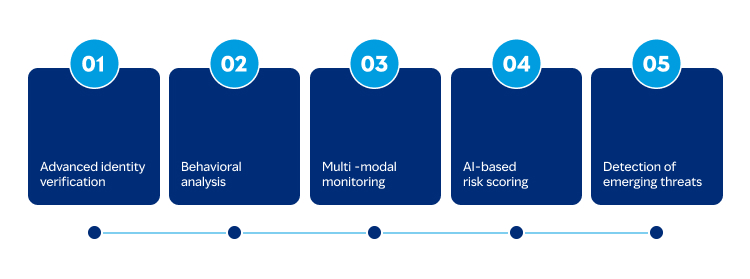
The true power of AI-based online assessment security lies in its ability to process multiple streams of data simultaneously.
By combining video, audio, and screen activity, AI proctoring tools can detect:
Transitioning to remote proctoring for organizations is not just about catching cheaters; it is also a strategic move to optimize the entire talent lifecycle. Here is how AI proctoring benefits:
A secure assessment environment is critical across various stages of the employee lifecycle:
To maximize the value of AI proctoring systems while maintaining a positive candidate experience, organizations must follow these best practices:
As with all technology that handles sensitive data, AI proctoring comes with valid concerns that organizations must address proactively.
The race between sophisticated workarounds and assessment security is ongoing. As generative AI and remote access tools become more advanced, so will the automated proctoring tools designed to catch them.
The future of AI-based online assessment security will likely see even deeper behavioral analytics and predictive intelligence, moving from merely flagging suspicious activity to actively preventing it in real time.
By embracing AI-driven proctoring systems, companies can confidently prevent cheating in online exams, scale their hiring, and ensure that every job offer extended is based on genuine, verified merit.
Originally published January 3 2019, Updated July 9 2026

Aniket is a digital growth strategist specializing in SEO and content strategy for the hiring and assessment space. He combines technical SEO, automation, and search intent intelligence to drive qualified B2B demand across global markets.
Online remote proctoring is the technology through which exams are conducted online in a cheating-free manner, using high-speed internet and a computer with a webcam. Online remote proctoring uses video streaming and AI or human proctors to invigilate large-scale exams securely.

Conduct Secure, Scalable, and Cost-Effective Online Proctored Exams
Know More
Give your test-takers and examiners a seamless examination experience
Know More
Find out everything you need to know about online remote proctoring - integration, settings and more.
Know More

Thanks for submitting the comment. We’ll post the comment once its verified.





 Behavioral Competencies
 Cognitive Competencies
 Coding Competencies
 Domain Competencies
















Would you like to comment?