

This article explains which human skills matter as AI scales: judgment, creativity, empathy, adaptability, and AI literacy, and why organizations should assess and develop them. It shows practical assessment methods, links those skills to AI agility, and explains how Mercer’s AI Agility Framework helps build an AI ready workforce. The focus is on simple, measurable steps to turn AI investment into safe, reliable business value.
AI-proof skills are becoming increasingly critical as organizations move from isolated AI experiments to widespread, operational use. Early deployments showed the potential for productivity gains, but they also revealed gaps, inconsistent decisions, governance blind spots, and ethical trade-offs that only humans can resolve.
As AI touches more decisions, the premium on durable human strengths grows – the ability to judge, to learn and adapt, to reason ethically, and to collaborate across functions.
These skills do more than reduce risk; they become the mechanism that converts technical capability into organizational agility. Together, these behaviors enable the responsible deployment of AI while maintaining a consistent pace.
To realize that value, organizations must treat AI-proof skills as a strategic priority. Redesign roles to make decision ownership explicit. Embed short, practice-based learning in the flow of work. Put simple governance and decision maps in place so accountability is visible and repeatable.
When these elements are combined, AI agility follows – teams adopt and improve AI responsibly, recover from errors faster, and scale with confidence. Prioritizing human capability is the most effective way to make AI a sustained source of competitive advantage.
AI is moving into everyday work. Routine tasks such as data gathering and basic reporting are increasingly automated, freeing people to focus on ambiguous cases, exceptions, and relationship-sensitive decisions. At the same time, decision cycles are accelerating, and volumes are growing, so teams receive AI outputs more frequently, and the potential cost of mistakes rises with that scale.
BCG’s research shows 74% of companies still struggle to scale AI and capture sustained value, a widespread problem tied to people and process, not just technology.
Therefore, organizations must prioritize AI agility, which is the ability to apply AI outputs consistently and safely at scale, so decisions improve, risks remain contained, and business value is realized more quickly.
Strengthening AI agility reduces rework and costly errors. It helps AI projects deliver value faster. It also protects reputation by building ethical checks into everyday work. Investing in people and simple processes upfront is usually cheaper and safer than fixing problems later.
AI‑proof skills make this possible. They help teams make better decisions, learn faster from real work, avoid harm, and work together to fix problems quickly. In short, these human strengths turn AI’s potential into dependable, scalable results.
Capabilities like judgment, adaptability, ethical reasoning, and collaboration form the practical backbone of AI agility in the workplace. They ensure people use models wisely, adapt as systems change, spot and mitigate harms, and keep technical and business teams working in step.
Practical judgment is the ability to interpret model outputs in context, recognize when recommendations do not fit, and make accountable decisions that balance immediate results with longer‑term stakeholder interests. Clear judgment prevents inappropriate automation, reduces costly rework, and protects customer and regulatory trust.
Organizations can use Mercer’s AI Agility Framework to identify key behavioral attributes, cognitive capabilities, and AI-specific skills that support responsible AI adoption.
Adaptability is the capacity to learn, unlearn, and adopt new workflows quickly as models, data, or processes change. Teams that adapt effectively move faster from pilot to production, recover more quickly from model failures, and sustain continuous improvement.
Practical steps include time‑boxed sprints, in‑flow microlearning, and short applied projects that let people practice new behaviors against real work.
Ethical reasoning is the habit of spotting bias, privacy concerns, and other potential harms, and choosing proportionate mitigations before and during deployment. It appears in practical behaviors such as flagging biased outputs, applying mitigations, and escalating issues when needed.
Embedding simple checklists, role‑level ethics criteria, and periodic case reviews turns those behaviors into routine practice that reduces incidents and preserves trust.
Collaboration means working across functions to ensure AI model outputs are understood and used correctly. It includes regular check‑ins between users, product or data teams, and risk owners, and a simple process for sending actionable feedback to modelers. Good collaboration ensures models are tuned to real needs and problems are fixed quickly.
Good collaboration speeds model tuning, improves real‑world outcomes, and spreads ownership across the organization. Practical actions include short, recurring calibration sessions, a feedback form that feeds the data team backlog, and clear accountabilities in updated role descriptions.
Organizations can leverage a range of practical methods to evaluate AI adoption, skills and measure workforce agility. These methods reveal how people use AI models, where judgment must remain human, and which interventions will deliver the greatest operational impact.
By pinpointing where human judgment is essential, decision maps guide which tasks to automate, augment, or preserve. This clarity shortens design cycles, prevents misapplied automation, and speeds confident rollout of AI into core workflows.
Simulations test how people respond to model outputs under realistic pressure, revealing gaps in judgment and escalation. Rapid, repeatable exercises accelerate learning, reduce deployment risk, and increase frontline readiness to adopt AI at scale.
Reviewing real outputs shows whether practitioners apply AI recommendations correctly and document the rationale. These artifacts drive targeted coaching, improve model feedback loops, and help organizations tighten human+AI handoffs for faster, safer adoption.
Measuring practical prompt skills ensures users get reliable, relevant outputs from generative tools. Strengthening prompt capability reduces hallucinations, builds trust in AI outputs, and helps teams iterate on use cases faster. Organizations can use Mercer’s Test for Prompt Engineering (MTPE) to assess prompt proficiency and target coaching where it will have the greatest operational impact.
Behavioral logs and override patterns reveal adoption bottlenecks and drift in real time. Continuous trace analysis lets organizations prioritize interventions, tune models faster, and maintain operational agility as usage scales.
Embedding people in live AI workflows validates role design and accelerates capability transfer. These low‑risk trials surface practical friction, build experiential learning, and create templates for rapid replication across teams.
Regular cross‑functional reviews align expectations, capture edge cases, and feed corrections back to models. Routine calibration tightens the feedback loop between users and modelers, improving model performance and sustaining adoption momentum.
Controlled comparisons provide causal evidence on which prompts, workflows, or UI changes improve outcomes. Using experimental results to iterate removes guesswork, speeds confident scaling, and embeds a data-driven rhythm into AI adoption.
Organizations can use Mercer’s AI Agility Framework to turn assessment findings into targeted action. The framework combines validated behavioral and cognitive measures with role‑specific AI skill checks to show who is ready and where gaps exist. Those insights map directly to capability matrices, focused learning journeys, and updated role profiles. The result is a clear, evidence‑led path from diagnosis to faster, safer, and more scalable AI adoption.
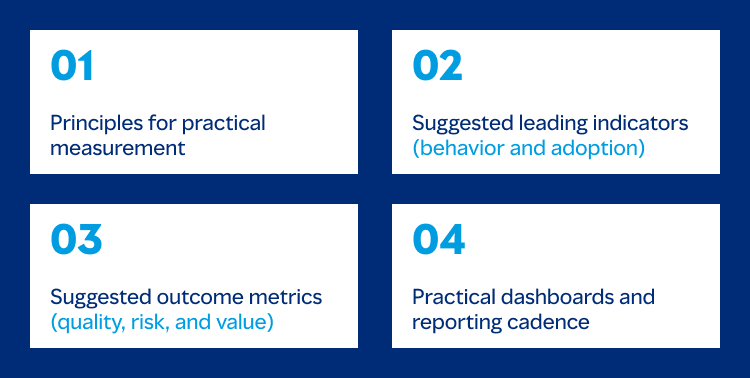
Organizations can use early signals and outcome metrics to understand whether people are changing how they work, whether AI models are improving production, and whether risk is falling while business value increases.
They can keep measures simple, tied to roles and specific decision owners, and reported at a cadence that leaders can act on, so capability investments can be adjusted, resourced, and justified with evidence.
As reported by Grand View Research, the AI governance market is projected to grow from roughly USD 308.3 million in 2025 to about USD 3.59 billion by 2033. The rapid expansion reflects AI’s shift from experimentation to operations and a stronger focus on risk controls and stricter compliance.
Effective AI governance means assigning clear owners, using simple checks, and running short regular reviews so teams can move quickly while spotting problems early.
Assign clear ownership for AI decisions at the team level. Local AI stewards handle day‑to‑day use, monitoring, and frontline escalation. A cross-functional oversight group (ethics or risk council) handles policy, high‑risk approvals, and periodic review. Explicit accountabilities, who signs off on what and when, cut downtime and make remediation swift.
Replace heavyweight approvals with compact, risk‑tiered gates. Low‑risk changes follow a checklist; higher-risk deployments require a short ethical impact statement and a cross‑functional review. Standardized artifacts data provenance notes, bias checks, explainability summaries, and one‑page mitigation plans make review fast and consistent.
Combine automated monitoring (drift, performance, and anomaly alerts) with human review thresholds. Define clear triage steps: detection, immediate containment, root cause analysis, remediation, and stakeholder communication. Keep incident playbooks short and practiced so teams can act quickly and learn from mistakes.
Schedule brief, regular rituals that embed governance into workflow rather than treating it as an afterthought. Examples include weekly 20–30-minute calibration meetings, monthly ethics clinics to review borderline cases, and quarterly steering updates for leaders. Rituals create disciplined feedback loops that feed model tuning, learning content, and policy updates.
Ensure data use follows simple, enforceable rules – limit scope to the minimum necessary, document data lineage, and apply anonymization or synthetic alternatives where appropriate. Maintain clear consent and retention policies so data practices remain defensible and transparent.
Preserve human decision nodes for outcomes that affect customers, employees, or the firm’s reputation. Design workflows that clarify when to follow model recommendations, when to augment them, and when humans must decide. Simple override documentation and review of override patterns reveal whether decision ownership is working as intended.
Provide users and stakeholders with concise explanations of model purpose, expected behavior, and limitations. Tailor explanations to the audience – frontline users need actionable guidance, while auditors and leaders need decision‑level summaries that support oversight.
Track leading governance indicators such as completion rates for impact statements, calibration meeting attendance, mean time to detect and remediate incidents, and proportion of high-impact decisions with documented human rationale. Use these signals in operational dashboards to guide resource allocation and policy refinement.
Treat governance failures as learning opportunities. Capture incidents, update playbooks, translate lessons into short training modules, and share findings in communities of practice. Continuous small improvements keep governance relevant as models, data, and business contexts evolve.
A tightly scoped pilot converts strategy into repeatable practice. Organizations can use a 12-to-17-week cadence to validate an operating model assessment, targeted development, governance, and measurement.
AI-proof skills turn AI’s potential into lasting value and form the foundation of AI agility. When people apply sound judgment and adapt quickly, organizations learn faster and make better decisions. Clear ethics and strong collaboration protect trust and reduce risk. Investing in these strengths builds resilience as models evolve and ensures dependable AI adoption. Prioritizing AI-proof skills is the most effective way for leaders to achieve true AI agility and sustained competitive advantage.
Originally published June 11 2026, Updated July 23 2026

Varsha specializes in tech and SaaS storytelling, crafting clear, high-impact blogs, social media content, ad copy, and thought leadership content. She brings structure, clarity, and a sharp brand voice to every piece. Outside work, she enjoys painting, sketching, and reading novels.
Skills assessment tests are used in the recruitment process to determine if a candidate possesses the necessary skills (analytical, technical, interpersonal, etc.) to thrive in a job role. Skills assessment tests are an essential component of recruitment today.


Thanks for submitting the comment. We’ll post the comment once its verified.





 Behavioral Competencies
 Cognitive Competencies
 Coding Competencies
 Domain Competencies

















Would you like to comment?