

Looking ahead, a company’s true strength won’t be measured by how advanced its technology is, but by the resilience of its culture. As new tools and systems continue to evolve, the fundamental needs of people, clear communication, genuine recognition, and a sense of belonging, remain unchanged. The most important job for future leaders is to ensure that, even as businesses become increasingly data-driven, they never lose their human touch.
As AI moves from novelty to standard practice, strong leadership is required to govern its use and convert capability into business impact. While AI excels at processing data, automating routine tasks, and surfacing patterns at scale, those strengths answer only part of an organization’s needs. Human leaders are required to interpret AI outputs, weigh trade‑offs, and make judgment calls where context and values matter.
Forward-thinking leaders set themselves apart by keeping human values at the center of innovation. They deploy AI tools responsibly, ensuring these tools elevate the quality of employees’ work rather than diminishing their role.
By harmonizing digital capabilities with clear moral guidance, these leaders foster an adaptable corporate culture built on mutual respect and shared success.
AI automates routine tasks, but does not reduce the need for deliberate, human-centered leadership. Here, people leadership means translating technical change into clear purpose and opportunity, so every team member understands how AI tools improve outcomes and support career growth.
An Infosys study found 80% of C‑level executives believe their leadership can adapt to AI adoption. That executive confidence must be translated into concrete, team‑level actions that prepare and support employees through the change.
AI‑ready leaders favor continuous, applied development instead of one‑off training. They run short experiments, pair colleagues for hands‑on practice, and provide timely coaching so skills grow while work continues. This approach speeds adoption, reduces disruption, and turns early wins into repeatable practices.
Equally important is preserving judgment, trust, and accountability. Leaders name decision owners, require concise human review for high‑impact outputs, and set transparent ethical boundaries. By combining purposeful direction, ongoing development, and clear oversight, leaders ensure AI augments human capability rather than replacing it.
Great leaders do more than supervise tasks; they reshape how teams work with AI so human judgment, development, and ethical responsibility remain central. Below are six practical domains in which top managers behave differently through concrete actions and practices.
Instead of treating AI as a plug‑and‑play solution, great managers design how decisions will be made with an AI system in the loop. They define who reviews high‑impact outputs, set escalation rules, and create lightweight governance processes that align with the team’s pace. Practical steps include documenting decision criteria, naming accountable owners, and scheduling short human‑review checkpoints.
These systems prioritize speed without sacrificing oversight, standardizing when a recommendation is actionable and when it requires human validation, so responsibility is clear, and errors are caught early.
Organizations can use Mercer Assessments to evaluate a leader’s strategic thinking and ability to make sound decisions under ambiguity. Leadership assessment results show which leaders possess the judgment and systems‑thinking required to design AI governance, set escalation rules, and run human‑review checkpoints.
Effective leaders embed learning within daily work through short, task‑oriented experiments and paired practice. They run learning sprints, measure progress with simple milestones, and reward applied learning that improves outcomes.
They can also leverage Mercer’s AI Agility Assessments and skills-based assessments that provide a baseline of team capabilities and guide tailored learning paths. Leaders can utilize Mercer’s 360-degree feedback tool, 360View, to track behavioral changes over time. This way, they can tie learning directly to business problems, so skill development is measurable, relevant, and immediately valuable to both the individual and the team.
Top managers make it safe to question AI outputs and to fail fast in low‑risk experiments. They model curiosity, acknowledge uncertainty, and celebrate lessons from unsuccessful trials. By normalizing early detection of issues and treating setbacks as learning data, managers shorten feedback loops and build a culture where people surface problems before they escalate.
Mercer’s Assessment Centers (virtual & hybrid) offer practical diagnostics to support this work. Interactive case studies and situational judgment tests (SJTs) simulate real‑world disruption and observe how leaders adapt, make trade‑offs, and manage teams under pressure.
Results from these tests identify specific strengths and development needs. This informs targeted coaching and experiential exercises that strengthen adaptability, change management style, and resilience, and help create more psychologically safe teams.
Leaders invest in understanding how individuals experience change and address career concerns directly. They communicate rationale clearly, hold private development conversations, and visibly recognize human contributions. Personality and behavioral assessments can help managers understand team motivators and tailor support, improving both engagement and retention during AI transitions. Tailored conversations and visible recognition reduce fear and signal that technology is intended to augment careers, not to displace people.
AI initiatives require alignment across data, product, and operations. AI‑ready leaders create clear handoffs, convene concise cross‑functional checkpoints, and surface assumptions for validation. Using role‑based competency frameworks and assessment data, leaders can identify gaps, appoint the right integrators, and align incentives so collaboration is operational rather than episodic. Establishing short, regular syncs prevents misalignment and ensures technical work translates into real business impact.
Leaders should agree on shared success metrics so everyone evaluates outcomes the same way. Use joint dashboards and short post‑pilot reviews to keep teams accountable and decide quickly whether to scale, iterate, or stop.
Top managers turn ethical principles into routine practice through brief bias checks, privacy guardrails, and named human sign‑offs for any decision that affects people. Standards must be concise and role‑specific so they are easy to follow and enforce.
Leaders should require a short pre‑action checklist (impartiality, privacy, explainability) and capture the named approver for each high‑impact decision. Use assessment tools that measure decision‑making and judgment to ensure those approvers have the training and competence to carry responsibility.
Make remediation steps explicit: document who will act, how issues will be corrected, and how affected parties will be informed. Regularly review a sample of decisions and update guardrails as new risks emerge to keep ethical controls practical and current.
Before acting on any AI recommendation that could affect customers, people, finances, or compliance, leaders can apply a short, focused review to surface risks and assign clear responsibility. They can use the checklist below as a repeatable gate, quick enough for routine use and rigorous enough to prevent costly errors.
Require a concise statement of the recommendation’s likely effects on customers, people, revenue, or reputation; if impact is unclear or material, pause execution and commission a short impact assessment before proceeding.
Ensure the team can explain, in plain terms, why the AI produced the output and which key assumptions drove it. If the rationale is opaque, request a concise technical summary or reproducible test prior to approval.
Verify data provenance, recency, and completeness used to generate the result; decisions based on stale, incomplete, or unverifiable data should be held until data issues are resolved.
Confirm compliance with privacy, intellectual‑property, and regulatory obligations; for sensitive or regulated decisions, obtain legal or compliance clearance prior to implementation.
Record a named decision owner and a human reviewer who will accept responsibility for the outcome. Explicit ownership ensures traceability, escalation capacity, and remediation responsibility.
Assess whether the action can be reversed or corrected promptly; when reversibility is limited, require stronger validation and senior sign‑off to reduce the risk of irreversible harm.
Define explicit success and harm metrics, assign owners, set a monitoring cadence, and establish thresholds that trigger a post‑implementation review or rollback.
Identify and inform impacted stakeholders (customers, teams, legal, compliance) so that the necessary expertise and communications are in place before action, reducing surprise and enabling rapid coordination.
Evaluate the recommendation against organizational values and ethical standards; if the output conflicts with those principles, halt action and escalate to determine an ethically defensible course.
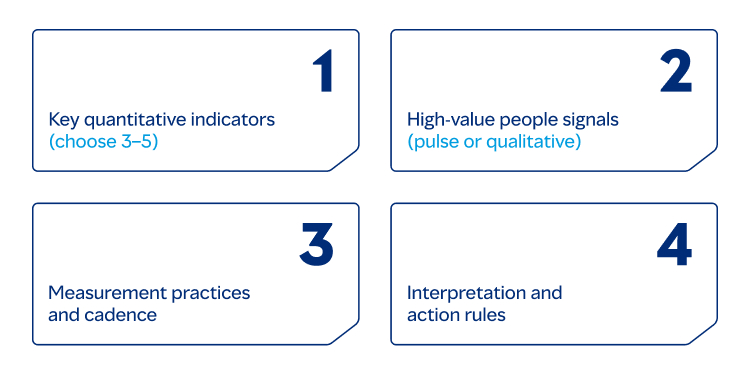
Establish a concise measurement approach that links leadership actions to AI adoption, decision quality, and people outcomes. Combine a small set of quantitative KPIs with high-signal qualitative measures and a clear cadence for review and action.
Even well-intentioned AI initiatives stumble on predictable operational and leadership errors. The short list below highlights the most frequent pitfalls leaders encounter and offers immediate, practical fixes that can be applied with minimal overhead. Use these as a rapid checklist when planning, running, or reviewing pilots.
Quick fix: Treat initial results as hypotheses – run small, controlled validations, compare against known baselines, and require test evidence before expanding use.
Quick fix: Map required end‑to‑end integrations at pilot start, secure engineering capacity, and confirm handoffs before scaling.
Quick fix: Require a one‑line value statement and a single measurable outcome for every pilot.
Quick fix: Set a recurring review cadence for data drift, model performance, and process changes with named owners and clear thresholds for action.
Quick fix: Document runbooks, rotate responsibilities, and cross‑train backups to avoid dependency risk.
Quick fix: Put SLAs and escalation rules in writing, schedule periodic performance reviews, and tie vendor KPIs to business outcomes.
Quick fix: Secure a brief or visible endorsement from a senior stakeholder and include them in key milestone reviews to unblock resources and signal priority.
Quick fix: Agree on minimal shared data standards (provenance, freshness, owner) for any dataset used in pilots and enforce them at intake.
Looking ahead, the ultimate measure of an enterprise’s success will not be the sophistication of its AI tools but the resilience of its culture. While these tools will evolve, the fundamental human needs for clear direction, genuine appreciation, and belonging remain constant. The highest responsibility of tomorrow’s leader is to ensure that as businesses become more data-driven, they do not become less human.
By investing in people while adopting new capabilities, exceptional leaders do more than navigate technological shifts; they build enduring organizations that stand the test of time.
Originally published June 22 2026, Updated July 23 2026

Varsha specializes in tech and SaaS storytelling, crafting clear, high-impact blogs, social media content, ad copy, and thought leadership content. She brings structure, clarity, and a sharp brand voice to every piece. Outside work, she enjoys painting, sketching, and reading novels.
A leadership assessment is a type of personality test used to identify and develop the competencies required in a good leader - decision-making, empathy, communication, inspiring others, etc. A leadership test can contribute to organizational planning initiatives, such as promotion decisions, succession planning, etc.


Thanks for submitting the comment. We’ll post the comment once its verified.





 Behavioral Competencies
 Cognitive Competencies
 Coding Competencies
 Domain Competencies

















Would you like to comment?