

This article explains why upskilling employees in cyber, cloud, and AI must be integrated into workforce risk management. It provides guidance on why enterprise upskilling is necessary, which skills to develop, and a step-by-step procedure for conducting skill assessment.
Today, building organizational resilience means ensuring employees grow alongside the technology driving modern business. The most critical areas for development are AI, cloud, and cybersecurity. When team members grasp these skills, they can work faster, collaborate seamlessly, and actively protect sensitive company information. This proactive training transforms a traditional team into an agile, forward-thinking workforce capable of navigating sudden market disruptions.
Conversely, neglecting these skills weakens an organization’s workforce risk management strategy. Without AI literacy, teams often remain stuck in slow, manual processes while competitors outpace them. Likewise, bypassing cloud training leads to isolated data and fragmented collaboration. Moreover, an untrained team becomes an unintended security gap, where a simple oversight can cause costly data breaches.
Investing in these skills is a vital step to safeguard your business from operational delays and falling behind the market curve. By closing these knowledge gaps today, organizations can ensure that their employees can confidently adapt to new industry standards rather than simply react to them.
Cloud, AI, and cybersecurity are no longer separate IT topics; together, they reshape how organizations compete, operate, and manage risk.

Generative AI, cloud, and cybersecurity now operate together and shape enterprise risk. AI can scale phishing, produce unsafe code or outputs, and expose sensitive data if misused. Cloud increases the number of systems, APIs, identities, and endpoints that touch that data. Cybersecurity must protect data, identities, and infrastructure while also governing the use of AI models.
Because these technologies are linked, failures cascade across teams. A misconfigured cloud service can expose datasets that are later used in an unvetted AI tool. An AI hallucination or biased output can create compliance or reputational issues. Weak identity or access controls make both cloud and AI systems easier to exploit, and incidents spread faster across functions.
Technology cannot secure itself; people set it up, monitor it, and act when things get challenging. When staff are skilled – configurations are correct, alerts are understood, and responses are timely, making security controls effective.
According to IBM’s Cost of a Data Breach Report 2025, 97% of organizations reported an AI‑related security incident, and they did not have adequate AI access controls.
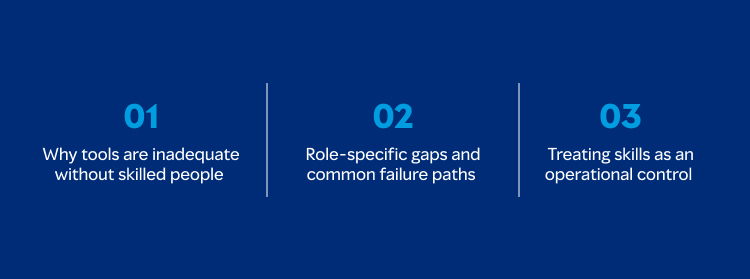
Security tools deliver value only when people can configure, operate, and act on them correctly. When competence is uneven, controls become superficial, alerts accumulate, configurations drift, and automated defenses are routinely bypassed by human error. Relying solely on technology, therefore, creates a false sense of security and leaves critical gaps unaddressed.
Gaps are often predictable and tied to specific roles. Developers may unintentionally introduce insecure code or expose secrets; IT and operations teams may misconfigure cloud storage or omit essential logging; data teams might train models on sensitive datasets or use unvetted AI services; business users may share confidential information via unauthorized tools. These recurring failures – exposed storage, leaked credentials, and unvetted models – represent common pathways to incidents.
According to Cisco research, only about 3% of organizations have reached a mature level of readiness for today’s cybersecurity risks. That gap makes workforce skills critical: technically capable staff reduce misconfigurations, spot threats sooner, and respond faster, which lowers incident impact and cost. Skilled employees also close governance and compliance gaps around data and AI use, reduce reliance on emergency contractors, and enable safer adoption of cloud and AI technologies.
Enterprise-wide upskilling is essential because cloud adoption, AI integration, and evolving cyber threats create risks that span every function. When only a few specialists understand secure design, configuration, and responsible AI use, organizations face slower detection, longer remediation, higher contractor costs, and greater regulatory exposure.
A skills-first approach ensures developers, operations, data teams, and business users share clear, measurable responsibilities for protecting data, securing services, and validating AI outputs. Objective cybersecurity skills assessment and role-based validation turn training from a checkbox into an auditable control that leaders can act on.
Enterprise skills strategy also supports retention and institutional knowledge, targeted mentoring, coaching, and practical learning keep capabilities within the organization rather than relying on external hires. In short, enterprise-wide upskilling aligns talent with strategy, reduces workforce-driven risk, and enables faster, safer adoption of cloud and AI across the business.
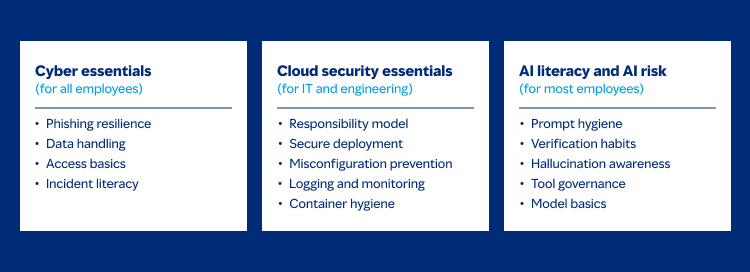
Each skill links to specific actions – what to do, how to verify it, and when to escalate, so training can be measured, validated, and tied to access controls.
According to LinkedIn’s workplace learning report, 47% of organizations invest in mentoring and coaching to improve retention. Higher retention preserves institutional knowledge and training investments, making it easier to sustain the practical skills needed for security and AI controls.
Therefore, organizations should pair mentoring with role‑mapped assessments and continuous reassessment so retained employees represent proven competence, reduce operational risk, and produce audit‑ready evidence.
Mercer turns skills from a checkbox into an auditable control. Our assessment solutions provide role‑specific tests and hands‑on simulations, issue verifiable credentials, and produce time‑stamped reports that feed directly into risk and compliance workflows. This approach provides clear evidence of who can perform critical tasks, where capability gaps create business risk, and which priorities leaders should address.
Cloud, AI, and cybersecurity are now deeply connected, making workforce skills a critical business control. Upskilling essential employees ensures they know how to protect data, secure cloud systems, and use AI safely. This turns everyday actions into steps that actively reduce risk. Verified skills and credentials provide clear proof that employees are prepared, helping organizations respond faster to incidents and meet compliance requirements.
In short, treating skills as a repeatable, measurable control transforms upskilling from an expense into a strategic investment that materially lowers workforce-driven risk.
Originally published July 16 2026, Updated July 23 2026

Varsha specializes in tech and SaaS storytelling, crafting clear, high-impact blogs, social media content, ad copy, and thought leadership content. She brings structure, clarity, and a sharp brand voice to every piece. Outside work, she enjoys painting, sketching, and reading novels.
The accelerated pace at which businesses are rushing toward digitization has primarily established that digital skills are an enabler. It has also established the ever-changing nature of digital skills, and created a need for continuous digital upskilling and reskilling to protect the workforce from becoming obsolete.


Thanks for submitting the comment. We’ll post the comment once its verified.





 Behavioral Competencies
 Cognitive Competencies
 Coding Competencies
 Domain Competencies


















Would you like to comment?