

According to Mercer’s Global Talent Trends 2026 report, AI investment intent is at an all-time high. Sixty-three percent of C-suite leaders say redesigning work around AI and automation is the people initiative most likely to deliver the greatest return this year. Additionally, 98% of executives plan organizational design changes in the next two years. The research also finds that 65% of executives expect to redeploy or reskill between 11% and 30% of their workforce due to AI within that same period.
Yet, only about one-third of C-suite leaders believe their workforce is currently equipped to combine human and machine proficiency effectively.
This gap between investment and execution is a challenge most AI strategies overlook. Many focus on adoption rates when they should be measuring agility.
The most common diagnosis is the most comfortable one: we have an AI skills gap. But what if the binding constraint is not ‘skills’ at all? What if the constraint is AI agility: the transferable human ability to adapt, judge, and redeploy work when AI changes the rules of the task?
That is the distinction at the core of Mercer’s AI Agility Framework: it separates what people know about AI tools from the deeper human attributes that determine whether AI adoption becomes business value.
‘We have an AI skills gap’ has become one of the most common explanations offered for stalled AI returns. This framing is appealing because it’s simple: train people on the tools, maybe add some prompt-engineering specialists, and the problem is solved. It treats AI agility as a skill that can be trained quickly, like in an afternoon workshop.
Robert Solow, a Nobel Prize-winning economist and MIT professor whose research fundamentally shaped how we understand technology and economic growth, made a well-documented observation, now widely referenced as Solow’s paradox. It says that technology adoption does not automatically translate into productivity gains. This pattern has recurred across multiple waves of technological change, from enterprise computing to the internet, and current data suggests generative AI is following the same trajectory.
Through the lens of the AI Agility Framework, the ‘skills gap’ diagnosis is incomplete—and can misdirect investment. The real difference in outcomes often comes from who can handle disruption, reason through uncertainty, and exercise sound judgment with AI, especially under pressure.
In other words, adoption is about usage; agility is about the distribution of behavioral, cognitive, and technical strengths, and those strengths remain invisible unless they are measured.
Many organizations struggle with stalled AI returns because they treat ‘AI skills’ as a single category, solvable through training alone. In reality, ‘AI skill’ often combines several fundamentally different qualities.
Mercer’s AI Agility Framework separates AI agility into three distinct components, each with a different developmental profile and a different implication for talent strategy:
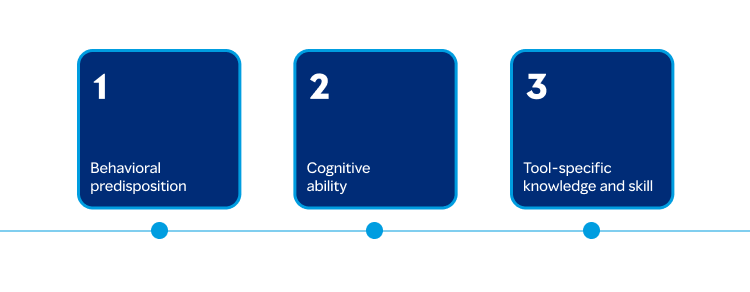
This examines whether an individual is genuinely open to having established workflows disrupted; whether they proactively seek new ways of working rather than waiting to be directed; and whether they remain resilient when early attempts with a new tool fail. These are tendency-based traits, not knowledge gaps, and they do not respond meaningfully to short-form training.
This involves an individual’s capacity to reason through ambiguity, identify patterns across disconnected information, and critically evaluate outputs that may be plausible in appearance but subtly incorrect. This is closer to underlying reasoning capacity than to domain-specific knowledge.
This is the ability to operate AI tools effectively: constructing useful prompts, setting constraints, evaluating outputs, and integrating results into the workflow. It is the dimension most L&D programs are built around, and it is also the most perishable. What counted as strong ‘prompt engineering’ in 2023 already looks dated next to today’s agentic and multimodal tools, and will likely be superseded again before most training cycles complete.
The strategic implication is straightforward: tool skill matters, but it is rarely the durable differentiator. A more sustainable advantage accrues to organizations that can identify and develop behavioral predisposition and cognitive ability across their workforce, because these attributes transfer across tools, models, and product cycles.
This is why the ‘skills gap’ narrative falls short. It collapses three distinct things into a single label, then attempts to solve all three with a single lever: training.
For leaders responsible for talent acquisition, learning and development, or workforce planning, this reframing suggests several practical adjustments.
Tool familiarity should not be the main hiring filter. Experience with a specific AI product might show current proficiency, but its value as a predictor of long-term performance fades as tools evolve. For roles needing adaptability, organizations should emphasize how candidates handle change, reason through ambiguity, and navigate new challenges, alongside their experience with current AI tools.
Training investments should be split into two distinct categories. Tool-specific training should be low-cost and frequently updated, as its value depreciates quickly. In contrast, developing reasoning under ambiguity, resilience to change, and collaborative adoption of new working methods deserve sustained investment; these skills grow over time and don’t become obsolete with each new AI release.
Adoption metrics should be examined for confidence-related bias before they inform action. Where usage data reveals gaps across teams, demographic groups, or geographies, the appropriate first response is not necessarily a remedial training program. It is an honest assessment of who has had access to informal coaching, psychological safety to experiment, and visible permission to be unpolished with a new tool in front of colleagues and managers.
AI agility decisions should be held to the same evidentiary standard as other talent decisions. Workforce planning, hiring, and restructuring are not based on a single self-assessment, and AI agility should be treated no differently. Whatever assessment methodology is used, it should meet the standard expected of any defensible talent measure: validated constructs, demonstrated consistency across demographic groups, and an established link between the measure and actual outcomes.
Organizations that gain a lasting advantage won’t be those with the most AI licenses. They will be the ones who correctly distinguish between:
A 95% pilot failure rate is unlikely to reflect a deficiency in the underlying technology. It more plausibly reflects a persistent conflation of adoption with AI agility. These are not the same thing, and Mercer’s AI Agility Framework is designed precisely to prevent that category error. Adoption is easy to count; agility must be measured, and measured correctly.
Originally published August 5 2026, Updated August 5 2026

Vaishali has been working as a content creator at Mercer | Mettl since 2022. Her deep understanding and hands-on experience in curating content for education and B2B companies help her find innovative solutions for key business content requirements. She uses her expertise, creative writing style, and industry knowledge to improve brand communications.
The accelerated pace at which businesses are rushing toward digitization has primarily established that digital skills are an enabler. It has also established the ever-changing nature of digital skills, and created a need for continuous digital upskilling and reskilling to protect the workforce from becoming obsolete.


Thanks for submitting the comment. We’ll post the comment once its verified.








 Behavioral Competencies
 Cognitive Competencies
 Coding Competencies
 Domain Competencies


















Would you like to comment?