

This article explains what AI guardrails in hiring are and why psychometric assessments are a practical solution to reduce risk. It gives a clear, seven‑step workflow for adding short, job‑relevant psychometric tests into recruitment, enabling quick, unbiased, and justifiable decisions. Find real use cases, examples, and a quick look at how Mercer Assessments supports job‑linked, audit‑ready assessments.
While artificial intelligence has become a prominent engine for modern hiring, its rapid adoption has surfaced significant challenges, specifically regarding AI bias in recruitment and ‘black box’ decision-making.
Black box decision-making occurs when AI provides an answer without explaining its internal logic. The input and the final result can be seen, but the actual reasoning remains hidden and untraceable, lacking transparency.
Using automated hiring tools without checks can replicate bias at scale. Psychometric assessments serve as the most practical AI guardrails in hiring that address these risks, offering a structured framework for objective and data-driven hiring.
By integrating these assessments directly into the early stages of the recruitment funnel, organizations can move beyond subjective resumes. This standardizes the selection process and helps measure potential.
According to research by Mordor Intelligence, the AI recruitment market is valued at USD 640.99 million in 2026 and is projected to reach USD 920.91 million by 2031.
This rapid growth is fueled by a structural shift as organizations move from small-scale pilots to enterprise-level rollouts. Nearly 70% of HR professionals are already experimenting with or deploying AI to modernize their talent functions.
AI touchpoints exist throughout the hiring cycle, transforming how recruiters engage with talent and how applicants experience the hiring process. Here are some of the ways AI is used in hiring:
AI tools parse unstructured data to rank candidates based on technical competency and specific job requirements.
AI-driven platforms evaluate speech patterns and sentiment during video assessments to provide recruiters with objective performance metrics.
Automated tools track online exams via webcam and keystroke analysis to detect suspicious behavior and ensure integrity.
Intelligent assistants can be used to sync recruiter calendars with candidate availability to automate meeting invites and handle rescheduling requests instantly.
Algorithms aggregate data from various touchpoints to produce weighted suitability rankings for comparing applicants against standardized benchmarks.
AI guardrails in hiring are the policies, processes, technical controls, and tools that are put upon AI recruitment tools to ensure decisions are compliant and ethical. These safeguards function as technical safety nets to prevent AI from replicating historical biases or producing black box results.
By implementing these controls, organizations can leverage automation while minimizing the risk of discriminatory outcomes and ensuring that every candidate receives an equitable evaluation.
As AI becomes central to talent acquisition, organizations are implementing strict guardrails to mitigate systemic risks and ensure ethical integrity. Here are some of the reasons why guardrails are leveraged:
Guardrails ensure that automated processes remain equitable and defensible in the face of new laws and regulations.
Robust controls protect sensitive applicant information and ensure that data processing activities align with global privacy mandates like GDPR.
Protective measures eliminate black box allegations that could lead to costly legal challenges or negative public perception.
Rigorous audits ensure that automated systems do not produce discriminatory outcomes in accordance with modern labor regulations.
Guardrails create clear, versioned decision trails so recruiters can trace and explain precisely how an algorithm produced a hiring outcome.
Psychometrics is the method of using standardized tests to quantify a person’s cognitive abilities, personality traits, and behavioral tendencies. By transforming abstract human qualities into objective data, it provides organizations with a measurable way to predict a candidate’s job performance and long-term cultural fit.
Common use cases of psychometrics include initial high-volume screening, predicting job performance, assessing cultural fit, and reducing unconscious bias.
According to the Mercer 2025 Global Talent Trends study, 74% of HR leaders who use psychometric assessments state that these tests have led to higher-quality hiring decisions.
Psychometric assessments improve shortlist quality by highlighting candidates with the skills and potential essential for the role. They support defensible decisions through documented score reports and test design. They also enable impartial monitoring with subscale and group‑level data for routine checks.
Here is how these assessments assist hiring managers:
Converting intangible qualities like emotional intelligence and problem-solving speed into objective, comparable data points for all applicants.
Leveraging statistical correlations between cognitive scores and historical job success to identify candidates with the highest growth potential.
Eliminating guesswork by providing a neutral, evidence-based baseline that ignores a candidate’s personal background.
Mapping individual personality profiles against existing team dynamics to ensure new hires complement rather than disrupt the workplace culture.
Identifying specific skill gaps within a candidate pool by comparing their psychometric test results against established high-performer benchmarks.
Matching candidates to roles that align with their natural behavioral tendencies results in higher job satisfaction and longer retention.
Confirming that a candidate’s underlying cognitive abilities support the advanced technical requirements of complex, high-pressure positions.
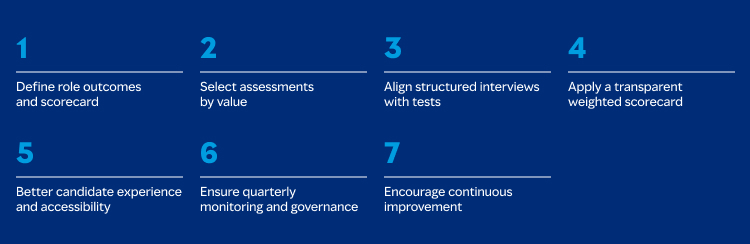
Organizations can use a seven‑step workflow to embed short, job‑relevant psychometric tests into hiring for precise decisions.
Each step maps operational controls for role definition, assessment choice, structured interviews, transparent scoring, candidate accessibility, and quarterly governance. These controls let the business scale hiring without increasing legal and operational risk.
A Fortune 500 company headquartered in Dublin needed to build an adaptive workforce with increased expertise and productivity.
Mercer Assessments helps organizations make better talent decisions that support holistic evaluation.
As AI takes hiring processes to new heights, the risks of automation increase, too. Psychometric assessments serve as a practical guardrail in this environment, providing standardized and measurable data that is far easier to defend than traditional methods. The goal is not to perform more testing, but to ensure that every hiring decision is consistent and ready for audit across all managers and locations. By using these scientific safeguards, organizations can turn AI from a potential risk into a transparent tool.
Originally published May 27 2026, Updated July 23 2026

Varsha specializes in tech and SaaS storytelling, crafting clear, high-impact blogs, social media content, ad copy, and thought leadership content. She brings structure, clarity, and a sharp brand voice to every piece. Outside work, she enjoys painting, sketching, and reading novels.
Psychometric tests measure an individual’s personality traits and behavioral tendencies to predict job performance. Psychometric assessments gauge cultural fitment, trainability, motivations, preferences, dark characteristics, etc., to hire and develop the right people.


Thanks for submitting the comment. We’ll post the comment once its verified.





 Behavioral Competencies
 Cognitive Competencies
 Coding Competencies
 Domain Competencies

















Would you like to comment?